Fourth Sunday of Advent (B) Stepping into God’s time.

Advent is the beginning of the Church year because it’s the beginning of God’s time.

Pope Francis says that when we step into God’s time we stop looking at our watches.IMG_1078
As long as we’re in our own time we’re always looking at our watches!

In these final days of advent use Mary and Joseph to step into Gods time. Put yourself in their shoes, first Mary’s then Joseph’s.

Pope Francis says that in these last days of Advent like Mary we should say to the baby Jesus in the womb; “Come!  I want to see your face” – and really mean it.

I love this book - absolutely beautiful. It would make a beautiful present for a committed Catholic. I've drawn on it extensively for this piece. I bought it on the USCCB website (United States Conference of Catholic Bishops) but it's also available from amazon.com here http://www.amazon.com/Pope-Francis-Guide-English-Spanish/dp/1601374984/ref=sr_1_1?ie=UTF8&qid=1420368580&sr=8-1&keywords=Pope+Francis+In+Gods+Time

I love this book – absolutely beautiful. It would make a beautiful present for a committed Catholic. I’ve drawn on it extensively for this piece. I bought it on the USCCB website (United States Conference of Catholic Bishops) but it’s also available from amazon.com here http://www.amazon.com/Pope-Francis-Guide-English-Spanish/dp/1601374984/ref=sr_1_1?ie=UTF8&qid=1420368580&sr=8-1&keywords=Pope+Francis+In+Gods+Time

He asks: “Are we watching, waiting, or are we closed? Are we secure in an inn or are we pilgrims?” Life will always bring us back to being a pilgrim. Life is a bridge, never build your house on it!

Joseph, what a lovely man. He clearly loves Mary and has entered the preparatory stages of marriage. But before they come to live together “she was found to be with child…” Disaster! Joseph knows he’s not the father; what’ll he do? What would you do? He does what we’d all do – most likely – he decides to separate, to “divorce her informally.” But there’s kindness in Joseph. He wants to “spare her publicity” – the danger for Mary of course is that if her situation becomes public knowledge she risks being stoned to death. So here’s a man torn between the rigid application of the law and compassion. Joseph’s heart becomes a bridge between the rigid application of the law and compassion – a heart of mercy. Joseph is not just a lovely man, he is like God as manifested in the adult Christ-child.

Pope Francis says that when Joseph was confronted with Mary’s unplanned pregnancy – unplanned at least in human terms – he “is the faithful and just man who chose to believe the Lord rather than listen to the voices of doubt and human pride” – and fear.

Mary and Joseph teach us that life is not about us. The single greatest lesson to be learned in life is that life is not about us. And together with the baby Jesus they teach us that life is not about our children either. They teach us that life is about what God is doing. So don’t spend your life in your own time. Get into God’s time.

Third Sunday of Advent (B) This little Baby is for everybody!

He’s standing among them, unknown to them. They’re up to their eyes in religion and he’s among them… unknown! Brilliant, isn’t it? It could happen to you! Maybe it’s happening all the time!

The third Sunday of Advent is different.

It’s got a different coloured candle on the Advent Wreath, the rose coloured candle.

It’s even got its own name, ‘Gaudete’ or ‘Rejoice Sunday’ – ‘Rejoice’ the liturgy cries; the Lord is near, Christmas is near. Jesus is coming. He crosses the miles… the great divide between God and man. Really he’s the one who fills in the valley, he’s the one who tears down the hills and the mountains that separate man and God. He comes looking for… you. It’s much easier when he’s looking for everybody else. But he’s looking for you. This is personal.

On this day in 2013 Pope Francis had this to say:

“We can always begin again.”

“Someone might say, ‘No, Father, I did so many reprehensible things’ – I am a great sinner. I cannot begin from scratch!”IMG_1082

But Pope Francis is adamant. “God is waiting for you, he is close to you, he loves you, he is merciful, he forgives you, he gives you the strength to begin again from scratch! Everybody!”

“We are able to open our eyes again, to overcome sadness, to strike up a new song. This is true joy, it remains even amid trial, even amid suffering, for it is not a superficial joy because it permeates the depths of the person who entrusts himself to the Lord and confides in him.”

This Christmas, make sure you don’t miss him. Make sure he’s not so close to you… unknown!

Tell you what, I’ll meet you at the crib!

Second Sunday of Advent (B): Our God comes.

Today’s readings are bursting with excited anticipation. I’m sure many of us could do with a bit of that!

While the joyful messenger (First Reading Isaiah 40:1-5,9-11) undoubtedly prefigures John the Baptist (Mark 1;1-8) he (or she!) also represents the call of every Christian. We’re to be like joyful messengers going up on a high mountain (where you can see for miles – kilometres) and we’re to shout with a loud voice. In other words; tell everyone, tell the whole world. Tell them what? Our God comes. This is the joy of Catholicism – God in Jesus has travelled the miles, and continues to travel the miles, that great divide between you and God, me and God. So get ready; prepare a way for the Lord!

The ‘space’ that exists between you and God is like a wilderness – put a way for the Lord in that wilderness.

That space between you and God is like a desert – put a highway for the Lord right there in the desert!

That space is like a valley, fill in the valley!

That space between you and God is like a hill, perhaps even a mountain, tear it down and lay it low!

That space is like a cliff, make it into a plain!

Do it and you’ll see the glory of the Lord, as today’s Entrance Antiphon says “…the Lord will make the glory of his voice heard in the joy of your heart” (Cf. Is 30: 19, 30).

Then you’ll have something to shout about! Indeed, “Shout with a loud voice joyful messenger…”

Advent: Tuning your heart to the arrival of the Christ-child

An interesting choice of Gospel, Mark 13:33-37. We can interpret it’s use here on the First Sunday of Advent to suggest that we use the four weeks of Advent like servants waiting for their Master to return, the waiting being the four weeks of Advent and the return of the Master being the arrival of the Christ-child on Christmas night.

So depending on how we use the next four weeks we’ll be awake or possibly even asleep when the Master of the house returns, the return being the arrival of the Christ-child in the crib on Christmas night.

adventAs the child is placed in the crib on Christmas night, simultaneously, the same child should be arriving in our hearts – that’s what being awake means. The physical gesture of placing the figure of the infant King in the crib on Christmas night ought to be matched simultaneously by the same King arriving within our hearts. The mismatch here between what’s happening on the outside and what’s happening on the inside is the source of all boredom with religion.

So I want to suggest some ways in which we might stay awake.

There’s Mass here MondayFriday at 7.30am and 10.00am. How about attending Mass for the four weeks of Advent? You’ll notice that I’m not proposing anything new. Nothing new in that; same old, same old. We don’t need anything new, we just need to see what’s there in a new way (which is why Pope Francis is so successful). We just need to come to it differently.

Generally Mass will not stand alone. Prayer is to Mass what weekday training nights are to the Wexford hurling team, or Kilkenny, or Tipperary. As a rule where there is no prayer there will be no Mass. Where there is, it’s usually little more than a habit waiting to be broken. So for each day of Advent try to associate a time of prayer and reflection with Mass – before or after but definitely at some point during the day (we’ll provide some material to help you). If you can’t do both, do one.

This will mean effort and discipline but there is no other way, push the boundaries out, it’s the only way to grow spiritually. If we do it well, we’ll make definite progress and our hearts will be more tuned to the arrival of the Christ-child on Christmas night.

Mercy exists because there’s ultimate Justice – Christ the King

“When the son of man comes in his glory escorted by all his angels…” Matthew 25:31-46

What’ll the world do? Send up fighter jets to intercept him!

Here Jesus portrays himself as “coming in his glory” and “all the nations will be assembled before him and he will separate one from another as the shepherd separates sheep from

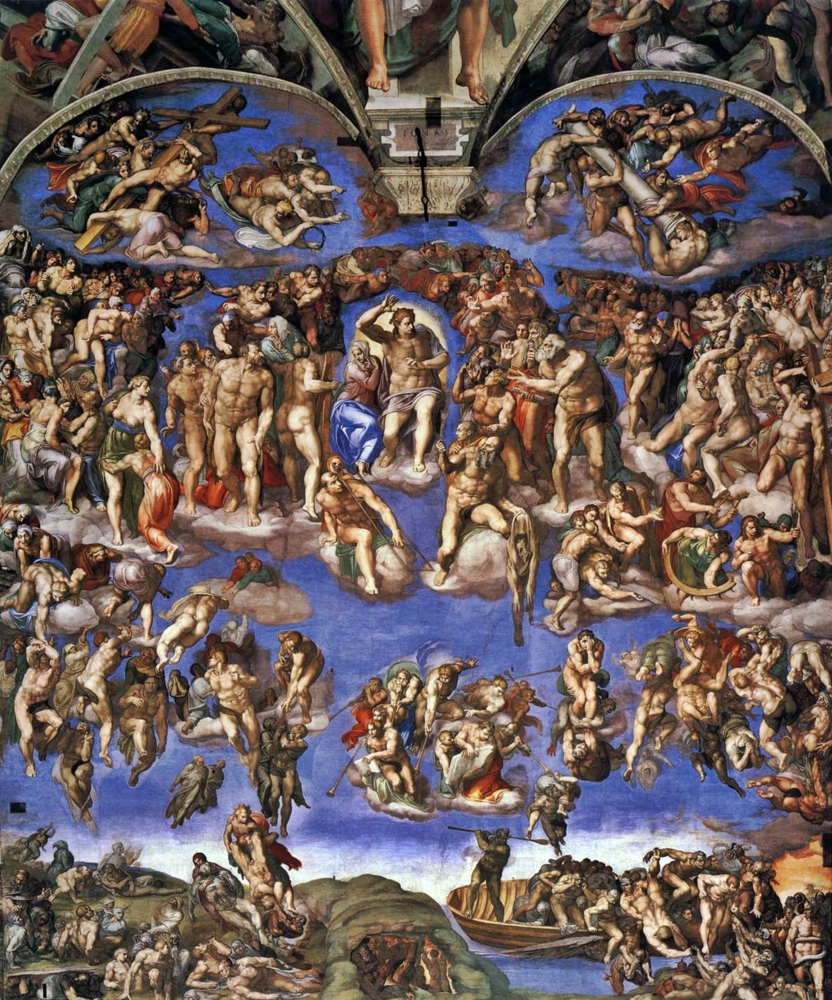
The Last Judgment by Michelangelo, executed on the altar wall of the Sistine Chapel in Vatican City. It is a depiction of the Second Coming of Christ and the final and eternal judgment by God of all humanity. The souls of humans rise and descend to their fates, as judged by Christ surrounded by prominent saints.

The Last Judgment by Michelangelo, executed on the altar wall of the Sistine Chapel in Vatican City. It is a depiction of the Second Coming of Christ and the final and eternal judgment by God of all humanity. The souls of humans rise and descend to their fates, as judged by Christ surrounded by prominent saints.

goats” – these are words spoken before his suffering, death, resurrection and ascension. So he’s painting a picture of a future cosmic event, his second coming when “everything is to be put under his feet” 1 Cor 20-26,28 (Second Reading).

But as Jesus paints this picture we simultaneously glimpse some fascinating details about the kingdom of God – windows and doors are opening before us.

One detail that’s obvious; there is ultimate justice.

All will stand before him – believer and unbeliever – and we will be separated, sheep from goats. The criterion for judgement is how we treat the least of our brothers and sisters. Ouch, that’s going to bite us! Everything will be judged from the poor man’s perspective.

There’s no need to worry about somebody getting away with murder – I’m using murder here figuratively, as in the banks got away with murder! We only ‘get away’ for a very short time, even if we never get caught for the dishonesty that netted us €40.00 or €40,000.00 there’s no place to hide. The king of the universe waits. Life is very short as anyone over fifty starts to realize quickly!

While we might ‘get away’ personally for a time the wider community (society generally) never gets away. This is the root of all crime and sin – self becomes the only arbitrator. There’s no common good, just me and mine, and increasingly as we’ve seen in Ireland it can extend to family and even out to our employment with devastating consequences for the nation, but disproportionately for the poor.

The thief, the fraudster, the murderer, the bully has no future except to put right the wrong he’s done; “when you go to court with your opponent, try to settle with him on the way, or he may drag you before the judge and the judge hand you over to the bailiff and the bailiff have you thrown into prison” Lk 12:58-59.

This holds true for all, there are no exceptions.

And legality means nothing to the universal King. State legislation is irrelevant. There’s no such thing as it’s ‘just business’ (so often used in the business world to justify itself). There’s only what’s right and wrong, there’s no conservative or liberal, there’s only true or false.

So, there is no need for us to judge. We can confidently leave it to the universal King-judge.

Of course, as I used to say to the prisoners in Portlaoise, you’re the blessed ones, at least now while you’re locked up and deprived of your liberty you’ve got the opportunity to start putting right the wrong you’ve done, to settle with your opponent while still on the way to the court.

This is all that God desires of the criminal-sinner.

In the end we decide what we receive, “because the amount you measure out is the amount you will be given back” Lk 6:38. if we persist in sin (which is putting self first, temporarily of course!) we get a judge, if we back away we get a shepherd Ezekiel 34:11-12,15-17 (First Reading), and a shepherd will save his sheep, he might even die trying!

Oh… he did die!

Spiritual naivety!

Spiritually naive! There's no such thing as the Church dying. There's only the kingdom of God being taken from a people who've failed to produce its fruit and being given to a people who will produce something!

Spiritually naive! Only from our perspective does it look like the Church is dying. From God’s perspective there’s only God taking the kingdom from a people who’ve failed to produce its fruit and giving it to another people who will produce something.

Thirty-third Sunday: Making a profit for God

Basic theme: If we prove to God that we can be trusted with his interests in this life, indeed with this life itself, then he’ll trust us with the next life.

Our life’s work then is to use everything we’ve got in such a way that God gets the benefit.

In other words life is not about us. Not a single detail of our lives is really about us!

So, to the parable, Matthew 25:14-30

The man entrusting his property is God.

He entrusts his property to servants; we’re the servants. His property is everything we’ve got, this life we’ve been entrusted with, which is not really ours but his; to be used for God’s benefit.

He then goes abroad; that’s how many perceive God, as being abroad!

“Now a long time after” he returns to go through his accounts; “a long time after” is our length

"Now a long time after the master of those servants came back and went through his accounts with them"

“Now a long time after the master of those servants came back and went through his accounts with them”

of years, long enough to lose our way! Going through his accounts is our final judgement.

To one he’d given five talents, to another two, to a third one. Two of the three make a profit, the guy with five makes five more, the guy with two makes two more but the guy with one gives back the one.

It’s the guy who made nothing that I’m interested in; what he had was taken from him and given to the guys who’d already proved they could make a return.

This is a common theme in the teaching of Jesus.

Spiritually naive! There's no such thing as the Church dying. There's only the kingdom of God being taken from a people who've failed to produce its fruit and being given to a people who will produce something.

Spiritually naive! There’s no such thing as the Church dying. There’s only the kingdom of God being taken from a people who’ve failed to produce its fruit and being given to a people who will produce something.

Spiritually there is no such thing as the Church dying, there is only the kingdom of God (what else can the Church be about?) being taken from a people who’ve failed to produce its fruit and being given to others who will produce something.

Notice too that this is good business sense and once again Jesus is using something we all understand – good business sense – and using it to teach us about God.

Finally, notice that the guy doesn’t do anything wrong, he keeps his talent safe, afraid to trade, and gives back what he’d received but without gaining anything for God.

His offence? He fails to become God’s missionary!

What on earth do you think life is for?

Lateran Basilica: Quenching our thirst for God.

The Pope's Cathedral, St. John Lateran, Rome, Apse Mosaics

The Pope’s Cathedral, St. John Lateran, Rome, Apse Mosaics

Every year on November 09th the Church celebrates the dedication of the pope’s cathedral.

It gives us the opportunity to reflect briefly on what the church is, or at least what it should be. What we should be. What we are, however dim our reflection might be!

Typical of the scriptures generally, the first reading, Ezekiel 47:1-2,8-9,12 uses an image we can all understand; the image of water and in this case the image of a river flowing from the Temple to the sea.

Enniscorthy is built on a river. Every town the length and breath of Ireland is built around a water supply.

Apply the image to the Church. The growing river symbolizes our growing relationship with God. If we don’t connect to God here (in this building) then we’ll die of thirst, this church will die out. We’ve nothing to pass on that the atheist can’t pass on! Much of the present crisis in the church is to be found here.

The river flows to the sea and fulfills itself there. The sea symbolizes the fullness of God (heaven). So too with us, we should be flowing towards God and if we are we’ll produce fruit

The River Tiber and St. Peter's Basilica, Rome

The River Tiber and St. Peter’s Basilica, Rome

symbolized by the fertility of the river bank; “along the river… will grow every kind of fruit tree with leaves that never wither and fruit that never fails… And their fruit will be good to eat and the leaves medicinal.”

The second reading, 1 Cor 3:9-11,16-17 tells us that the church is not about buildings but about people, a people, a people becoming the body of Christ.

In the Gospel, John 2:13-22 Jesus makes it very clear that the church is to be a house of prayer, the place of encounter with the Divine. In my twenty odd years of priesthood I think there’s been a growing tendency to turn it into everything but a house of prayer!

Finally, Jesus reference to the sanctuary of his body confirms the true meaning and destiny of the church.

All Souls: The mystery revealed to “mere children”

Matthew 11:25-30

Jesus is saying that “these things” meaning the mystery of God remains a mystery to the “learned and the clever” but not to “mere children” – to “children” it’s revealed.

Now the first thing I should say is that this is not an argument against learning; it’s about the human heart.

Once again Jesus uses something that we can all understand, in this case a child, and he uses it to teach us about God.

Holding hands 2Think of the child-parent relationship. A child spends so much time with his or her parent(s); all day and all night at first, gradually the child is weaned but for years it’ll be there first thing in the morning, many times during the day, then in the evening and last thing at night.

Many of these times correspond to the times when the Church encourages us to pray.

In the child-parent relationship the whole foundation of the child’s future life is laid and as the child matures, provided the child-parent relationship has itself matured, the child will be trusted with virtually everything, even the family secrets! Eventually the child will be trusted with the family business. Remember this is not really about a child-parent relationship but about our relationship with God.

There’s so much in this image of a child; there’s the difference between the child (son or daughter), the servant (employee) and the biblical-historical understanding of a slave, words full of spiritual meaning. It’s the son or the daughter who will inherit, not the employee! The sons place is assured.

And if the child doesn’t want the inheritance or can’t be trusted with it, what’ll happen? It’ll probably be given to someone who can be trusted. Remember the passages where the kingdom is taken from people who fail to produce its fruit and given to others who will produce something?

Only when our relationship with God resembles the very best child-parent relationship will God reveal “these things” to us.

So here in just one image, in that of a child, Jesus teaches us almost everything we need to know about God and our relationship with God.

Thirtieth Sunday Year A: I’d never say I love my mother by loving my sister!

The religious leaders approach Jesus with a question designed to trap him; “Master, which is the greatest commandment of the law?” This is another way of asking ‘what’s this God thing all about? What’s the most important thing, the bottom line?’

How would you answer it?

Most of us have already asked and answered this question without putting it into words. It’s been a part of our self-talk, part of the conversation we have with ourselves at some point.

Nowadays most people don’t even ask the question partly because the culture has already answered it and the answer is now an unquestioned cultural assumption – if we just love one another; that’s what’s important. There are many variations of it. You’ll often hear it articulated and summarized perfectly as ‘they don’t go to Mass but they’re good people’ or the more theological astute might attempt to say ‘I love God by loving my neighbour’

We’ve flattened the Christian message to just one commandment – variations of “love your neighbour” (but usually without “as yourself” – the inclusion of “as yourself” makes the commandment much more demanding). In flattening the message almost exclusively to “love your neighbour”, God and the love of God has been squeezed out and consequently the church and the sacraments are considered by many to be irrelevant.

When Jesus is asked the question he answers it with great care, it’s detailed, largely because it’s a trick question.

There are two commandments and they can’t be flattened into one. The second “resembles” the first but it’s not identical.

The first is to love God (corresponding to the first 3 commandments which are about loving God). The second is to love your neighbour (corresponding to the other 7 commandments which are about loving God and neighbour). It’s significant that Jesus very deliberately retains the original order in his summary.

“On these two commandments” stands the whole mystery of God.

Two wings are required to fly you into the kingdom of God. Try it on one wing and you’ll surely fall out of the sky – that’s if you can get off the ground at all!

God deserves to be loved in his own right. This is where the deep inner joy comes from; this is the source, the foundation. The absence of this explains so much.

I’d never say I love my mother by loving my sister and then forget about my mother! We shouldn’t do it with God either.