Tag Archives: spirituality

Jesus has a great big heart! Reflections for Holy Thursday and Good Friday.

Jesus has got a great big heart!

One of the biggest problems within Catholicism is that we’ve watered down Christ and the Gospel so that more often than not we’re like the man who started to build without first sitting down to work out the cost to see if he had enough to finish the job. When he can’t finish he becomes a laughing stock (Luke 14:28). The result is a city (Church) that always looks half-built, or less than half-built – or like a ruin and the object of ridicule!

The first meaning of Holy Thursday is service – love.

Most of us have grasped that Christianity (therefore Catholicism) is about service – but Jesus has got a great big heart and his understanding of service is considerably more than giving a few hours here and there. It’s nothing like reaching a realization that life has been good so I’ll give something back. As good as that is, it’s not the message of Jesus.

Jesus asks that we lay down our lives! Believe it or not, only then will we know the joy of the Gospel.

In the aftermath of Good Friday the disciples will remember the washing of the feet and begin to see it not just as a general call to service, but also as pointing to the greatest service known to humankind; Jesus’ suffering, death and resurrection in which men and women are washed clean of sin (in his body and blood).

What does it mean to be washed clean of sin?
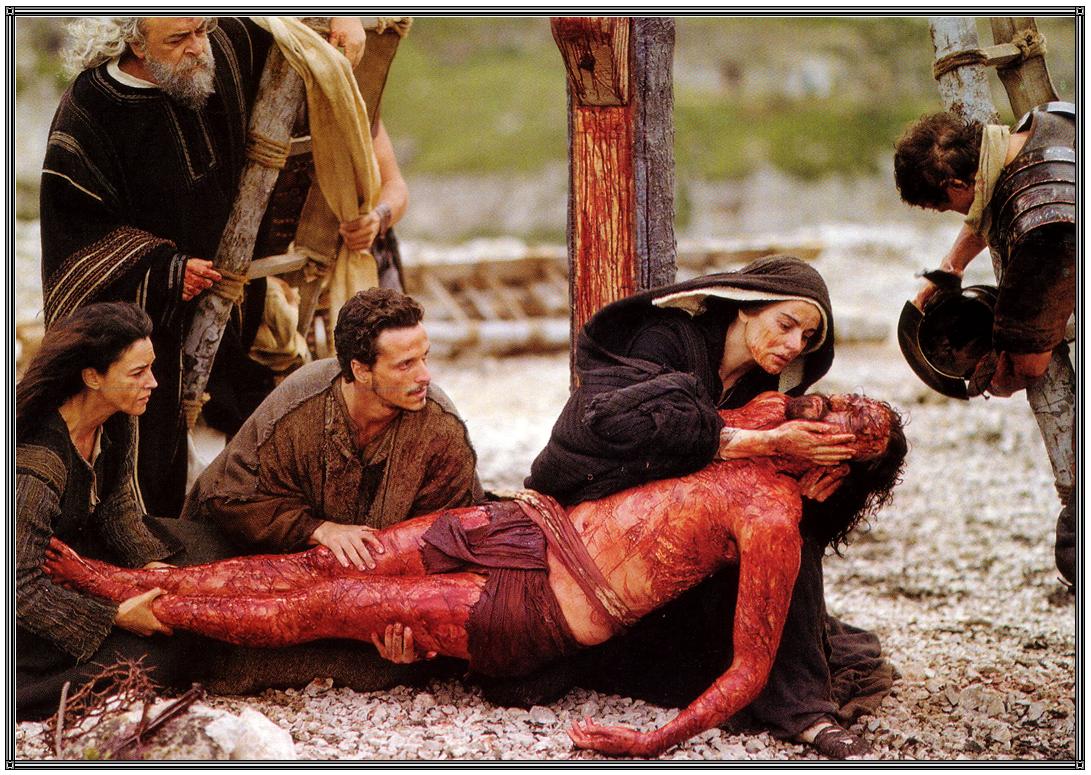
I did not die on the Cross for you to bear the burden of your sin.

I did not die on the Cross for you to bear the burden of your sin.

It means that Jesus didn’t die on the Cross for you and I to bear the burden of our sins. I’d like you to really think about that, meditate on it… St Paul says “that for someone really worthy, a man might be prepared to die – but what proves that God loves us is that Christ died for us while we were still sinners.” (Romans 5:7). A parent might be prepared to die to save the life of a son or daughter, but would you be prepared to die for a notorious criminal?

So instead of condemning the already condemned man, like we often do, Jesus does the opposite, he seeks to take the condemned man’s place in prison, or in the electric chair, or wherever! What do we think he’s doing on the Cross?

Can you see it?

At once he identifies with both the guilty and the innocent, guilty perpetrator and innocent victim. So whom exactly is Christ excluding? Nobody. Awesome!

I want you to see something else. Jesus never says wrong is right or right is wrong, he upholds a moral standard that applies to and judges all men and women, but instead of condemning those who fall short, what does he do? He lays down his life, literally, he offers his body and blood that they might be saved (which itself implies ultimate Justice) which is the exact opposite of what so many Catholics have done in recent years – they’ve run away believing that righteousness is on their side. This is not the path of Christ. Followers of Christ redeem with their lives! They become like Christ – hung among thieves!

Of course, all this implies that there’s ultimate justice; a final putting to right of wrongs. Indeed, mercy is justice transfigured by love. Unless we want to live in a meaningless universe, this is how it has to be!
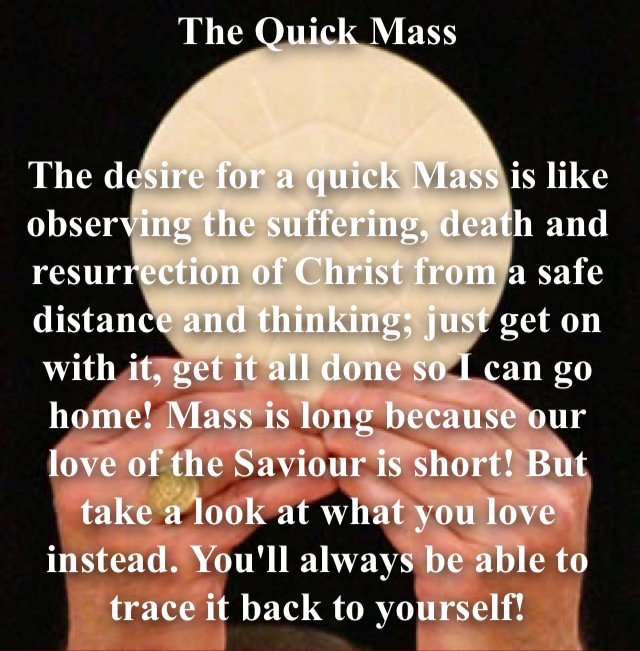
Mass is long because our love of the Saviour is short!

Mass is long because our love of the Saviour is short!

The second meaning of Holy Thursday is the Eucharist – Holy Mass. The Last Supper is the DNA of Holy Mass. Jesus identifies his body with bread and his blood with wine. Try to capture something of the intensity with which Jesus took the bread and wine and offered it to his disciples. He knew he was ‘going away’ and he was giving them the means by which he’d stay with them. Catholicism is not primarily a moral code, an ethical system, it’s a person; Jesus Christ, who offers himself to us in Holy Mass; his life, body and blood, soul and divinity, his suffering, death, resurrection and glorification – everything.

The third meaning of Holy Thursday is the priesthood, but priesthood as being like Christ, as laying down your life, as the literal offering of your body, the pouring out of your blood, the willingness to exhaust yourself on behalf of God and man, to give everything, not a few hours here and there, to hold nothing back, to have no ‘me’ and no ‘mine’, only to have Him!

Because if you have Him you have everything. And you know what? He’s worth it!
Fifth Sunday of Lent: Life without death would drive us mad!

IMG_1197As we approach Easter, appropriately enough, the question of death and resurrection surfaces.

So what does Jesus teaching around these issues look like?

Well, from today’s Gospel we’ve got: “If anyone believes in me, even though he dies he will live.” I’d like you to note something – even though he dies he will live. I’m placing emphasis on; even though he dies. What’s the alternative?

From elsewhere we find Jesus attempting to open the hearts and minds of the people to something greater: “Do not be afraid of those who kill the body but after that can do no more.” Luke 12:5

It’s a crisis situation. Lazarus is seriously ill. There’s a level of panic – family and friends need to be informed. Among Lazarus’s close friends is Jesus and so they send for Jesus – the man you love is ill, come quickly. Quickly – because if you don’t hurry he’ll be dead!

Yet Jesus doesn’t respond with any sense of urgency – he obviously doesn’t view death as the absolute human disaster – and doesn’t depart until two days later and by the time he arrives Lazarus is already dead for four days. When he arrives both Martha and Mary ‘mark his card’ so to speak: “If you had been here our brother would not have died.” Isn’t this the accusation that man fires at God all the time?

Martha and Mary have faith in Jesus – the faith comes from their close friendship. But while they have faith, it is faith that still has to grasp the full meaning of Jesus Christ and the human person, i.e., the immortality of the soul.

This is the big one – if Jesus can’t overcome death he’s useless to them – and to us!IMG_1160

Yet this is not Jesus definitive act. He calls Lazarus from the dead, gives him back to Martha and Mary, and we can only imagine the excitement of life in the years thereafter … until next time! Lazarus gets to die twice! Lazarus resurrection is not true resurrection, it’s unfinished business.

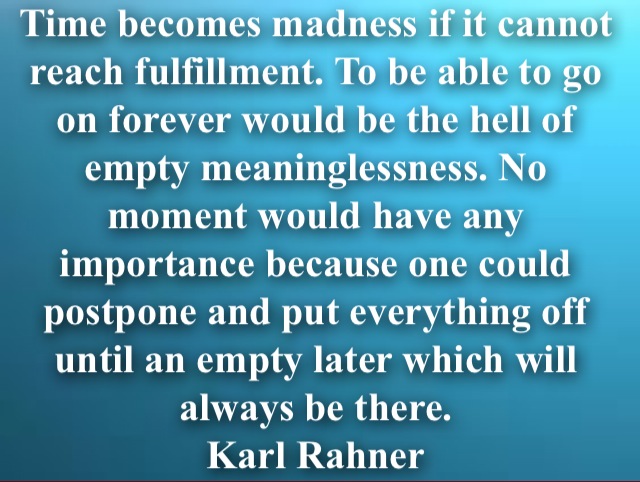
Try imagining life without death. “Time becomes madness if it cannot reach fulfillment. To be able to go on forever would be the hell of empty meaninglessness. No moment would have any importance because one could postpone and put everything off until an empty later which will always be there.” Karl Rahner.

IMG_1180

Karl Rahner with Joseph Ratzinger

Lazarus resurrection is a very poor reflection of Jesus resurrection, a dim reflection of Easter. Jesus resurrection is very different. After rising he’s no longer bound by time and space and he doesn’t wander aimlessly about the earth looking for meaningful employment! He ascends. There’s completion, fulfillment.

Death, in a truly Christian understanding, far from being the absolute human disaster, is the gateway to fulfillment, to completion. If you and I could go on without death we’d go absolutely mad! We’d choose death in sheer desperation!

“If anyone believes in me, even though he dies he will live.”

Fourth Sunday of Lent: The blind man; victim of God’s love and man’s unbelief.

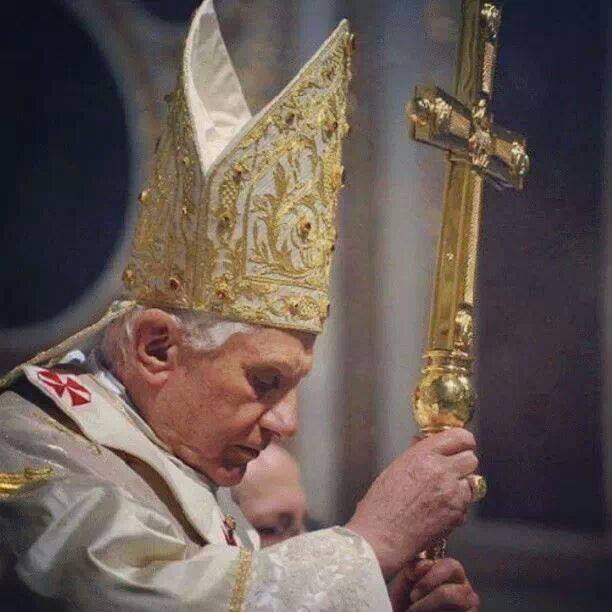
Jesus came into the world to separate those whose blindness is curable from those whose blindness cannot be cured because they presume themselves to be healthy. Pope Benedict XVI 

IMG_1112

John 9, The cure of the man born blind

Sometimes religion can be blind!

On the human level the man can see for the first time.

But the miraculous restoration of the mans sight has another layer of meaning. This healing is not just about restoring a man’s eye sight, it’s about recognizing the true identity of Jesus and as a result becoming a missionary. It’s impossible to discover the true identity of Jesus and keep it to yourself!

As events unfold it’s clear that the blind man’s healing is pushing the people involved to the point where they must make a decision about Jesus, about his identity. But they don’t want to go there even though they’re religious people and willing to argue about it. “We have just enough religion to make us hate, but not enough to make us love one another.” Johnathan Swift. They’re like children kicking, screaming, resisting! The majority just refuse. No, we’re not moving. “Nobody who has been drinking old wine wants new” Luke 5:39. This is a real danger for religion and religious people – that we do not press on.

The blind man quickly begins to see beyond his physical healing and in this sense ‘to see’ means to come to faith in Jesus which is what happens. He pressed on. Through his encounter with JesusIMG_1113 the blind man comes to faith, step by step, it’s a gradual development, from describing Jesus as “the man” to “prophet” to “Lord”, and his journey to faith happens while he’s being questioned – interrogated – to the extent that he has to defend himself, and in fact he ends up defending Jesus! He’s even abandoned by his family. Once questioned his family quickly distance themselves from him. This hostile engagement on the front-line is such an important part of growing in faith. When did we engage in it last?

The blind man becomes something of a victim because Jesus restored his sight. He becomes a victim of God’s love and man’s unbelief. Spiritually, God’s love is a wound that never quite heals until it can reach fulfillment.

See, he becomes a missionary in sharp contrast to the people around him. There is a reversal of order at work here that’s classic Jesus shock! The blind man can see while those with sight can’t see at all! He who is last is now first, and the first are rapidly becoming last. As religious people we need to make sure it doesn’t happen to us!

As events unfold the blind man gets increasingly bold. He just gets fed up with their unbelief and becomes incredulous towards them, almost ridiculing them: “Now here is an astonishing thing! He has opened my eyes and you do not know where he comes from!” I’ll paraphrase that – he’s looking at them and thinking; what kind of fools have I got here that they can’t work this out?

Why couldn’t they see? What stopped them looking at the facts and reaching the obvious conclusion? Why couldn’t they reach the point where with the ‘blind’ man they too could say; Lord, I believe, and worship him?

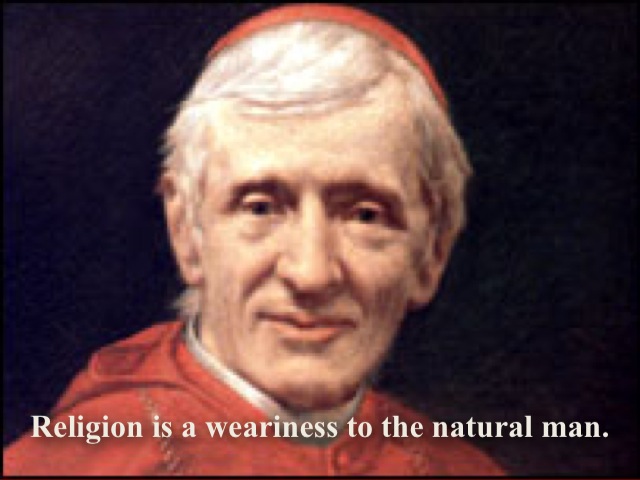
John Henry Newman

Of course they could see, but they didn’t want to see, and thus refused to see, because seeing would mean having to change their lives. “Nobody puts new wine into old skins; if he does, the wine will burst the skins, and the wine is lost and the skins too. No! New wine, fresh skins!” Mark 2:22

Time to change our lives?


IMG_1138


Third Sunday of Lent: A lesson in evangelization, a lesson in love.

The Samaritan woman represents the existential dissatisfaction of one who does not find what he seeks. She’s had “five husbands” and now she lives with another man.” Pope Benedict XVI

John 4: 51-42. The Woman at the Well.

Once again Jesus uses something very ordinary – water – to teach us about God and God’s desired relationship with us.

First thing to note: Jesus has gone out, he’s in hostile territory: “What? You a Jew and you ask me, a Samaritan, for a drink?” We need to move out from the security of our Church buildings too!IMG_0947

Now the woman could be any woman here (or man). She’s busy with her life doing something that’s life-essential – drawing water from the well.

But watch what happens as she meets Jesus – in the end she’ll put down the water jar and go and tell her friends about the man she’s met. She becomes a missionary. If it happened here in Enniscorthy some might say she’s turned into some kind of religious nut!

First she doesn’t get it: “You have no bucket, sir, and the well is deep; how could you get this living water?” She’s thinking in terms of water (her earthly life) but he’s talking about himself as “living water” (human fulfillment, which she’s so close to – she can actually reach out and touch God physically yet she might never meet him and know only the joys of this world). Notice too that she calls him “sir” rather than Lord – her journey will be from “sir” to Lord.

IMG_0935She gets there gradually, in stages, slowly discovering the full identity of Jesus on a one to one basis. It’s personal, one to one, the heart of God meets the heart of a woman and revelation occurs gradually.

Lesson – We must meet him personally. We must converse with him, if we do, he’ll change our lives.

Suddenly, as soon as the woman asks for “that water” Jesus asks her to call her husband – watch where this is going – and she replies “I have no husband” to which Jesus responds; “although you’ve had five (husbands) the one you have now is not your husband.” Classic!

Remarkably, she doesn’t protest, clearly she’s got some awareness of a religious understanding of marriage which Jesus affirms as God’s understanding of marriage (as opposed to the cultural understanding). She also acknowledges the expectation of Messiah.

Of course, nowadays we’d probably tell Jesus off and shout discrimination!

But she humbles herself, submits to a higher power and order, accepts the reality of sin, and he brings her forward. She meets the tender embrace of Jesus’ heart – mercy – always available to us in Confession. What if she’d gone the other way?

There’s one final detail I’d like you to notice. She brings the town to see Jesus –  the town asks him to stay – and when they too have encountered him they say something that we all need to be able to say:

“Now we no longer believe because of what you told us; we have heard him ourselves and we know that he really is the saviour of the world.”

St. Patrick’s Day and the will of God

Today’s Liturgy gives thanks to God for the mission of St. Patrick. Patrick brought us Christ.

That’s not quite the same as celebrating our Irish-ness which increasingly we seem unable to do without rivers of booze! So just in case we get carried away let me place our Irish-ness in the context of the life and work of St. Patrick.

I’ll put it this way:

In God’s presence, in the kingdom of God you won’t find a group holding a placard which reads ‘I’m Irish’ or another group declaring ‘I’m English’ – no more than you’ll find groups bearing the name ‘Catholic’ or ‘Protestant’ or ‘Muslim’. You’ll just find people who did the will God.

The will of God lifts humanity above our self-imposed limitations – Irish or English, Catholic or Protestant and so on – and becomes the source of a new world order which itself is a foreshadowing of the life of heaven.

A Lenten exercise inspired by St. Patrick.

Homily Notes. Luke 10:1-12,17-20

Today’s readings are about bringing Jesus and the Gospel to others – going out. The psalm captures it well: Go out to the whole world; proclaim the Good News.

Today’s Mass Preface tells us that St. Patrick did just that:

For you drew him (St. Patrick) through daily prayer
in captivity and hardship
to know you as a loving Father.
You chose him out of all the world
to return to the land of his captors,
that they might acknowledge Jesus Christ, their Redeemer.

We all need to be a little bit like St. Patrick.

However, I’m always amazed by our reluctance to be missionaries – by the ability of the baptised to place the Church outside themselves.

Why did he baptise you (he – meaning Christ)?

He wants you to be his missionary, his eyes and ears, hands and feet.

We need to get this – as God’s baptised we no longer represent ourselves and our own interests, we represent Jesus Christ and the kingdom of God. In every encounter, in every person we meet, in every transaction, in every detail of our lives you and I represent Christ.

IMG_0746We’ve got to take this call seriously – don’t wait for others, not even me!

So let’s do something really practical. This week, pick one day, and deliberately represent Christ in every detail of your day. Focus on it – you’re no longer just working for yourself or your employer, you’re working for Christ.

Say to yourself: Today, I represent Jesus Christ and the Gospel.

Second Sunday of Lent: It’s wonderful to be Catholic; I’ll make tents so we can stay!

Homily Notes. Matt. 17:1-9

Peter, James and John glimpse ‘something greater’

Of course, it wasn’t the first time. With Jesus there’s always ‘something greater’ to be experienced.

That’s our first lesson – the disciples are always in the company of Jesus, stuck to him, and in his company their hearts are opened out to ‘something greater’

Significantly, they climb a very high mountain before they glimpse this ‘something greater’. This too is instructive – if we’re going to develop spiritually it’s like climbing an interior mountain. But the higher we go the more beautiful and dangerous it becomes. Many don’t make it.

While on the mountain-top they glimpse another world, Jesus is transfigured and he’s talking with Moses and Elijah, two great men of God long since dead.

This suggests continuity. Jesus is the continuation of a line through history and if we care to look the line is marked by individual holy lives shining brightly in the midst of corruption – it’s not just anybody Jesus is talking with as he is transfigured! But do you seriously think the line stopped with Jesus? Jesus is the pivotal point, the line flowed to him and flows from him, to this day, and it will remain until the end of time a line marked by holy men and women shining brightly in the darkness.

Where’s the line? Wouldn’t you want to be a part of that line?

Peter wants to stay on the mountain top – he suggests making tents – but we can’t live on a mountain-top, we have to come back down the mountain.

When we have a spiritual experience it is grace that’s doing the work, God is doing the work, carrying us. At some point God is going to put you back down and say; now you do it, walk the walk yourself. If you’re really advancing he’ll put you back down and withdraw his favour for a time. If you survive you’re well on the way to becoming a Saint.

Of course, Peter is going to come back down the mountain; big time! In the face of the suffering and death of Jesus he’ll crack, denying Jesus; mountain-top to the valley of tears. It’s all our lives.

But at some point Peter is going to remember the mountain-top experience. At some point the memory will click-in and it’ll carry him through the valley of tears.

Which brings us to something that really troubles me. I have seen a massive exodus from the Catholic Church in my lifetime – for many reasons. I have also seen many peoples’ faith crumble in the face of difficulty and it leaves me wondering if the people abandoning the Church and faith have ever been to the mountain-top with Christ within their Catholicism, have they ever known ‘something greater’ within their Catholicism – if they had they simply wouldn’t be exiting!

No, they’d be saying with Peter, it is wonderful for us to be here, to be Catholic, we’ll make some tents so we can stay!

First Sunday of Lent: The temptations – throw yourself off the roof, God will look after you!

Homily Notes. Matt 4:1-11

The devil features strongly in today’s Gospel.

Notice his ability to take Jesus to Jerusalem and make him stand on the parapet and take him to a high mountain and show him all the kingdoms of the world … Interesting.

The first temptation – change these stones into bread.

Jesus replies: “man does not live on bread alone but on every word that comes from the mouth of God.”

These are extraordinary words because Jesus has been fasting for forty days and forty nights yet he stresses that God’s Word is as important as our food!

So let’s look at our relationship with food because Jesus is using it to teach us. Most likely we start with breakfast, have something at lunch time, and something in the evening – and if you’re like me … it’s complicated!

How long do we go without sitting down to God’s Word? Could it be said by any stretch of the imagination that we ‘eat’ God’s Word?

We need to hear – really hear – God’s Word so that we’re responding to God rather than a God who is nothing more than our projection.

I’d like you to take a very close look at the second temptation. It’s the temptation to jump off the parapet – self harm and suicide – on the basis that God will look after us because God’s Word says so.

Jesus doesn’t deny that God will look after us – he says “you must not put the Lord your God to the test.”

The third temptation is just as interesting because it suggests that the kingdoms of the world and their splendour – the wealth of the world – are not in God’s control but in the control of the devil who is therefore able to offer it to Jesus and presumably others too.

Isn’t that very interesting – in a world where God is blamed for starvation!

Jesus answer is even more telling; life is found not in the pursuit of worldly wealth but in the pursuit of God.

Sunday 8 Year A: Try reconciling euthanasia or even abortion with this!

Homily Notes.

IMG_0955Matt. 6:24-34 That is why I am telling you not to worry about your life and what you are to eat, nor about your body and how you are to clothe it …

Suggestion: Read and re-read the Gospel.

Summary: Use whatever it is you have – your education, your business, your wealth, not for your own personal gain but for God’s gain on earth, and God will grant you everything you need.

Firstly, something that jumped out at me, but if you’re to experience it too, you’ll need to read and re-read this particular Gospel passage until the message Jesus is attempting to convey starts to take hold of you, and as it takes hold think about euthanasia or abortion and it’ll hit you – bang – they’re totally opposed to the teaching of Jesus and impossible to reconcile apart from Mercy. Please do try it.

Secondly, notice what Jesus actually says. He says, if I put God and God’s kingdom first then God will look after me. I suspect that most of the time we place ‘me’ first and God doesn’t figure too prominently after that, other than to deliver in accordance with our plans.

No doubt there are people who’ll hear today’s Gospel and think; what a fairy-tale! In fairness, even for believers it’s daunting. Mercifully, the passage is quite nuanced and easily misunderstood. Still it’s also somewhat reasonable once you accept the creator God and the person of Jesus Christ.

IMG_0757If God is (if there is a God) then there is an Order. After all He created everything – don’t let pseudo-science put you off, there’s nothing in science to deny intelligent design. You may be surprised to know that it was a priest who proposed the big bang theory.

The world is intelligent and it was intelligent long before we recognized it. It’s not human intelligence that gives intelligence to the world – no – intelligence is already there, before and prior to us.

Thus Jesus argues: look around you, the birds get by and they do not sow or reap or gather into barns, yet your heavenly Father feeds them, and there’s a beauty in creation that’ll match the finest clothes any day of the week.

Therefore we can forget ourselves because we’re part of a much bigger picture, because there’s an Order and an Order-er, and the Order-er hasn’t abandoned us, rather, He’s our Heavenly Father who knows we need to live.

IMG_0648

As Pope Benedict said so beautifully: “Each of us is the result of a thought of God. Each of us is willed. Each of us is loved. Each of us is necessary.”

Of course, Jesus is not suggesting that our livelihood will fall out of the sky! On the contrary, he’s suggesting that instead of educating ourselves and doing whatever it is we do for our own personal gain that we change our focus and do it instead for God and God’s advancement.

It’s a mammoth change of direction!

Love like Jesus – and get yourself in trouble!

Homily Notes

Seventh Sunday, Year A. Matt. 5:38-48

At first sight today’s Gospel seems very demanding.

Demanding might seem an understatement. Perhaps the immediate response of many will be; it’s impossible. It’s audacious in its demands; “offer the wicked man no resistance, if anyone hits you on the right cheek, offer him the other as well …”

Yet when Jesus begins to argue that if we do good only to those who do good to us and save our greetings for our friends (brothers) only, I think we can begin to see that he’s got a point.

IMG_0852There is nothing exceptional in doing good to those who do good to you or in loving those who love you.

When the words of Jesus drag us to look at ourselves in this way we can begin to see the obvious limitations of our goodness and by comparison the magnanimous goodness of God who “causes his sun to rise on bad men as well as good …”

Thus, here again we glimpse the missionary demand of Jesus, to move out of ourselves individually and collectively and to go out and always be charitable – even towards our enemies!

IMG_0850To live in this way is counter cultural. It sets us apart, makes us like a city built on a hilltop. You will never hear a Government minister or a TD* ask this of you. No media person will ask it of you. But Jesus asks it. Who do you follow?

While we might think that modern Ireland is challenging Catholicism, it’s actually not challenging Catholicism at all; rather, it’s challenging a poorly incarnated (lived) Catholicism. No democracy will ever present you with a challenge greater than loving your enemy or being as perfect as your Father in Heaven!

In the end we’re being called to love like Jesus Christ who gave his life, not just for good men, but for bad men too.

These words of Jesus open doors that’ll – if we pass through – get us in a lot of trouble!

IMG_0851

*TD – a member of the Irish Parliament (Dail Eireann)