Tag Archives: Jesus Christ

Twenty-sixth Sunday: The compassion of God didn’t leave sinners where they were

God is at work because tax collectors (extortionists) and prostitutes are changing their way of life.

Matthew 21:28-32

Jesus compares the people he’s speaking to – the Jewish religious leaders – to a son who says he’ll go and work in his father’s vineyard but then doesn’t go. Jesus accuses them of partaking in religion but in a way that doesn’t lead them into the kingdom of God (the kingdom of God is nothing more than God ruling your heart).

So here Jesus reveals the purpose of religion; that our hearts are ruled by God. This is the most important detail about every person’s existence; that each enters the kingdom of God.

On the other hand Jesus compares the tax collectors and prostitutes to a son who says to his father; “no, I will not go and work in your vineyard” but afterwards thinks better of it and goes, and the proof is clear for the Jewish religious leaders to see – the very public sinners were changing their lives; Zacchaeus declares to Jesus that he’ll pay back those he’s cheated four times the amount (Luke 19:8) and the woman “who had a bad name” sat weeping at his feet before kissing and anointing them with oil (Luke 7:36-38).

Jesus says this alone should have been enough to convince the Jewish leaders that God was working through him and indeed through John.

Here Jesus gives us the ultimate test to establish if God is present or not in a person’s life – “you will be able to tell them (true disciples) by their fruits” (Matthew 7:16). Where God is present certain types of behaviour follow, where God is not present other types of behaviour follow. But who decides what’s in and what’s out?

The present generation has great difficulty with some of this and wants to change it – much of it a sure sign of living outside the kingdom. Changing this is the spiritual equivalent of changing the laws of physics! It’s impossible.

When a man (or woman) begins to enter Gods kingdom (remember the definition – God ruling our hearts) he discovers the reality of sin, he doesn’t need convincing, more importantly his own sin begins to bother him, and if he continues to make his way into Gods kingdom he will change and be changed. It’s actually entry into the kingdom of God that decides what’s in and what’s out. The more you enter the more the Catechism makes sense.

This is what happened to the tax collectors and prostitutes. The compassion of God didn’t leave them where they were – and it didn’t want to leave the religious leaders where they were either. Too often today people understand the compassion of God to mean the acceptance of sin!

The compassion of God is grace or graces that change us inside (interior) and as we are changed inside we are changed outside (exterior) – our behaviour changes from the inside out. It’s precisely because we’re becoming a new person that our lifestyle choices change.

The religious leaders should have known this, they should have known that wherever the kingdom of God is present, there you find repentance and conversion. That they didn’t recognize this means that they had not entered the kingdom of God themselves.

This is a problem that persists to this day – too many speak of religion and God from a position outside the kingdom of God. The result is the blind leading the blind!

The Holy Trinity: Everything we need to know about the future of the world can be found in the figure of Christ crucified.

Holy Trinity Icon

“The three persons of Father, Son and Holy Spirit are pictured at a table with a space vacant at the front for the believer; for you and me.” Fr. Billy Swan

Today’s Gospel (John 3:16-18) moves from the personal and the private to the public… from the salvation of the person to the salvation of the world, and back again to the personal and the private.

In our day there is a determined effort to confine religion and therefore the person of Jesus Christ to the private.

The wisdom of the day suggests that there should be no place for religion and therefore no place for the person of Jesus Christ in education, in health systems… anywhere in public life.

It’s absolutely impossible to reconcile this privatization of religion and the message of today’s Gospel which clearly states that the person of Jesus Christ is the key to personal salvation but also to the salvation of the world.

Now, I need to explain the meaning of salvation precisely because when we think about salvation we’ve already privatized it and we never think of salvation as having anything to do with the future of the world – here and now.

So what does salvation mean? It means nothing more than human well-being individually and collectively. Happiness. It means the well-being of the world – the old missioners would have said the temporal and eternal well-being of humankind.

This means that we can have all the economic policies we want, all the education policies, all the health policies… but if they’re not founded on God they’ll eventually turn and bite us!

The world is set on a path that says we don’t need God; we’ll do it our way, yet “God sent his son into the world… so that through him the world might be saved.” I trust you can see the contradiction?

So what’ll happen? This is what I think will happen; the world will persist on this path, the world is not for turning (there are very good reasons for that; historical reasons) and only from a point of collapse will the world return to God.

That’s what a generation will see and experience; a collapse. But let’s go deeper; spiritually it’ll look like the Evil One has taken everything from God and when it looks like Evil has triumphed God will act.

Go deeper again; in other words it’ll look like the period of time between Christ’s death and resurrection when even the disciples thought everything was lost.

Go deeper still; in other words what happened to Christ (what we celebrate every Easter) is what’ll happen to humanity.

The rejection of God always leads to the figure of a crucified humanity, to the point where everything seems lost. But God will not abandon his creation.

The future of the world is there before us in the figure of Christ crucified. Everything we need to know about the future can be found there.

Sixth Sunday of Easter: How terribly discriminatory of Jesus!

Sixth Sunday of Easter Image“In a short time the world will no longer see me…”

The short time is his death (Good Friday), resurrection (Easter Sunday) and ascension (next Sunday).

After these events the “world” no longer sees him but Jesus makes a distinction – those who love him do “see” him.

How terribly discriminatory of Jesus!

So how is it that some “see” him and others don’t?

He promised to come back, to show himself, to enter into our lives and he achieves this through the gift of the Holy Spirit (Pentecost Sunday).

Have you ever noticed how it’s impossible to get inside another person’s life, how the other person is always totally other. This is not so with God, God is Spirit and thus able to enter our bodies and provided we co-operate the Spirit then draws us deeper and deeper into God. “On that day you will understand that I am in my Father and you in me and I in you.”

But we must co-operate. He says there are some, those whom he calls “the world” that can never receive him. Jesus, you’ll get yourself in trouble speaking about secular society like that!

In other words there are conditions attached to receiving Jesus Christ – shock, horror – that’ll send a few over the edge! It troubles me when I hear religious people speak of God’s unconditional love. It indicates they know little about the spiritual life. If by unconditional they mean God’s love is always offered, always available, that’s fine, no problem there. But God’s love is of little use to us if it’s always offered, always available but always out there and remote. We need him within. But if they mean by unconditional that there are no conditions to receiving Jesus Christ, that’s nonsense. Rubbish! Of course there are conditions, otherwise everybody would know Jesus Christ!

Jesus clearly states two such conditions in today’s Gospel. Indeed the whole teaching is prefaced by the conditions.

1. If you love me – for many that means a radical reorientation of life.
2. If you love me you will keep my commandments – the experience of receiving Jesus Christ through the indwelling of the Holy Spirit is simultaneously experienced as a call to a moral standard that simply cannot be detached from the person of Jesus Christ.

“If you love me you will keep my commandments, (and then) I shall ask the Father, and he will give you another Advocate…”

A word of caution: this is not instant, it requires spiritual growth over many years.

God hung among thieves!

Christ crucified among thieves“To be connected with the Church is to be associated with scoundrels, warmongers, fakes, child-molesters, murderers, adulterers, and hypocrites of every description. It also, at the same time, identifies you with saints and the finest persons of heroic soul within every time, country, race and gender. To be a member of the Church is to carry the mantle of both the worst and the finest heroism of soul … because the Church always looks exactly as it looked at the original crucifixion, God hung among thieves”

Fr. Ronald Rolheiser

Fifth Sunday of Easter: Jesus Christ, the joy of Catholicism


"When we pray properly sorrows disappear like snow before the sun"

St. John Vianney: When we pray properly sorrows disappear like snow before the sun.

It’s sometime before his suffering, death, resurrection and ascension.

Thus when he says he’s going away he’s talking about a future event.

It’s most interesting though to observe the meaning he gives to his going away. His going away is not his death, but his death, resurrection and ascension, and in going away he’s not abandoning us.

Thus in the teaching of Jesus Christ death is not the final end event, but part of something much greater. We need to begin to think in this way. For the believer life opens upwardly to the splendour of God. For the unbeliever life (ultimately) must narrow downwardly to the grave!

He is going away (death, resurrection and ascension) “to prepare a place for you…” This is personal.

Have you ever noticed that you can’t really walk in another person’s shoes, that no matter how close you might be to another person, that person is always separate, uniquely other? There’s a sense in which in the end there’s only God and you in the universe!

Jesus promises that after he’s gone (death, resurrection and ascension) he’ll come back to take you with him. It’s so personal.

We tend to think of this returning as death but that misses so much of the picture – most of all it misses the joy at the heart of our religion.

The returning to take us with him is the gift of the Holy Spirit (Pentecost) through whom God enters into our lives, not in the future, but now. We’re taken up into the Divine life. We’re given a “place” in the Divine life. This is what Jesus means when he speaks of “rooms in my Father’s house” – it’s a share in God’s life. Try to imagine what happens when the Divine life begins to enter our lives; a transformation begins. Thus we find the Saints saying things like; “When we pray properlysorrows disappear like snow before the sun.” St. John Vianney. The all powerful God mingles his life with ours – pure joy! 

This is what makes the Catholic. Without Him religion falls flat. In fact, I’ll go much further and say; this is the joy of life, never mind Catholicism!

We don’t inherit the kingdom because we’re good people. We inherit the kingdom because God has given us a place (or room) in his Divine life and God by his very nature can’t be held captive by death.

Fourth Sunday of Easter: Good shepherds or hired hands?

He says he’s the gate of the sheepfold. All others who have come are thieves and brigands.

What is this sheepfold and who are these thieves and brigands?

IMG_1352The very idea of a sheepfold suggests that we do not follow Jesus as individuals in isolation – there’s always Jesus Christ (the shepherd) and the Church (the sheepfold).

The sheepfold is the Church but it’s the Church merging into the kingdom of God. The Church is the gathering of those who’ve entered into the life of God through Jesus – it’s this passing through Jesus that produces the Church.

Jesus describes people who enter in this way as “safe” going “freely in and out” (of the life of God), “sure of finding pasture” – powerfully descriptive words.

There are other people who’ve entered the Church but without entering the life of God. They’re just going through the motions. These are the thieves and brigands – an accusation that’s directed in the first place at the religious leaders of his day.

Catholics, but particularly bishops and priests who maintain the mere external practice of religion without true conversion of heart are thieves and brigands. They usurp the things of God becoming obstacles rather than stepping stones to God. Pope Francis repeatedly warns about the threat such people pose within the Church.

But this problem is not confined to priests and bishops. Few are immune to the trappings of religion without the appropriate conversion of heart. 

Such ‘Catholics’ find life in the Church boring. They’re highly visible at the one-off events, First Communions, Confirmations, there’s an obvious disconnect which manifests itself in distraction. There’s little sense of the sacred, little sense of the presence of the Totally Other. In their distraction they “steal and kill and destroy” the sacred.

Finally, allow me to present you with the ultimate test of the Christian; are you a goodIMG_1356 shepherd prepared to lay down your life for the flock (the Church, God’s people) or are you a hired hand who runs away when the wolf attacks?

The difference, I think, is the gate we’ve used to enter the sheepfold. Have we really come in through Jesus?

Second Sunday of Easter: Christ without the Church is a contradiction.

What’s brought them to this room? They’re gathered in the room for the same reason that Mary of Magdala was up early on Easter Sunday morning – while it was still dark – visiting the tomb of Jesus. They love him; if they didn’t love him they wouldn’t be there – simple as that. They’d be at home or occupied in some other way. They’d be somewhere else.

And what brings Christ to this particular room? Why not a room in some other house? Because the people who love him are gathered in this particular room. “Why should the privileges of the true Christian be disclosed to humankind at large?” (John Henry Newman). It’s not going to happen. He reveals himself to those who love him.

There’s something else about the people gathered in this room. Each person there is leaving another life behind – perhaps family and friends too – and they’re gaining new friends, bound together by a common interest and love; the person of Jesus Christ. This love steals their hearts and unites them with others (once strangers) in a bond that’s effectively the formation of a new family; the Church.

The idea that we can somehow follow Christ on our own is nonsense. Once Christ steals more than one heart he binds those hearts together in a union of love – which is why we find the disciples gathered together. They belong to one another as much as they belong to Christ. One flows into the other. Christ without the Church is a contradiction and the Church without Christ is an even bigger contradiction!

Torch-lit Good Friday 2014 Way of the Cross procession presided over by Pope Francis at the Colosseum.

We can only presume about the whereabouts of Thomas. It seems odd that he’s not with them. Why isn’t he with the others? What could be more important? I suspect he’s among the first people to leave the Church, disappointed and disillusioned, his faith shattered by the events of Good Friday. To borrow the words of Pope Francis; Thomas sees the monstrosity of man when we allow ourselves to be guided by evil, rather than seeing the mercy of God. Sound familiar? How many have left the Catholic Church for this very reason? And his insistence that unless he can see the holes that the nails made is the demand of a man near the edge of faith.

How is he saved from the edge? Eight days later the infant Church is gathered again and this time Thomas has returned to the fold because of the witness of the others. Now he encounters the risen Christ himself and the encounter restores his faith in Christ but it also seals his return to the Church – one flows into the other.

This is profoundly instructive – the future of the Church hangs on this and this alone; encountering Jesus Christ.

Small numbers on Holy Thursday: A return to our beginnings?

Here in St. Senan’s Parish (Enniscorthy) numbers attending the Evening Mass of the Lord’s Supper on Holy Thursday were small.

Generally, blame for this decline is attributed to a discredited Church. But that doesn’t stand up to scrutiny.

Here’s why: The events of Holy Thursday, Good Friday and the Holy Saturday Easter Vigil (and Easter Sunday) are not primarily about the Church but about Jesus Christ and more particularly about Christ’s desire to enter into relationship with humankind. Dare I say it; to save humankind! In summary; it’s about people’s relationship with Christ and the work of salvation.

Therefore, if people’s absence on Holy Thursday night was truly about a discredited Church as opposed to their relationship with Christ then you would expect that large numbers of people found other ways to mark the Last Supper on Holy Thursday night.

But can you imagine large numbers of people in Enniscorthy (or wherever) doing that on Holy Thursday night? Isn’t it much more likely that for the vast majority of people Holy Thursday night was no different to any other night? 

The truth of the matter is that significant moments in Christ’s life (in which he attempts to influence human affairs) have no relevance for growing numbers of Irish people.

Behind the blaming of the Church the real questions are about Christ and his meaning for peoples lives. 

In the failure of many to celebrate Holy Thursday all that’s happening is that Christ is being stripped again, humiliated and rejected. Isn’t it true to say that really it’s not about the Church at all but about taking everything from Christ?

The growing unbelieving world is taking his birthday away from him, making it into something else; likewise his Last Supper, his passion, death and resurrection and if many are not actively taking from him, many are doing it through indifference.

Is this a reason to be discouraged? No. Not at all.

Mother Theresa said; “if you are discouraged it is a sign of pride because it shows you trust in your own powers.” This is God’s work.

IMG_1263We’re merely returning to our beginnings when the vast majority rejected Christ.

But the stone rejected by the builders became the corner stone. He rose again; and he’ll rise again, just at that point when we think all is lost, at that point when it looks like all is lost, as it did in those desolate hours before the resurrection. The future is Paschal.

It does mean however that the Church must radically change how we do things. In the towns and cities we need to move out from the security of our Church buildings. Pope Francis suggests we need to rent a garage or a shed in the densely populated areas and put a priest or a catechist there, celebrate Mass there.

Pope Francis calls this putting things in a missionary key.

Finally, there’s another name for how Christ accepts, embraces and transforms all this IMG_1222rejection of himself – it’s called mercy.

We need to trust it … we’re certainly not going to defeat it! 

Jesus has a great big heart! Reflections for Holy Thursday and Good Friday.

Jesus has got a great big heart!

One of the biggest problems within Catholicism is that we’ve watered down Christ and the Gospel so that more often than not we’re like the man who started to build without first sitting down to work out the cost to see if he had enough to finish the job. When he can’t finish he becomes a laughing stock (Luke 14:28). The result is a city (Church) that always looks half-built, or less than half-built – or like a ruin and the object of ridicule!

The first meaning of Holy Thursday is service – love.

Most of us have grasped that Christianity (therefore Catholicism) is about service – but Jesus has got a great big heart and his understanding of service is considerably more than giving a few hours here and there. It’s nothing like reaching a realization that life has been good so I’ll give something back. As good as that is, it’s not the message of Jesus.

Jesus asks that we lay down our lives! Believe it or not, only then will we know the joy of the Gospel.

In the aftermath of Good Friday the disciples will remember the washing of the feet and begin to see it not just as a general call to service, but also as pointing to the greatest service known to humankind; Jesus’ suffering, death and resurrection in which men and women are washed clean of sin (in his body and blood).

What does it mean to be washed clean of sin?

I did not die on the Cross for you to bear the burden of your sin.

I did not die on the Cross for you to bear the burden of your sin.

It means that Jesus didn’t die on the Cross for you and I to bear the burden of our sins. I’d like you to really think about that, meditate on it… St Paul says “that for someone really worthy, a man might be prepared to die – but what proves that God loves us is that Christ died for us while we were still sinners.” (Romans 5:7). A parent might be prepared to die to save the life of a son or daughter, but would you be prepared to die for a notorious criminal?

So instead of condemning the already condemned man, like we often do, Jesus does the opposite, he seeks to take the condemned man’s place in prison, or in the electric chair, or wherever! What do we think he’s doing on the Cross?

Can you see it?

At once he identifies with both the guilty and the innocent, guilty perpetrator and innocent victim. So whom exactly is Christ excluding? Nobody. Awesome!

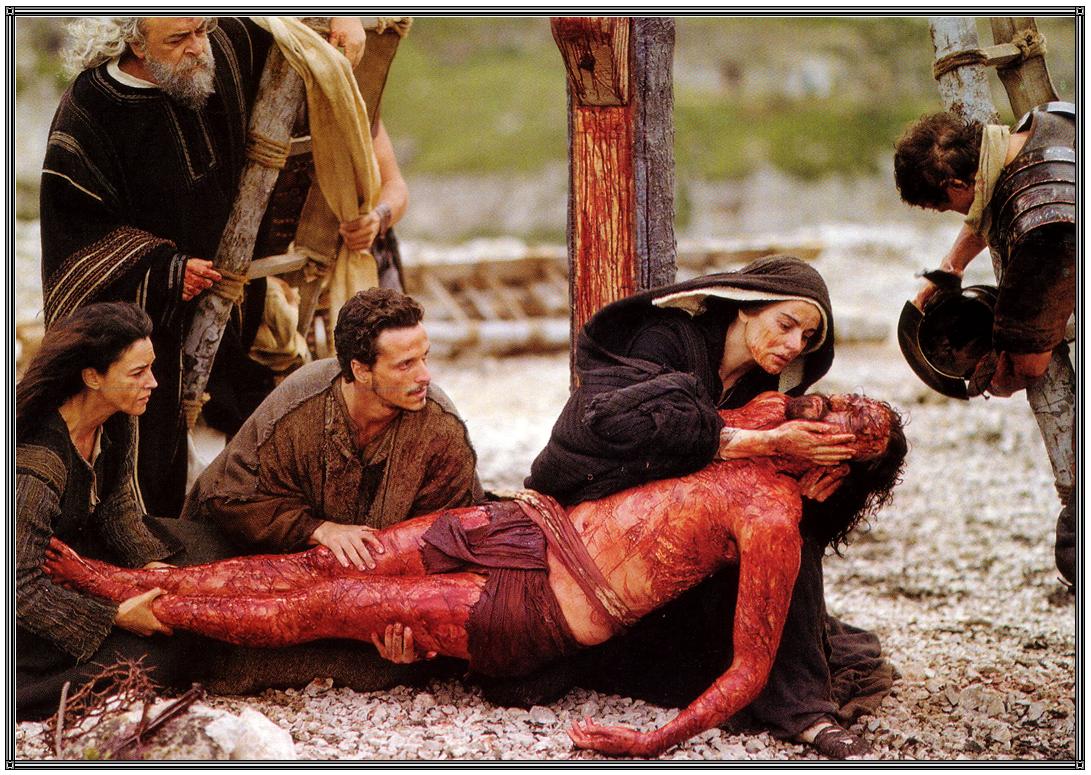
I want you to see something else. Jesus never says wrong is right or right is wrong, he upholds a moral standard that applies to and judges all men and women, but instead of condemning those who fall short, what does he do? He lays down his life, literally, he offers his body and blood that they might be saved (which itself implies ultimate Justice) which is the exact opposite of what so many Catholics have done in recent years – they’ve run away believing that righteousness is on their side. This is not the path of Christ. Followers of Christ redeem with their lives! They become like Christ – hung among thieves!

Of course, all this implies that there’s ultimate justice; a final putting to right of wrongs. Indeed, mercy is justice transfigured by love. Unless we want to live in a meaningless universe, this is how it has to be!

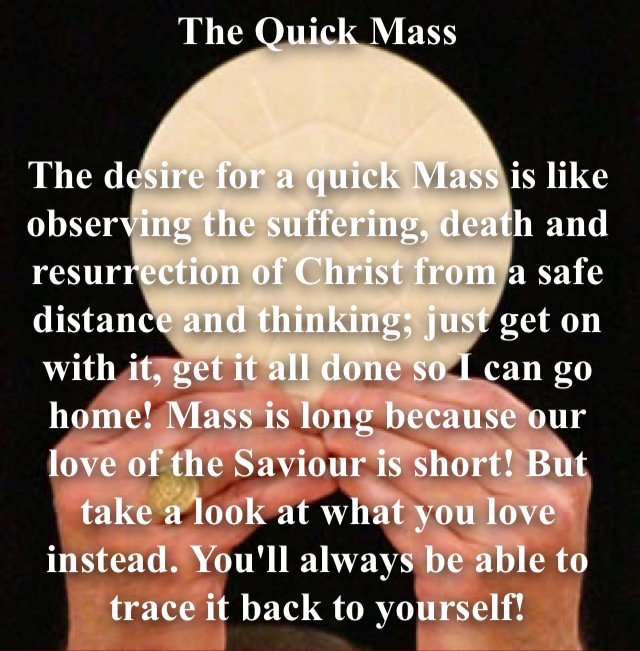
Mass is long because our love of the Saviour is short!

Mass is long because our love of the Saviour is short!

The second meaning of Holy Thursday is the Eucharist – Holy Mass. The Last Supper is the DNA of Holy Mass. Jesus identifies his body with bread and his blood with wine. Try to capture something of the intensity with which Jesus took the bread and wine and offered it to his disciples. He knew he was ‘going away’ and he was giving them the means by which he’d stay with them. Catholicism is not primarily a moral code, an ethical system, it’s a person; Jesus Christ, who offers himself to us in Holy Mass; his life, body and blood, soul and divinity, his suffering, death, resurrection and glorification – everything.

The third meaning of Holy Thursday is the priesthood, but priesthood as being like Christ, as laying down your life, as the literal offering of your body, the pouring out of your blood, the willingness to exhaust yourself on behalf of God and man, to give everything, not a few hours here and there, to hold nothing back, to have no ‘me’ and no ‘mine’, only to have Him!

Because if you have Him you have everything. And you know what? He’s worth it!

Twenty Second Sunday (C): Jesus insults the guests, then the host!

Luke 14:1,7-14

Twenty Second Sunday, Year C, September 01 2013

A leading Pharisee – a person of standing in the community, in society generally – hosts a meal, inviting family and friends and among the guests is Jesus.

So here’s the scene; a host, guests and God all rubbing shoulders!

And the guests are more interested in their personal standing, in themselves, than they are in God and Gods Kingdom. There’s nothing new there – even to this day!

Their religion is about themselves rather than God and neighbour. Or perhaps their religion has had little impact on them. Their religion hasn’t converted self – which usually means self has converted, indeed, corrupted religion! Which is what we’ve got today; no, yes?

They’re full of self rather than God and neighbour.

And if something, indeed, somebody is full then you can’t get anything more in. She or he will have to be emptied before God can enter.
Really Jesus is asking; are you so poor inwardly that you must compete outwardly for position at a table, for recognition, for honour, for contentment, for meaning?

It’s the classic Jesus question: Do we find ultimate meaning in the material or the spiritual? It’s an important question – especially in a time when the material has failed and so many have lost meaning.

And given their self centredness it’s not likely they had the humility to hear Jesus call to a much deeper love, a more radical service, to forget self and put God and neighbour first.

Without that humility it’s most likely they felt insulted by Jesus.

In the end it comes down to who is dominating us, deep within?

Is it self or is it God?

Inside; who is in charge?

You’ll be much happier when God rules inside!