Tag Archives: Jesus Christ

He makes our hearts bigger!

25th Sunday in Ordinary Time

Matthew 20:1-6 Why be envious because I am generous?

Observing myself responding to this piece I notice how I’m drawn to the grumbling. I too experience this as unfair.

Then, as I slowly focus on the landowner, I realize that it would have cost him much less if he’d used my standard.

This guy doesn’t think like us or see things as we do. He’s got a huge heart.

Suddenly, I experience myself being drawn toward him but I also notice that as I move toward him and his way of doing things – his generosity – my heart is expanding, it feels much healthier, and as it expands it reveals to me how much smaller my heart was becoming as I identified with the grumbling, with our way of doing things.

I trust we all realize that this guy – the landowner – is the heart of God, the most beautiful and the biggest heart of all!

Perfectly positioned to see the glory of God

Jesus’ circle of friends – disciples, whatever you want to call them – are invested in Jesus. They love him.

Thus today, Holy Saturday – the time between his burial yesterday (Good Friday) and tomorrow (Easter Sunday) – must have been a dark, dark time for them. They’d pinned so much on him… hopes… dreams…

Now, what I want you to see is that because they’re invested in him, because they love him, the two Marys (“Mary of Magdala and the other Mary”) are up early – “towards dawn” – and heading to the tomb. Because they love him they’re staying close to him even in death.

When the Easter events are unfolding they’re not somewhere else, they’re not at work, or on a short break, or immersed in some recreational activity, they’re not off somewhere pampering themselves, they’re not “down the local!”

No, they love him so they’re present, or at least nearby, critically they’re caught up in it all. They’re undoubtedly crushed, devastated, questioning, recalling stuff he said, trying to make sense of it all, but they’re perfectly positioned to be gifted something extraordinary, to receive so much from God.

They will see the glory of God because they are present and they are present because they love Jesus.

This love or the absence of it explains everything.

There’s a whole world going on around the two Marys and the disciples that cares little about Jesus or what’s happened to him.

They will not see or experience Jesus’ resurrection because they are not there. They are elsewhere; fishing, farming, down the pub, otherwise occupied – his life and death just doesn’t matter enough to them, they didn’t get caught up in him.

And so it is today. There is no great mystery about it all. In terms of responding to Jesus Christ humanity is exactly as it was back then…

Spiritual experience and Christian spiritual experience are not quite the same!

On the purely human level people discipline themselves to climb mountains and when they reach the mountain-top the views are magnificent, breathtaking, up there it is delight, enjoyment, peace, it is spiritual experience.

But it is not necessarily Christian spiritual experience, it is human spiritual experience.

Christian spiritual experience is something more, more than the views from the mountain-top and how that touches us.

In the Gospel today it is not the surrounding views that the disciples are caught up in, that’s not what is remembered. In fact there is no mention of it.

No, it is spiritual experience of a different kind that they remember. It is something more, something beyond purely human spiritual experience. It is Heaven thrown open and it is the presence of Jesus Christ that is opening Heaven up.

It is Heaven, grace, God, acting on human effort and taking human spiritual experience to another level altogether.

Pentecost: Making things a little too black and white!

This is so simple.

It’s nearly too simple for many of us. I suspect it’s much too black and white!

The Spirit arrives into our lives in a very ordered way – remember it’s the Spirit that brings us into intimacy with God.

There are ordered steps and each step builds on the previous step.

If you love me – that’s the first step; if you love ❤️ me… look how he’s phrased it; if

If you love me, then the second step; you’ll keep my commandments. So the second step is keeping his commandments but you’ll never have one without the other.

Then Jesus repeats himself, making the same point but in a slightly different way.

And then to really push the point home he states that the reverse is true: “Those who do not love me do not keep my words.” Few of us are comfortable with this, typically we’d say; much too black and white!

So, the Spirit does not enter every life, only the lives of those who love Jesus (God), and keep his commandments, his Word.

So we’re given a reason for lack of intimacy with God.

Finally we’re told something of what the Spirit’s presence does; it causes us to remember Jesus teaching, his teaching becomes part of who we are, my identity, your identity, our identity.

Jesus shock – cutting off hands and tearing out eyes!

Twenty Sixth Sunday

Who was this outsider that he’d figured out the significance, if not the identity, of Jesus?

“But he’s not one of us” the disciples complain.

He wasn’t part of the twelve. He didn’t have the benefit of sharing intimately in Jesus inner circle. Yet here he is, ministering in the power of Jesus.

Here we glimpse the wonder of the Father’s revelation which is always capable of catching us offside so to speak. The Father is full of surprises!

Jesus corrects his inner circle; he may not be one of us in the sense that he’s not physically present in this group, but he knows me… and that’s all he needs.

Essentially this passage is teaching us that Jesus is everything, that knowing and recognizing him is everything – not the group we belong to – and that giving a cup of water to someone just because she belongs to Christ is hugely significant because the giving of the water is really about the recognition of Jesus.

The recognition of Jesus is everything.

But then Jesus turns his attention to sin, to the power that is his absolute opposite.

That he swings so suddenly – almost violently – to bring up his opposite suggests he wants us to hear what he has to say.

It’s Jesus shock!

It’s shock tactics so he can get our attention – “thrown into the sea with a great millstone round his neck… cut off your hand… tear out your eye…”

It’s a shocking message, hyperbole obviously, but nonetheless a very simple message that Jesus really wants us to hear.

Do not sin.

Sin – without repentance – is the highway to hell!

Love is the standard by which God will judge us – but it is love of a much higher standard than we realize

Jesus has taught us that there’s a definitive standard – love defined as love of God and love of neighbour – by which we will all be judged.

But don’t be complacent about God’s love… and be careful of presumption…

Because this love is of a much higher standard than most people realize. Remember Jesus’ teaching that his new standard is higher than the old; love your enemies.

Or the widow who put in one small coin. She put in more than all the others although the others put in much bigger amounts… because she gave everything she had.

He’s indicating different levels of love… which correspond to different levels in the next life, in the kingdom of God.

When Jesus speaks about love he really means all-consuming charity, charity that no longer experiences even a hint of self denial. He’s not really thinking about romantic love.

So be careful… sometimes people use Jesus emphasis on love to include stuff that may be contrary to Jesus intentions; may be contrary. Some TV personalities are quite adept at this!

Here’s a good illustration of the inner dynamics of judgement; suppose I’m buying a car. For many it’s an ordinary enough event and few would even relate it to God. But for others it’s far from an everyday event. I could splash out 20,000 or 50,000 or even 80,000. What we do not suspect is that we’ll relive that choice – and every other choice – from within the standard of God’s love at the moment of our judgement; how did I love God and how did I love my neighbour in these choices?

In our judgment we’ll see what we actually did with what we had, and what we could have done – and much of it will be stuff that we don’t even connect with God, stuff that we might call “business” or “the market” or some other name whereby we remove whole areas of our lives from God, as if God could be excluded, but seeing what we could have done, but didn’t do, at this level – in the presence of God – is actually pure punishment.

So while we might think that a man or woman has been successful, that same success may prove their downfall at the moment of their judgement.

The criteria of judgment will always be; how did I love God and love my neighbour in my everyday choices and no area of human life, endeavour or enterprise escapes God’s attention.

Have you ever wondered why Jesus taught that the poor are blessed? Partly, because they avoid this responsibility and thus they avoid this kind of judgement. But that’s only part of the reason.

The bigger part is how success, more often than not, deceives and empowers our small ego lives into choking our need for big life, for God.

But that’s another day’s work!

Jesus’ reasons for unbelief – the parable of the sower. Matt 13:1-9

We hear all sorts of reasons for unbelief.

But every time I read the parable of the sower I’m struck by its reach. Is there a reason advanced for unbelief that’s not included in the parable?

Jesus compares people who hear the word to seed that falls on the edge of a path.

The seed of the word is sown in the heart but there’s no understanding. Where there is no understanding, abandonment follows.

The heart is simply not receptive – receptivity is the precondition of understanding – the heart is not open, and entry through anything that’s closed solidly is difficult. The word simply bounces off non-receptive hard objects and falls away.

Next, Jesus compares people who hear his teaching to the seed that falls on patches of rock. It lacks both rich soil and deep roots.

When confronted with human suffering and human failure including outrageous scandal – scorching sun – the faith of some people withers because it’s not deeply rooted in the rich soil that is Jesus Christ.

Scorching and withering – apt descriptions of human suffering and failure.

That objections to God using this very argument can attract millions of views on YouTube suggests that many have not taken Jesus and his teaching seriously. The God that many refuse to believe in is not the God found in the teaching of Jesus Christ. They dismiss a God unrelated to Jesus Christ!

Next, Jesus compares people who hear the word to seed falling in thorns; falling in the midst of the worries of this world and the lure of riches the seed is choked to death! A strong image, mind. Choked, and common parlance adds “the living daylights out of!”

It’s dramatic, but for most people the choking happens unconsciously. It’s simply that other stuff – the cares of this world (interests that are good and wholesome in themselves) and the pursuit of wealth – take our hearts. For many the interests become false gods.

Is there a source of unbelief that’s not covered in this parable?

It seems that many people attempt to believe without Jesus Christ and his teaching which means they end up struggling to believe at all.

Good Friday; our words are approximations of eternity.

Before we begin… a few pointers to help you get the most from our celebration of Good Friday.

Firstly, it’s not just the person of Jesus that’s rejected, it is God’s truth! He is Truth in human flesh. It’s also Truth – absolute Truth – that’s rejected.

Secondly, I’d like you to notice in the opening lines of the Gospel that when they go to arrest Jesus they don’t know who they’re looking for. He’s not a big name in society!

Thirdly, I’d like you to notice that the State and the religious leaders do their best to get rid of Jesus, but in their best efforts to get rid of him they’re actually fulfilling God’s will! The wisdom of man is foolishness to God!

Image of Christ crucified 7But most of all I’d like you to notice that Jesus suffering is redemptive. If you redeem something you give something away to get something back. God gave his Son to get us back… “to ransom a slave you gave away your son!” (Easter Proclamation: Exsultet).

This is the Mercy of God. Mercy is the heart of God and it’s the heart of the Gospel. Mercy means that there is ultimate Justice! For only if Justice has been transgressed can anyone be merciful. To put it in legal terms; only if a ‘law’ has been broken can anyone be merciful. So if God is merciful then there is an absolute law, God’s law, by which we are all judged.

If we think of what it means to be merciful ourselves we know that to be merciful costs. It’s difficult. Perhaps some of us are so hurt that we cannot be merciful, and if we are to be merciful it will be like crucifixion. There you have it… there you have it in your own experience; the seeds of the eternal. Therefore if God is to be merciful, God must suffer. Only if we live in a meaningless universe can it be otherwise – only in a world where words are empty and meaningless, meaning only whatever we want them to mean at any given time. But unknown to ourselves our words are approximations of eternity.

Here’s a way to get inside God’s Mercy. He died without sin for you. He died without sin on your behalf. Therefore you will die without sin if you allow Jesus Christ to ‘wash’ you. If he died without sin for you, that means you’ve done it! Put it this way: If you owe a debt and can’t pay, what happens? Now supposing someone else pays the debt on your behalf, what happens? You’re free! Behold the lamb of God who takes away the sins of the world? How does he take them away? By taking them on himself.

Here’s an exercise for those who struggle with guilt and at the same time a lesson for those who think that there’s no sin at all – two extremes to be avoided, everything is a sin (broadly equates with the past) and nothing is a sin (broadly equates with the present): Focus on the figure of Christ crucified on the Cross… Now imagine him calling your name… “Paddy, Paul – whatever your name – I did not die on the Cross for you to bear the burden of your sin.”

When that comes as grace, you’ll cry!


Palm Sunday: Murdering God’s absolute truth!

Jesus is God’s truth in the flesh, in human form. He’s thinking, talking and walking absolute truth!

As a matter of interest what part of this truth needs updating? What do you think?

IMG_1263God’s truth is unwelcome, it’s not wanted, they’ll slap it, punch it, kick it, spit on it, make fun of it, and eventually murder it.

Interestingly it’s an unlikely marriage of religious and civil-political authority that murders God’s truth. We need to be careful that we’re not doing the same!

Remarkably in the face of this violence he’ll remain silent: “But to Pilate’s amazement Jesus made no further reply.” The silence is born of absolute truth. Jesus’ silence in the face of Pilate’s questioning speaks loudly of something greater than death, indeed life itself. This is a truth that’s more than capable of defending itself. We can kick it this way and that way, murder it, but it’ll never go away. Put it down and it’ll pop back up!

This is why those who suggest that the Church will die out are spiritually naive. The Church is being pushed out to the margins, but she’s just living the great themes of salvation history, she’s being purified by her Master, same old, same old. She’ll have her time in the desert and like Christ she’ll return, trained for battle. Besides, everything about Jesus Christ points to human failure, but it is always human failure into ultimate victory.

As for Pilate? Well, Pilate does what every political leader will do whenever and wherever possible; he placates the crowd. It’ll improve the chances of holding on to political power! But where will Pilate go in the end?

As for the crowd, we can hardly but notice the stark contrast between ‘Hosanna in the highest heaven’ on Palm Sunday and ‘crucify him, crucify him” on Good Friday although it’s something of a false contrast because they’re probably two very different crowds – disciples and friends on Palm Sunday but seething enemies on Good Friday. Nonetheless crowds are always fickle. If you don’t believe me ask yourself why a drinks company will spend €4m on a TV advert?

Here’s an interesting detail about Christ’s passion; we’ve got God’s truth in the flesh, we’ve got the mass of ordinary people, the electorate so to speak, we’ve got the religious leaders, we’ve got political and civil leaders – the same essential elements that we’ve got now – and still the one thing that’s sure to be the casualty in this mix is Gods truth!

It’s easy to understand Pope Francis emphasis on mercy.


Monday, Fifth Week of Lent.

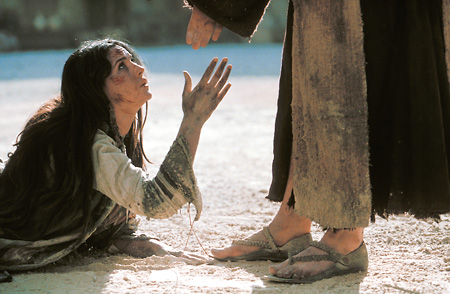
John 8:11 The adulterous woman.

woman-caught-in-adulteryPonder the effect Jesus words and actions had on this woman “caught in the very act of committing adultery…”

She’ll love him, madly. She’ll be crazy about him and dare anybody say a bad word about him in her presence, she’ll defend him, fight for him, tell others about him, speak so positively about him that it’ll be infectious. She’ll give everything for him!

This is what makes a disciple, this concrete experience of the love but particularly the mercy of Jesus Christ.

Now, let’s consider the opposite: What would Jesus have effected in this woman if he’d joined in condemning her?

See the difference?

It’s easy to understand Pope Francis emphasis on mercy, isn’t it?