Tag Archives: Gospel

Fifth Sunday of Easter: Jesus Christ, the joy of Catholicism


"When we pray properly sorrows disappear like snow before the sun"

St. John Vianney: When we pray properly sorrows disappear like snow before the sun.

It’s sometime before his suffering, death, resurrection and ascension.

Thus when he says he’s going away he’s talking about a future event.

It’s most interesting though to observe the meaning he gives to his going away. His going away is not his death, but his death, resurrection and ascension, and in going away he’s not abandoning us.

Thus in the teaching of Jesus Christ death is not the final end event, but part of something much greater. We need to begin to think in this way. For the believer life opens upwardly to the splendour of God. For the unbeliever life (ultimately) must narrow downwardly to the grave!

He is going away (death, resurrection and ascension) “to prepare a place for you…” This is personal.

Have you ever noticed that you can’t really walk in another person’s shoes, that no matter how close you might be to another person, that person is always separate, uniquely other? There’s a sense in which in the end there’s only God and you in the universe!

Jesus promises that after he’s gone (death, resurrection and ascension) he’ll come back to take you with him. It’s so personal.

We tend to think of this returning as death but that misses so much of the picture – most of all it misses the joy at the heart of our religion.

The returning to take us with him is the gift of the Holy Spirit (Pentecost) through whom God enters into our lives, not in the future, but now. We’re taken up into the Divine life. We’re given a “place” in the Divine life. This is what Jesus means when he speaks of “rooms in my Father’s house” – it’s a share in God’s life. Try to imagine what happens when the Divine life begins to enter our lives; a transformation begins. Thus we find the Saints saying things like; “When we pray properlysorrows disappear like snow before the sun.” St. John Vianney. The all powerful God mingles his life with ours – pure joy! 

This is what makes the Catholic. Without Him religion falls flat. In fact, I’ll go much further and say; this is the joy of life, never mind Catholicism!

We don’t inherit the kingdom because we’re good people. We inherit the kingdom because God has given us a place (or room) in his Divine life and God by his very nature can’t be held captive by death.

Fourth Sunday of Easter: Good shepherds or hired hands?

He says he’s the gate of the sheepfold. All others who have come are thieves and brigands.

What is this sheepfold and who are these thieves and brigands?

IMG_1352The very idea of a sheepfold suggests that we do not follow Jesus as individuals in isolation – there’s always Jesus Christ (the shepherd) and the Church (the sheepfold).

The sheepfold is the Church but it’s the Church merging into the kingdom of God. The Church is the gathering of those who’ve entered into the life of God through Jesus – it’s this passing through Jesus that produces the Church.

Jesus describes people who enter in this way as “safe” going “freely in and out” (of the life of God), “sure of finding pasture” – powerfully descriptive words.

There are other people who’ve entered the Church but without entering the life of God. They’re just going through the motions. These are the thieves and brigands – an accusation that’s directed in the first place at the religious leaders of his day.

Catholics, but particularly bishops and priests who maintain the mere external practice of religion without true conversion of heart are thieves and brigands. They usurp the things of God becoming obstacles rather than stepping stones to God. Pope Francis repeatedly warns about the threat such people pose within the Church.

But this problem is not confined to priests and bishops. Few are immune to the trappings of religion without the appropriate conversion of heart. 

Such ‘Catholics’ find life in the Church boring. They’re highly visible at the one-off events, First Communions, Confirmations, there’s an obvious disconnect which manifests itself in distraction. There’s little sense of the sacred, little sense of the presence of the Totally Other. In their distraction they “steal and kill and destroy” the sacred.

Finally, allow me to present you with the ultimate test of the Christian; are you a goodIMG_1356 shepherd prepared to lay down your life for the flock (the Church, God’s people) or are you a hired hand who runs away when the wolf attacks?

The difference, I think, is the gate we’ve used to enter the sheepfold. Have we really come in through Jesus?

Third Sunday of Easter: Christ bestows life on those who love him.

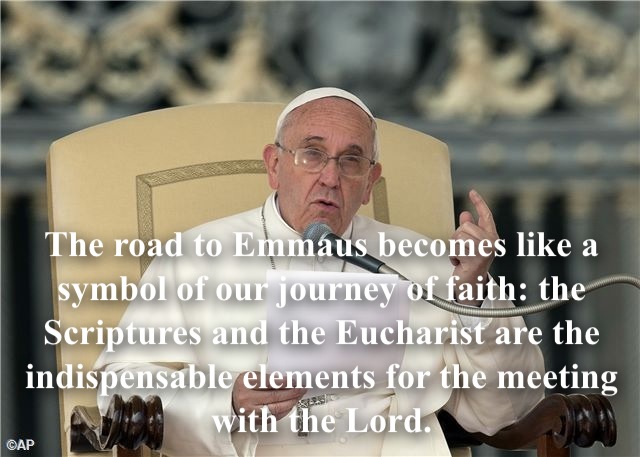
Everything needed to encounter Jesus Christ can be found in today’s Gospel.

Pope Francis, Sunday Homily, May 04 2014

Pope Francis, Sunday Homily, May 04 2014

Three things are needed; the desire for God, the Word of God and the bread of the Eucharist. Pursue the three things relentlessly and I guarantee you, if you’re not a Catholic already, you’ll become a Catholic – you’re inner world will start to resemble the Catechism!

Suddenly Jesus comes up and walks with two of his disciples. 

Significantly, they’re discussing him, his life and the events surrounding his death and reported resurrection. They’re downcast and haven’t yet come to faith describing Jesus as “a great prophet” rather than Lord. 

They’re interested in Jesus. He’s important to them. They’re looking to him and thus he comes to meet them. It’s a two way thing. This is the first requirement – interest, desire, or as Jesus put it, knocking, searching and looking because the privileges of the true Christian will never be disclosed to humankind at large.

Let’s imagine ourselves going for a walk down the promenade (a path on the banks of the River Slaney in Enniscorthy), or shopping, or our life from this moment to the next occasion we’ll gather here; how often is Jesus Christ likely to be the focus of our attention? This is the reason we don’t feel connected to God. Our hearts and minds are somewhere else. Do you know why this happens?

We accept much too uncritically the secular narrative that we need a particular lifestyle if we are to be happy – watch the soaps any evening and you’ll find that there’s a narrative running through them about what brings us happiness. It’s everywhere, it’s rarely challenged and it’s big business! We’re slow to understand that Jesus Christ bestows life on those who love him; a full measure, pressed down, shaken together and flowing over. Grace by its nature is excessive and overflows – it’s missionary!IMG_1202

Now look where he takes them when he begins to walk beside them. He leads them to reflect on the Word of God, the scriptures. This is the second requirement. Read the Gospels reflectively, repeatedly. There our minds will meet the mind of God, our hearts will meet the heart of God and our hearts too will begin to burn within us.

“… he made as if to go on; but they pressed him to stay with them.” They have the desire, they want him! If they’d let him go on, revelation wouldn’t have happened, they wouldn’t have been at the table with him when he took bread and they wouldn’t have recognized him. Imagine how close they’d have been but they still wouldn’t have made it. I’d say we’ve often been that close too!

This is the third and final requirement; the breaking of the bread. Their faith development reaches its climax in recognizing Jesus in the breaking of bread and suddenly he’s gone. Odd that, why disappear just then? Because he’s left them all that they need to find him. He’s left them directions – the Word and the breaking of bread, Holy Mass.

In every Mass two of the three requirements are always present; the Word and the breaking of the bread. But is the third always present; a real desire for Jesus Christ?

Easter Sunday: Without this day death has the last word.

“Why should the privileges of the true Christian be disclosed to mankind at large?” John Henry Newman.

It’s “the first day of the week (Sunday) and still dark” and Mary of Magdala is up early to visit Jesus tomb. Why? Because she loved him. If she didn’t love him she wouldn’t be there.

Finding the tomb empty she runs to find Peter and the other disciple. 

Just a few months earlier Mary of Magdala had a very different set of friends.

“They have taken the Lord” she says, using a title that she doesn’t fully understand. How can he be Lord if he ends in death? Death is Lord then! The only man worth calling ‘Lord’ is the man who overcame death – not some guy who can kick a football or host a TV show!

Jesus has brought them together – but for this man Jesus, Mary of Magdala wouldn’t be running to find Peter and the others. Their love of Jesus has bound them together, given her and given them a new set of friends, a new family – the Church.

Peter, if married, has allowed a new person into his life, a person now as important to him as his wife. Every marriage should have him! Every life!
IMG_1151
They run, they’re full of emotion, it’s a matter of love and BANG they’re allowed to see because they love him.

They see, not everyone sees, only those close to him. The majority are doing their own thing, elsewhere. So it is to this day. “Why should the privileges of the true Christian be disclosed to mankind at large?” John Henry Newman.

Nonetheless –

Without this day we have no future. Just the denial of an inevitable and approaching doom!
Without this day cancer will often have the last word!
Without this day injustice will often have the last word!
Without this day violence will often have the last word!
Without this day evil has the last word!                                                                                           Without this day death, always and without exception has the last word!

Small numbers on Holy Thursday: A return to our beginnings?

Here in St. Senan’s Parish (Enniscorthy) numbers attending the Evening Mass of the Lord’s Supper on Holy Thursday were small.

Generally, blame for this decline is attributed to a discredited Church. But that doesn’t stand up to scrutiny.

Here’s why: The events of Holy Thursday, Good Friday and the Holy Saturday Easter Vigil (and Easter Sunday) are not primarily about the Church but about Jesus Christ and more particularly about Christ’s desire to enter into relationship with humankind. Dare I say it; to save humankind! In summary; it’s about people’s relationship with Christ and the work of salvation.

Therefore, if people’s absence on Holy Thursday night was truly about a discredited Church as opposed to their relationship with Christ then you would expect that large numbers of people found other ways to mark the Last Supper on Holy Thursday night.

But can you imagine large numbers of people in Enniscorthy (or wherever) doing that on Holy Thursday night? Isn’t it much more likely that for the vast majority of people Holy Thursday night was no different to any other night? 

The truth of the matter is that significant moments in Christ’s life (in which he attempts to influence human affairs) have no relevance for growing numbers of Irish people.

Behind the blaming of the Church the real questions are about Christ and his meaning for peoples lives. 

In the failure of many to celebrate Holy Thursday all that’s happening is that Christ is being stripped again, humiliated and rejected. Isn’t it true to say that really it’s not about the Church at all but about taking everything from Christ?

The growing unbelieving world is taking his birthday away from him, making it into something else; likewise his Last Supper, his passion, death and resurrection and if many are not actively taking from him, many are doing it through indifference.

Is this a reason to be discouraged? No. Not at all.

Mother Theresa said; “if you are discouraged it is a sign of pride because it shows you trust in your own powers.” This is God’s work.

IMG_1263We’re merely returning to our beginnings when the vast majority rejected Christ.

But the stone rejected by the builders became the corner stone. He rose again; and he’ll rise again, just at that point when we think all is lost, at that point when it looks like all is lost, as it did in those desolate hours before the resurrection. The future is Paschal.

It does mean however that the Church must radically change how we do things. In the towns and cities we need to move out from the security of our Church buildings. Pope Francis suggests we need to rent a garage or a shed in the densely populated areas and put a priest or a catechist there, celebrate Mass there.

Pope Francis calls this putting things in a missionary key.

Finally, there’s another name for how Christ accepts, embraces and transforms all this IMG_1222rejection of himself – it’s called mercy.

We need to trust it … we’re certainly not going to defeat it! 

Jesus has a great big heart! Reflections for Holy Thursday and Good Friday.

Jesus has got a great big heart!

One of the biggest problems within Catholicism is that we’ve watered down Christ and the Gospel so that more often than not we’re like the man who started to build without first sitting down to work out the cost to see if he had enough to finish the job. When he can’t finish he becomes a laughing stock (Luke 14:28). The result is a city (Church) that always looks half-built, or less than half-built – or like a ruin and the object of ridicule!

The first meaning of Holy Thursday is service – love.

Most of us have grasped that Christianity (therefore Catholicism) is about service – but Jesus has got a great big heart and his understanding of service is considerably more than giving a few hours here and there. It’s nothing like reaching a realization that life has been good so I’ll give something back. As good as that is, it’s not the message of Jesus.

Jesus asks that we lay down our lives! Believe it or not, only then will we know the joy of the Gospel.

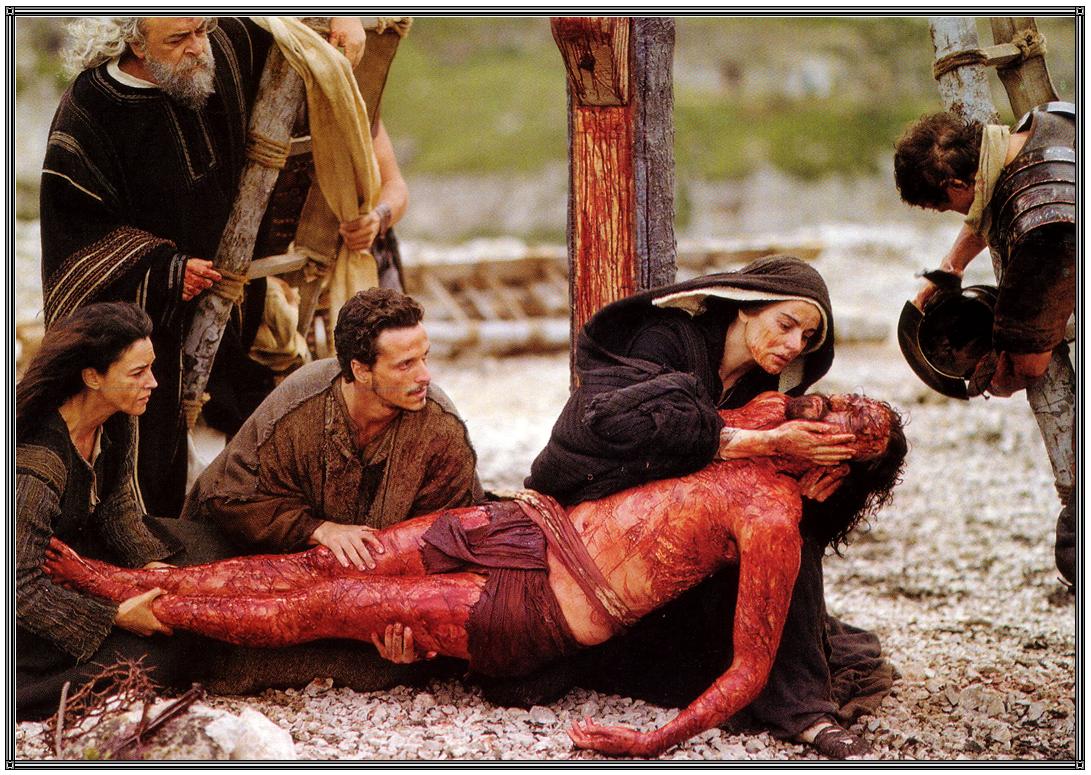
In the aftermath of Good Friday the disciples will remember the washing of the feet and begin to see it not just as a general call to service, but also as pointing to the greatest service known to humankind; Jesus’ suffering, death and resurrection in which men and women are washed clean of sin (in his body and blood).

What does it mean to be washed clean of sin?

I did not die on the Cross for you to bear the burden of your sin.

I did not die on the Cross for you to bear the burden of your sin.

It means that Jesus didn’t die on the Cross for you and I to bear the burden of our sins. I’d like you to really think about that, meditate on it… St Paul says “that for someone really worthy, a man might be prepared to die – but what proves that God loves us is that Christ died for us while we were still sinners.” (Romans 5:7). A parent might be prepared to die to save the life of a son or daughter, but would you be prepared to die for a notorious criminal?

So instead of condemning the already condemned man, like we often do, Jesus does the opposite, he seeks to take the condemned man’s place in prison, or in the electric chair, or wherever! What do we think he’s doing on the Cross?

Can you see it?

At once he identifies with both the guilty and the innocent, guilty perpetrator and innocent victim. So whom exactly is Christ excluding? Nobody. Awesome!

I want you to see something else. Jesus never says wrong is right or right is wrong, he upholds a moral standard that applies to and judges all men and women, but instead of condemning those who fall short, what does he do? He lays down his life, literally, he offers his body and blood that they might be saved (which itself implies ultimate Justice) which is the exact opposite of what so many Catholics have done in recent years – they’ve run away believing that righteousness is on their side. This is not the path of Christ. Followers of Christ redeem with their lives! They become like Christ – hung among thieves!

Of course, all this implies that there’s ultimate justice; a final putting to right of wrongs. Indeed, mercy is justice transfigured by love. Unless we want to live in a meaningless universe, this is how it has to be!

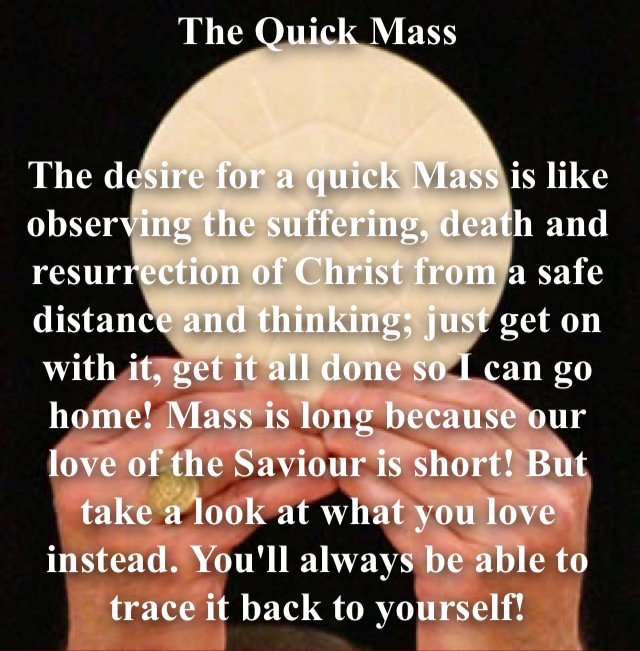
Mass is long because our love of the Saviour is short!

Mass is long because our love of the Saviour is short!

The second meaning of Holy Thursday is the Eucharist – Holy Mass. The Last Supper is the DNA of Holy Mass. Jesus identifies his body with bread and his blood with wine. Try to capture something of the intensity with which Jesus took the bread and wine and offered it to his disciples. He knew he was ‘going away’ and he was giving them the means by which he’d stay with them. Catholicism is not primarily a moral code, an ethical system, it’s a person; Jesus Christ, who offers himself to us in Holy Mass; his life, body and blood, soul and divinity, his suffering, death, resurrection and glorification – everything.

The third meaning of Holy Thursday is the priesthood, but priesthood as being like Christ, as laying down your life, as the literal offering of your body, the pouring out of your blood, the willingness to exhaust yourself on behalf of God and man, to give everything, not a few hours here and there, to hold nothing back, to have no ‘me’ and no ‘mine’, only to have Him!

Because if you have Him you have everything. And you know what? He’s worth it!

Fifth Sunday of Lent: Life without death would drive us mad!

IMG_1197As we approach Easter, appropriately enough, the question of death and resurrection surfaces.

So what does Jesus teaching around these issues look like?

Well, from today’s Gospel we’ve got: “If anyone believes in me, even though he dies he will live.” I’d like you to note something – even though he dies he will live. I’m placing emphasis on; even though he dies. What’s the alternative?

From elsewhere we find Jesus attempting to open the hearts and minds of the people to something greater: “Do not be afraid of those who kill the body but after that can do no more.” Luke 12:5

It’s a crisis situation. Lazarus is seriously ill. There’s a level of panic – family and friends need to be informed. Among Lazarus’s close friends is Jesus and so they send for Jesus – the man you love is ill, come quickly. Quickly – because if you don’t hurry he’ll be dead!

Yet Jesus doesn’t respond with any sense of urgency – he obviously doesn’t view death as the absolute human disaster – and doesn’t depart until two days later and by the time he arrives Lazarus is already dead for four days. When he arrives both Martha and Mary ‘mark his card’ so to speak: “If you had been here our brother would not have died.” Isn’t this the accusation that man fires at God all the time?

Martha and Mary have faith in Jesus – the faith comes from their close friendship. But while they have faith, it is faith that still has to grasp the full meaning of Jesus Christ and the human person, i.e., the immortality of the soul.

This is the big one – if Jesus can’t overcome death he’s useless to them – and to us!IMG_1160

Yet this is not Jesus definitive act. He calls Lazarus from the dead, gives him back to Martha and Mary, and we can only imagine the excitement of life in the years thereafter … until next time! Lazarus gets to die twice! Lazarus resurrection is not true resurrection, it’s unfinished business.

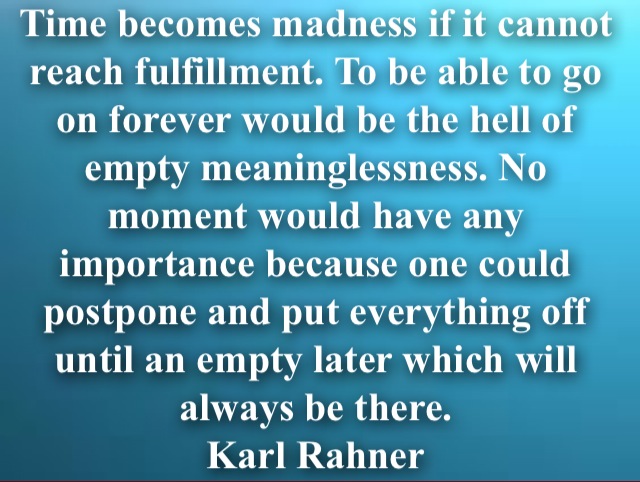
Try imagining life without death. “Time becomes madness if it cannot reach fulfillment. To be able to go on forever would be the hell of empty meaninglessness. No moment would have any importance because one could postpone and put everything off until an empty later which will always be there.” Karl Rahner.

IMG_1180

Karl Rahner with Joseph Ratzinger

Lazarus resurrection is a very poor reflection of Jesus resurrection, a dim reflection of Easter. Jesus resurrection is very different. After rising he’s no longer bound by time and space and he doesn’t wander aimlessly about the earth looking for meaningful employment! He ascends. There’s completion, fulfillment.

Death, in a truly Christian understanding, far from being the absolute human disaster, is the gateway to fulfillment, to completion. If you and I could go on without death we’d go absolutely mad! We’d choose death in sheer desperation!

“If anyone believes in me, even though he dies he will live.”

Fourth Sunday of Lent: The blind man; victim of God’s love and man’s unbelief.

Jesus came into the world to separate those whose blindness is curable from those whose blindness cannot be cured because they presume themselves to be healthy. Pope Benedict XVI 

IMG_1112

John 9, The cure of the man born blind

Sometimes religion can be blind!

On the human level the man can see for the first time.

But the miraculous restoration of the mans sight has another layer of meaning. This healing is not just about restoring a man’s eye sight, it’s about recognizing the true identity of Jesus and as a result becoming a missionary. It’s impossible to discover the true identity of Jesus and keep it to yourself!

As events unfold it’s clear that the blind man’s healing is pushing the people involved to the point where they must make a decision about Jesus, about his identity. But they don’t want to go there even though they’re religious people and willing to argue about it. “We have just enough religion to make us hate, but not enough to make us love one another.” Johnathan Swift. They’re like children kicking, screaming, resisting! The majority just refuse. No, we’re not moving. “Nobody who has been drinking old wine wants new” Luke 5:39. This is a real danger for religion and religious people – that we do not press on.

The blind man quickly begins to see beyond his physical healing and in this sense ‘to see’ means to come to faith in Jesus which is what happens. He pressed on. Through his encounter with JesusIMG_1113 the blind man comes to faith, step by step, it’s a gradual development, from describing Jesus as “the man” to “prophet” to “Lord”, and his journey to faith happens while he’s being questioned – interrogated – to the extent that he has to defend himself, and in fact he ends up defending Jesus! He’s even abandoned by his family. Once questioned his family quickly distance themselves from him. This hostile engagement on the front-line is such an important part of growing in faith. When did we engage in it last?

The blind man becomes something of a victim because Jesus restored his sight. He becomes a victim of God’s love and man’s unbelief. Spiritually, God’s love is a wound that never quite heals until it can reach fulfillment.

See, he becomes a missionary in sharp contrast to the people around him. There is a reversal of order at work here that’s classic Jesus shock! The blind man can see while those with sight can’t see at all! He who is last is now first, and the first are rapidly becoming last. As religious people we need to make sure it doesn’t happen to us!

As events unfold the blind man gets increasingly bold. He just gets fed up with their unbelief and becomes incredulous towards them, almost ridiculing them: “Now here is an astonishing thing! He has opened my eyes and you do not know where he comes from!” I’ll paraphrase that – he’s looking at them and thinking; what kind of fools have I got here that they can’t work this out?

Why couldn’t they see? What stopped them looking at the facts and reaching the obvious conclusion? Why couldn’t they reach the point where with the ‘blind’ man they too could say; Lord, I believe, and worship him?

John Henry Newman

Of course they could see, but they didn’t want to see, and thus refused to see, because seeing would mean having to change their lives. “Nobody puts new wine into old skins; if he does, the wine will burst the skins, and the wine is lost and the skins too. No! New wine, fresh skins!” Mark 2:22

Time to change our lives?


IMG_1138


Third Sunday of Lent: A lesson in evangelization, a lesson in love.

The Samaritan woman represents the existential dissatisfaction of one who does not find what he seeks. She’s had “five husbands” and now she lives with another man.” Pope Benedict XVI

John 4: 51-42. The Woman at the Well.

Once again Jesus uses something very ordinary – water – to teach us about God and God’s desired relationship with us.

First thing to note: Jesus has gone out, he’s in hostile territory: “What? You a Jew and you ask me, a Samaritan, for a drink?” We need to move out from the security of our Church buildings too!IMG_0947

Now the woman could be any woman here (or man). She’s busy with her life doing something that’s life-essential – drawing water from the well.

But watch what happens as she meets Jesus – in the end she’ll put down the water jar and go and tell her friends about the man she’s met. She becomes a missionary. If it happened here in Enniscorthy some might say she’s turned into some kind of religious nut!

First she doesn’t get it: “You have no bucket, sir, and the well is deep; how could you get this living water?” She’s thinking in terms of water (her earthly life) but he’s talking about himself as “living water” (human fulfillment, which she’s so close to – she can actually reach out and touch God physically yet she might never meet him and know only the joys of this world). Notice too that she calls him “sir” rather than Lord – her journey will be from “sir” to Lord.

IMG_0935She gets there gradually, in stages, slowly discovering the full identity of Jesus on a one to one basis. It’s personal, one to one, the heart of God meets the heart of a woman and revelation occurs gradually.

Lesson – We must meet him personally. We must converse with him, if we do, he’ll change our lives.

Suddenly, as soon as the woman asks for “that water” Jesus asks her to call her husband – watch where this is going – and she replies “I have no husband” to which Jesus responds; “although you’ve had five (husbands) the one you have now is not your husband.” Classic!

Remarkably, she doesn’t protest, clearly she’s got some awareness of a religious understanding of marriage which Jesus affirms as God’s understanding of marriage (as opposed to the cultural understanding). She also acknowledges the expectation of Messiah.

Of course, nowadays we’d probably tell Jesus off and shout discrimination!

But she humbles herself, submits to a higher power and order, accepts the reality of sin, and he brings her forward. She meets the tender embrace of Jesus’ heart – mercy – always available to us in Confession. What if she’d gone the other way?

There’s one final detail I’d like you to notice. She brings the town to see Jesus –  the town asks him to stay – and when they too have encountered him they say something that we all need to be able to say:

“Now we no longer believe because of what you told us; we have heard him ourselves and we know that he really is the saviour of the world.”

A Lenten exercise inspired by St. Patrick.

Homily Notes. Luke 10:1-12,17-20

Today’s readings are about bringing Jesus and the Gospel to others – going out. The psalm captures it well: Go out to the whole world; proclaim the Good News.

Today’s Mass Preface tells us that St. Patrick did just that:

For you drew him (St. Patrick) through daily prayer
in captivity and hardship
to know you as a loving Father.
You chose him out of all the world
to return to the land of his captors,
that they might acknowledge Jesus Christ, their Redeemer.

We all need to be a little bit like St. Patrick.

However, I’m always amazed by our reluctance to be missionaries – by the ability of the baptised to place the Church outside themselves.

Why did he baptise you (he – meaning Christ)?

He wants you to be his missionary, his eyes and ears, hands and feet.

We need to get this – as God’s baptised we no longer represent ourselves and our own interests, we represent Jesus Christ and the kingdom of God. In every encounter, in every person we meet, in every transaction, in every detail of our lives you and I represent Christ.

IMG_0746We’ve got to take this call seriously – don’t wait for others, not even me!

So let’s do something really practical. This week, pick one day, and deliberately represent Christ in every detail of your day. Focus on it – you’re no longer just working for yourself or your employer, you’re working for Christ.

Say to yourself: Today, I represent Jesus Christ and the Gospel.