Briefly, we’ll look at just two of the seven gifts of the Spirit – it’ll give us an idea of how important they are.
Perhaps during the week the parents – teachers too – might adapt or simplify my words and engage the children with the ideas I’m presenting.
Firstly, Wisdom; what’s that? Firstly, it’s a gift of the Holy Spirit. Therefore it doesn’t belong naturally to human nature. It’s a gift given by the Holy Spirit and when we receive it, we know (instinctive-like) that it’s in the spiritual life and not in health and wealth that we find lasting security. Those who don’t have the gift will naturally look for their security in everything from health to wealth.
Secondly, Understanding; what’s that? When we receive the gift of understanding we penetrate the truths of our faith. As we receive it we move from faith into certainty. Those who do not have the gift are always unsure, wobbly, blown this way and that, they lack conviction about God.
The gifts make a big, big difference. They’re synonymous with the spiritual journey into God (synonymous = equivalent in meaning, expressing the same idea). The gifts of the Spirit are the road into God.
Now, tell me, how many of you guys just want to get this part (Mass) over with?
Well, to be honest I was like that when I was your age. And I stayed like that through most of my teenage years.
Until one day in 1983, the 19th of July – I will never forget the day – I was at home with my father. There was a fire and tragically later that day my father died.
Now apart from the grief, something else happened. I started to ask serious questions about the meaning of life. That one event, and the questions it surfaced within me, changed the whole course of my life.
I believe we’re offering you answers to questions that most of you haven’t even started to ask. (I’m in favour of Confirmation at a later age!)
So the ‘Spirit’ team has produced a programme to give you a good experience of Confirmation in the hope that when (and if!) you do begin to ask the deeper questions, you might remember this positive experience of Confirmation and return to look in more detail.
Meanwhile, some things I’d like you to know and remember. I would like you to know that it’s in the spiritual life – the spiritual life is our life with God – that you will find true and lasting security.
If I could I’d love to spare you the futile effort of trying to find lasting security in this world, in just about everything from health to wealth.
I would like you to know that there’s no difficulty in life that can’t be overcome by spiritual growth.
I would like you to know that every challenge, every difficulty – even if it looks like there’s no way out – every suffering, every sickness is a call to spiritual growth; that it doesn’t have to end in meaningless despair.
Even if you make a complete mess of your life, I want you to know that the mess is nothing more than God’s way of calling you to spiritual growth, to do things differently, to do things his way.
No matter how many times you fall, no matter how many times you fail, remember, every fall, every failure, is God’s call to spiritual growth.
Finally, the gifts of the Holy Spirit, like Confirmation itself, like all the sacraments, belong to the spiritual life and it’s there – and only there – that we receive them.
So, do you have a spiritual life? Yes? No? No! I’m going to be really cruel to you; then what are you doing here?
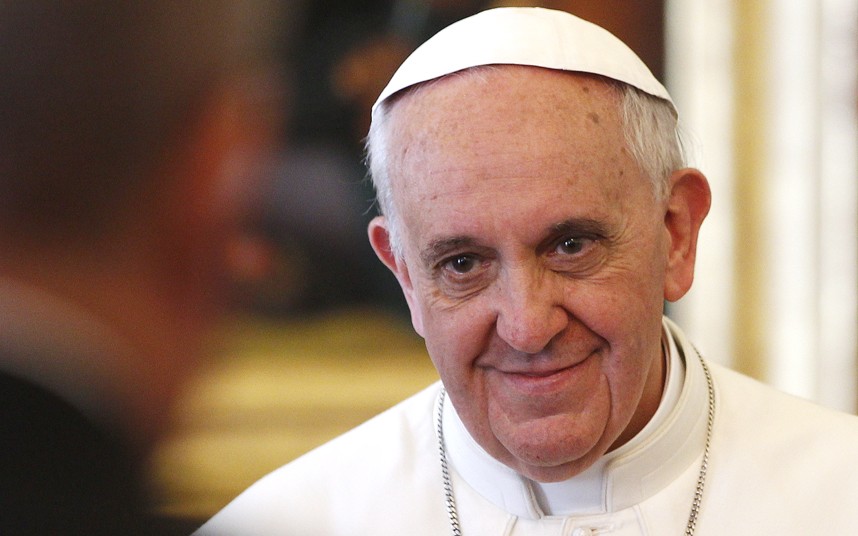
Click the video links below for a summary of Pope Francis’ catecheses on the gifts of Wisdom and Understanding. (Credit: Rome Reports)
We’re asking you today to witness to the Spirit. Actually, that’s not right. You’ve chosen this, didn’t you? So you’re telling us that you’re going to witness to the Spirit.
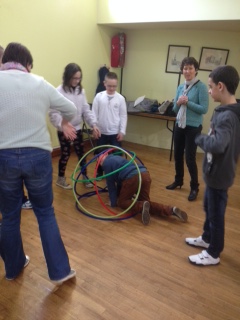
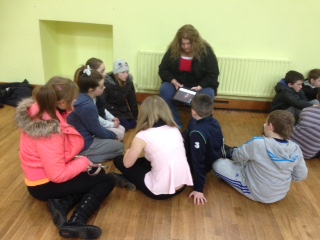
‘Spirit’ Workshop No. 2. Candidates for Confirmation viewing video footage on an iPad of how people witness to the Spirit.
The visit of Annette McCarthy to the school on Friday together with the workshop this morning will have given you real examples of witnessing to the Spirit.
Here’s another way that you might witness. Sometimes as people get older they can become invisible. People don’t see them any more. So, here’s what I want you to do. You can make older people visible – all through your life – by just smiling and saying ‘hello’.
Still, I do not want you to get the idea that witnessing to the Spirit is just about being a ‘good’ person or a ‘nice’ person. Sometimes even our goodness is a witness to ourselves rather than God, my spirit rather than God’s Spirit, and merely carries the mask of witnessing to God. This – reducing Christianity to being a ‘nice’ person – is something we’ve been doing within Catholicism for most of my lifetime, and it’s directly related to the slow decline of Catholicism.
Catholicism is first and foremost a well-trodden path to a real and ongoing encounter with God. This ongoing encounter with God is what gives our lives joyful and lasting security. This is basic Jesus-speak! He never tires of telling us things like “…a man’s life is not made secure by what he owns even when he has more than he needs” and “Fool! This very night the demand will be made for your soul; and this hoard of yours, whose will it be then?” (Luke 12:15, 12:20)
There’s a desperate human need portrayed in today’s First Reading (Job 7:1-4,6-7), the kind that must surely precede suicide. There’s similar human need portrayed in today’s Gospel (Mark 1:29-39) but in the Gospel the need encounters Jesus Christ and is transformed. I heard an elderly man say recently – a man who’d lost both his wife and his son – “Life? It’s nothing in the end!” He’s right. Without Jesus Christ, it comes down to nothing in the end. It’s the encounter with God that causes us to witness. Witness is not a dry demand!
This encounter with God is not imaginary. Its development is marked by clearly defined stages, every bend on the road to God, every junction, every cul-de-sac, every obstacle, and every contour is documented. Catholicism is first and foremost a ‘how to’ manual, how to encounter God, and for the purists it’s an experiential ‘how to’ manual produced by God. So, before you walk away from Catholicism, read the life of at least one saint. It’s an interesting question to ask those who’ve already abandoned Catholicism: Did you read the life of at least one saint before walking away?
So, I do not want to be asking you to witness to a Spirit that you do not know. That’s to do violence to you. We can only witness to God’s Spirit to the degree that he’s present within us.
When we try to witness to Gods Spirit when he’s not inside us – when he’s not a real living force in our lives or when he’s diminished to the bare minimum for human life – we get fed up, bored, we fall away, and worse, we may even resent this imposition. Religion without the Holy Spirit quickly becomes a burden and even tyranny!
Sooner rather than later, our actions will always harmonize with what’s inside us.
I’ll give you an example using one of the gifts of the Spirit: Piety, or as you’d call it; Reverence.
Piety (Reverence) is a gift of the Holy Spirit which means that it doesn’t belong naturally to human nature. It’s as it says on the tin – a gift of the Holy Spirit. It’s an instinctive-like affection for God that makes us desire to worship him. Pope Francis described it as indicating “our belonging to God and our profound bond with him, a bond that brings meaning to our lives.” He said this bond is not “a duty or an imposition” but “a living relationship with the heart… our friendship with God, given by Jesus.” (Catholic World News, June 04, 2014). Where it is present religion is never boring, where it’s absent everything about religion is boring!
So, the gift of Piety (Reverence) alone, or its absence, can explain so much about our behaviour around religion, about how we witness, or don’t witness!
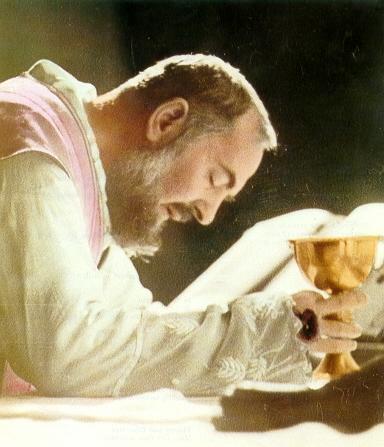
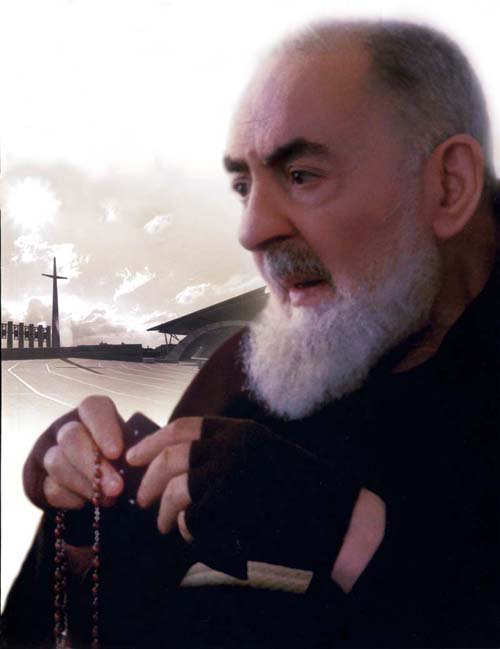
The struggle between Pio and Satan became more difficult when Pio freed the souls possessed by the Devil. Pio recounts being physically beaten! Father Tarcisio of Cervinara said, “More than once, before leaving the body of a possessed, the Devil has shouted, “Padre Pio, you give us more trouble than St. Michael”; also, “Father Pio don’t steal the bodies from us and we won’t bother you.”
This weekend we begin the Confirmation ‘Spirit’ Programme. We’re beginning with the Gifts of the Holy Spirit.
The purpose of the gifts is to make us holy, like God. They’re the means by which God draws us into his own life, the Divine life.
Some of us will know them, particularly those of us of a certain age – we were taught them ‘by heart’ as we used to say. My mother can still list them – at 83 years. We’ll look at just two, briefly, the first two, Wisdom and Understanding.
Wisdom; what’s that? Firstly, it’s a gift of the Holy Spirit. Therefore it does not belong naturally to human nature. It’s a gift given by the Holy Spirit and when we receive it, we know (instinctive-like) that it’s in the spiritual life and not in everything from health to wealth that we find lasting security. Those who don’t have the gift will naturally look for their security in everything from health to wealth.
Understanding; what’s that? When we receive the gift of understanding we penetrate the truths of our faith. As we receive it we move from faith into certainty. Those who do not have the gift are always unsure, they always lack conviction.
Now, the thing about the Gifts of the Spirit is that they can be difficult to understand. If you go looking for an explanation you’ll find multiple explanations, nearly all different, or at least they appear to be different.
Here’s the reason. The gifts come from the Holy Spirit. Therefore they’re supernatural. They’re not naturally part of human nature. We’ve almost lost this sense. This is the root of the difficulty with explanations. The gifts are known only by experience and cannot be really known outside the spiritual life and spiritual growth. So our understanding of the gifts tends to reflect the point where we stand on the scale of spiritual growth. That’s the reason we get so many different explanations.
Overall, in my lifetime, there’s been a tendency to reduce the gifts to the purely natural. I think this reflects the decline of Catholicism generally.
“The devil can confuse the most brilliant mind.” Padre Pio
Now, similarly – and this is the point I want to make about today‘s Gospel (Mark 12:21-28) – spiritual evil, both satan and unclean (evil) spirits, cannot be understood outside the spiritual life and spiritual growth.
The essence of the spiritual life is the death of self. This is the reason true religion will never be popular. The death of self is the last thing we want to hear and we ‘naturally’ fight it all the way, sometimes spending a fortune trying to avoid it! As John the Baptist said; “I must decrease and he must increase” (John 3:30). Here’s the point: Only when we’ve spiritually advanced to the point where we’ve truly died to self and started living for God alone, only then will we come face to face with spiritual evil. Only then will satan and the unclean spirits manifest themselves directly to us and become a part of our experience. It is spiritual maturity – a full complement of the gifts of the Holy Spirit – that forces satan out of the shadows, “What do you want with us, Jesus of Nazareth? Have you come to destroy us? I know who you are: the Holy One of God.” Satan was always there, hidden, unseen, but now holiness forces him out. If only Jesus could get the same recognition from us!
So, we’ve looked briefly at both ‘extremes’ if you like, the Holy Spirit and the gifts of the Spirit on the one hand, and satan and the unclean spirits on the other, and we’ve seen that our understanding and knowledge of both is determined by where we stand on the scale of spiritual development.
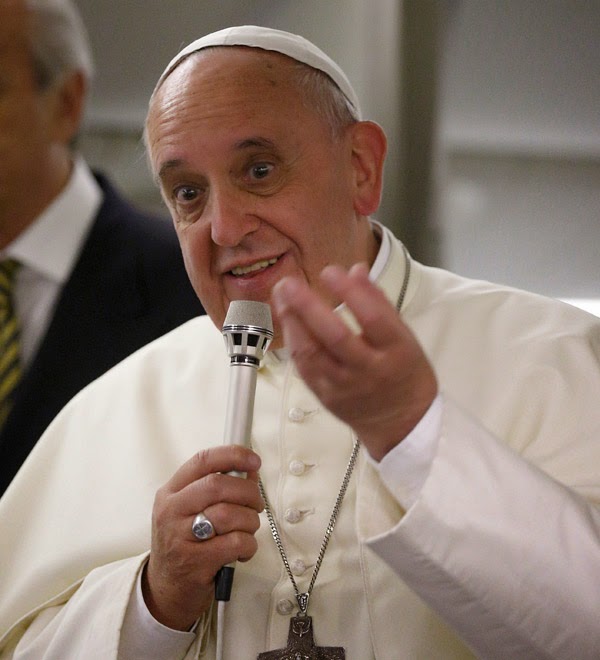
“It (celibacy) is a rule of life that I appreciate very much, and I think it is a gift for the church,” Francis told reporters aboard a plane returning to the Vatican. “But since it is not a dogma, the door is always open.”
Of course the lady is correct. Celibacy is a discipline, not a dogma. There is evidence to suggest that at least some of the apostles were married. Indeed my lady friend reminded me that Jesus had cured Peter’s mother in law, so Peter was married (Matthew 8:14). But there’s another possible interpretation open to us here. Peter’s mother in law, now enjoying full health, starts to wait on Jesus in Peter’s house. Doesn’t that seem odd? It’s Peter’s mother in law rather than his wife that waits on Jesus. Where is Peter’s wife? Perhaps she’s out somewhere. But there’s another possibility; Peter was widowed at the time of Jesus call. It’s another possibility.
It’s important too that we take note of the apostle John. We know he was celibate and that he seems to have held a special place in Christ’s heart, perhaps due to his celibacy. At any rate, we’re told repeatedly that he’s the one Jesus loved (John 13:23), and as Christ was dying it was to John that he entrusted his mother (John 19:26).
My lady friend’s argument follows the familiar logic; the apostles were married so therefore priests should be allowed to marry. For many people this historical fact is all the proof needed to abolish compulsory celibacy. But there is another perspective, that of the teaching of Jesus as recorded in the Gospels. The teaching asks serious questions of married apostles and possibly even prevails over the practise.
In the Gospels we discover Christ’s call to a radical discipleship, Mark 10:21 “There is one thing you lack. Go and sell everything you own and give the money to the poor… then come follow me.” It’s a call the apostles heard and embraced, some of whom were married, others unmarried. The Gospels suggest that the first apostles were extremely challenged by Christ and if we accept the Gospel accounts of Christ’s teaching then there’s little doubt that the apostles themselves, both married and unmarried, must have understood that Christ’s call to self denial extended even to marriage, “… there are eunuchs who have made themselves that way for the sake of the kingdom of heaven.” (Matthew 19:12)
In fact, based on the evidence of Christ’s own teaching in the Gospels the first married apostles must have felt challenged about their married status. I’d go so far as to say that they even felt disadvantaged! This is not conjecture. The evidence indicates that this is exactly what happened. In the teaching of Christ and consequently in the early Church the practise of celibacy and virginity was highly valued, “what about us? We have left everything to follow you… I tell you there is no one who has left house, wife, brothers, parents or children for the sake of the kingdom of God who will not be given repayment many times over…” (Luke 18:28, Matthew 19:29). No wonder it was valued! But something even more significant happened, married couples, responding to the teaching of Christ practised continence within marriage, among them there were surely some of the apostles.
So it’s much too simplistic and even misleading to argue that the apostles were married so priests should be allowed to marry. The historical reality is much more nuanced than that.
Life went on after Christ and the Church developed. There are major figures, none more so than St. Paul, a strong supporter of celibacy, 1 Cor 7:32-35. In fact, this is a feature of the first millennium. There is no proper law of celibacy. Instead, the significant figures in the Church tend to recommend celibacy. Generally, the important figures in the early Church together with the higher members of the clergy practised celibacy.
So the picture is one of married and celibate priests, in tension to some degree, but it’s necessary to concede that it’s Christ’s radical call heard in the Gospel that’s causing at least some of the tension, “If any man comes to me without hating his father, mother, wife, children… he cannot be my disciple” (Luke 14:26). It should go without saying – but I’ll be cautious – that there are other factors at work in shaping these developments, not least a rejection of the goodness of human sexuality, a certain disdain for the sexual that had pockets of support but usually ended in heresy.
Eventually celibacy became compulsory for priests in the West. It’s with glee that some people point out that this happened because the Church didn’t want to lose its property to priest’s families. This may be true but it’s certainly not the complete truth. It conveniently ignores how celibacy and virginity never disappeared, and how the practises were highly valued by Christ, and by the Church from the very beginning, and how they are rooted in the call of Jesus Christ to leave everything and follow him.
There’s one further nuance that’s necessary to note. In the 11th century the Church split between East and West – temporarily – but reconciliation would bring with it two different traditions regarding celibacy. The Eastern Orthodox Church kept their tradition of a married clergy. But even this is nuanced; a single man cannot marry after Ordination, and to this day bishops in the East are drawn only from the celibate priests. So the tension between the historical practise of married apostles and priests, and the radical call of Jesus as recorded in the Gospels remains evident.
In conclusion we can argue:
1. Celibacy is a rejection of the sexual and it’s goodness.
2. It’s a kind of ‘spiritual worldliness’ on behalf of the Church. It’s about the Church protecting its assets.
3. It’s a response to Christ’s call to leave everything.
Take your pick.
Then ask yourself why you’ve made that particular choice?
If you think there’s an element of all three, to which of the three should we give precedence?
Me? I go with the call to leave everything although I’m not particularly good at it!
“Every child has the right to a mother and a father and, as much as possible, the State should vindicate that right. That is a much more important right than that of two men or two women having a family” Minister Leo Varadkar, Dail Eireann, 27 January 2010.
The question of same sex marriage can be very personal and highly emotive. Indeed we all probably know same sex couples, perhaps family members and friends. When I think about this issue I think of a very close homosexual friend of mine and I’m always terrified of hurting him. The explosive word in this debate is ‘homophobia’ and while phobia is generally associated with fear, in the context of homophobia it’s more often associated with hate and violence and therefore lends itself to being used disingenuously to close down debate. It happens. Nonetheless we need to acknowledge that homophobia exists and that homophobes need to get over themselves! Every human being – without qualification – should be treated with “respect, compassion and sensitivity.” However, for the vast majority of people this is a matter of conscience – on both sides.
“It is unhelpful in the extreme to cite Church teaching on homosexuality. Some of us are not aligned with any particular Church and the specifics of faith based objections to homosexuality tend to muddy the waters with regard to the debate about redefining marriage. All arguments against redefining marriage have got to come from a place that finds a universal and empathetic source. That source being genuine concern for the public policy and societal changes that will follow when a child centred, social institution is altered in a way that will lead to severing of natural ties and obscuring kinship bonds.” Kate Bopp. Kate says that her own value system is based in agnosticism.
We’ll begin by exploring marriage as most of us have known it, but although this is clearly a Catholic blog we’ll work independently of all religious argument. It’s something of a surprise to most people to discover that Catholicism argues in the first instance from nature and reason, and only then appeals to revelation. So there will be no religious arguments. We’ll then move on to ask an important question; what’s our understanding of marriage? If we can answer this question I think we’ll go a good way to understanding why some people are for and some people are against the equality of same sex marriage. So we’ll try to tease out our understanding of marriage by considering the characteristics of marriage. This seems to be a reasonable way to proceed.
Traditionally a man and a woman met, they married and then started a family. Nowadays a man and a woman meet, they’ll often have a child or two and some years later they might marry. Now I’ve simplified it somewhat but I’m sure you can see that essentially we’ve reversed things, turned things upside down and inside out!
Now, the thing about traditional marriage – and this might surprise you; it was pure genius. At some point in history, probably to do with the influence of the Judeo-Christian religion – but as we’ll see this influence is itself based on something a priori – marriage brought together some important details about human life, and it brought them together in the interests of the common good. This bringing together in love and the common good is the essence of marriage. The details are just there, staring at us. The most obvious detail is that the human being comes in two different shapes, male and female, and yet the shapes fit together – the sheer brilliance of nature – and when they fit together one of them will occasionally come away carrying a new and unique human life, another human person whom she’s able to nurture and feed – he cannot do this in the same way. It assumed into itself the fact that one shape can never do some things while the other can, but that both shapes working together can often do everything, that the shapes are very different but nonetheless absolutely complementary. It brought into itself the realization that this shape thing wasn’t just physical but went much deeper, that it’s also psychological – men are from Mars, women are from Venus – a woman isn’t a man and a man isn’t a woman, a father isn’t a mother and a mother isn’t a father yet each complements the other.
It brought into itself an important truth about human life; no other species requires the best part of twenty years to grow up, to reach maturity (some of us never quite get there!) – a fragile task fraught with dangers – and traditional marriage saw much wisdom and indeed nature’s hand in making child-rearing a shared responsibility, ideally the shared responsibility of the child’s biological father and mother who provided the child with the secure home of their married love, “’til death do us part.” Most importantly traditional marriage incorporated and made tangible the belief that children should never be deprived of the unique and important roles of a mother and a father, never, ever, where possible. It brought together all these strands of human experience and more, physical attraction, sexual attraction, companionship, friendship and much more, and brought it all together into a unified whole – marriage; it was pure genius.
Pure genius or otherwise the belief that the traditional family is the ideal place to rear children, while never unproven empirically, and not likely to ever be unproven, has been slowly eroded culturally. In effect what we once brought together in marriage we’re now pulling apart; sex from marriage, sex from love, sex from babies (conception), sex from male and female complementarity, love from commitment, children from biological fathers and mothers. It’s not so much that we’re turning marriage upside down and inside out, rather, as Rabbi Sacks suggests, we’re pulling it apart. The reason we’ve developed in this manner is that we now have a greater emphasis on me and my personal satisfaction, so that everything is expected to serve me, including marriage. This emphasis expresses itself concretely as ‘choice’ – the freedom to choose. While choice is undoubtedly a good thing, we need to remember that a choice, indeed every choice, is only as good as the process used to make it.
We’ve been eroding the significance of marriage for most of my lifetime, pulling it apart, so it seems only logical that at some point we’d start pushing it this way and that way, adding additional parts, omitting other parts, putting parts together, according to choice, choice that’s guided by nothing more than love, romance, and equality. It’s not surprising then that we’re now pushing marriage to include equally two men or two women. Soon we’ll start pushing it in other directions. Why not? If marriage means nothing more than love, a little romance, and equality, then a bisexual person who loves a man and a woman at the same time has a right to marry both. Why not one man and two women or vice versa? If marriage understood as love, romance and equality, and nothing more, doesn’t amount to a redefinition of marriage, then what in the world will?
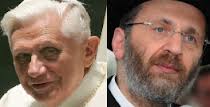
Pope Benedict described as “profoundly moving” Rabbi Gilles Bernheim’s essay “Gay Marriage, Parenthood and Adoption: What We Often Forget To Say” but later Rabbi Bernheim was discovered to have ‘borrowed’ some of the material for his essay and had to resign his position as the Chief Rabbi of France. The essay explored the ideas I’ve touched on here.
While many proponents of same sex marriage view it as a unique issue, a simple matter of equality, for many others it’s part of much bigger development, that of gender ideology. Gender ideology means that I choose whether I want to be male or female, and I can change at any future point if I so choose. There are no givens anymore. Male and female are not given by nature; they’re choices. It’s as if the human being has detached from nature, at least in his or her mind, as though the human species is no longer an integral part of nature but stands outside it. This is all the more remarkable in light of ecology, as if the human species alone stands beyond all ecological concern. Can we really do this? I expect Pope Francis will have something to say about this in his next encyclical.
It’s quite possible that ultimately this unraveling of traditional marriage might bring us, not just to something like the perceived paradise of marriage equality, but to the complete removal of marriage and traditional values from society. A long shot, perhaps. Still, I’m sure we have takers for it? At any rate, I suspect we’re not redefining marriage because the family has changed – nobody denies that – we’re attempting to redefine marriage because we no longer understand the meaning of marriage in the first place.
We move on now to explore the meaning of marriage. It’s this, our understanding of the meaning of marriage, that’ll determine how we vote in the referendum. It’s here that we find the fault line.
The obvious characteristic of marriage is love. We all agree on this much; marriage is about love. We might qualify it by saying “’til death do us part, for better or for worse, in sickness and in health.” For some people that’s all there is – the question is answered. Marriage is about love, and this referendum is about the equal right of same sex couples to marriage, nothing more and nothing less, so there’s no basis to oppose the equality of same sex marriage. People shouldn’t be denied a shot at happiness. Many people hold this view in sincerity and we need to respect such people. Other people hold – sincerely too, I might add, and they should also be respected – that there are other equally and indeed more important characteristics of marriage. They believe that marriage is about much more than two walking and talking Hallmark cards!
At this point I want to introduce what I think will be quite a surprise. I bet you associate the Church almost exclusively with a religious view of marriage. Here’s the surprise; the Church believes that the primary characteristic of marriage is not found in religion, or in the State, but in nature. Marriage is first and foremost natural and it’s natural long before it’s civil or religious. This is the common ground between religious people and atheists on marriage. So the idea that this debate is about a religious understanding of marriage versus a civil understanding of marriage is something of a red herring. So, for the Church and for many atheists the primary characteristic of marriage is; it’s natural.
Some will include same sex couples in this understanding of marriage simply because same-sex attraction occurs in humans (and elsewhere as far as I know) and is therefore natural, but others believe that ‘natural’ here means more than mere attraction and includes the potential to reproduce and therefore must include male and female complementarity. We don’t see this easily because the modern mind has separated sex and conception. Generally our generation is doing this – pulling things apart. If we ask the question ‘what is sex for?’ it’ll help us to see this point more clearly. Imagine an alien arriving from outer space. He’s no knowledge of the human species. It wouldn’t take our space friend long to figure out what sex is for; “it’s how the human race reproduces itself” he’d say, but it requires male and female. Thus many people consider the complementarity of male and female and the unique potential of a man and a woman precisely as male and female to bring forth new human life to be essential and natural characteristics of marriage.
“But if a child has no such right [to a mother and a father], then where in the world does the right of two men or two women to have a child come from?” David Quinn, Irish Independent, 19 January 2014
The final characteristic of marriage is the most decisive for many people. People believe in the importance of a father and a mother in a child’s life. They believe these are unique roles. Think about the biological ties at the heart of the mother-baby relationship, think of a mother breast-feeding her baby; truly unique. No less unique, yet different and complementary, is the father-baby relationship. Such important roles should never be excluded from marriage where possible. In fact, children have a right to a mother and a father, and indeed, every child has a mother and a father, even if one is absent, even if both are absent. But if a child doesn’t have a right to a mother and a father then where does the right of a same sex couple to have a child come from? Therefore, many people believe that the important and unique role of a mother and a father for children and for society is an essential and natural characteristic of marriage. To reduce the belief that every child has a right to a father and mother to an allegation of ‘homophobia’ is disingenuous to say the least.
Dr. Joanna Rose was conceived through sperm donation and campaigns for the rights of children to be raised by their genetic parents if possible. Click the link below to hear her debate Finbar Murray who was raised by his biological mother and her lesbian partner and believes he’s suffered no loss. http://www.rte.ie/radio/utils/radioplayer/rteradioweb.html#!rii=9%3A20717697%3A0%3A%3A
Marriage then is not just about a couple. It never was, and it never will be. More importantly, it’s about children. I once heard a man say to his daughter about his wife’s violent death; “she was just my wife, but she was your mother.” He said it quite naturally as though everybody knows the truth of his statement. The equality of same sex marriage will mean that preference cannot be given to an opposite sex couple – a father and a mother – in the adoption process. Same sex couples will be equally entitled to a child. In effect, the State will deny some children a father and a mother. Indeed, some children will be conceived in such a way that they’ll be deliberately prevented from knowing their genetic mother or father. Of course, it’s much too early to establish the effects, if any, on children reared in same sex marriage environments. It’ll take at least one generation, possibly two, to get an accurate measure. Yet we’re constantly reminded of the importance of gender balance in business, in Dail Eireann, in just about everything, yet it’s irrelevant in the life of a child? Somebody explain that. Two men or two women starting a family will require legislation to support surrogacy, sperm and egg donation, and adoption too, and whether it comes before, with, or after the referendum is irrelevant. It’s clear that marriage is not just about love, not even in the case of same sex marriage. Besides, if marriage is not about children and their welfare there’s no reason for the State to be involved at all. Why bring the State into bedrooms? Marriage is at the very least equally about children, and children deserve the best, and for many people marriage is society’s effort to offer the best; a mother and a father and the security of their married love.
Brendan O’Neill, atheist, editor of the on-line magazine ‘Spiked’ has expressed opposition to same sex marriage and in particular to the manner of the campaign to legalize gay marriage. Writing about the departure of Brendan Eich as CEO of Mozilla, O’Neill says Eich was “hounded out” because he opposed same sex marriage and refused to “genuflect at the altar of gay marriage” O’Neill says that “whatever form it has taken, coercion has been the order of the day in every campaign to legalize gay marriage, meaning Eich’s fate wasn’t some abnormality – it was part of a pretty scary ‘new normal’, of a sweeping culture of intolerance that has been fostered by the political set pushing gay marriage.” Strong words!
While some will argue that same sex marriage is not changing the Constitution but merely adding to it – I do wonder though how a dictionary might have defined the family in 1937 – nonetheless it will have far reaching consequences. The agents of the State will have no choice but to accept the State’s understanding of marriage or risk sanction. Teachers will be obliged by the State to teach the equality of same sex marriage to very young children, sometimes directly, sometimes indirectly, and sometimes it’ll be contrary to the wishes of parents. Therefore the consequences of same sex marriage will see the growing arm of the State reach right into the family unit. In effect, the State will seize from mothers and fathers a little more control of the family.
In summary, reasonable opposition to the equality of same sex marriage, as opposed to homophobic opposition, is based on the belief that the family is the foundation of society and that the ideal or normative place for a child to be conceived, born, and reared, is within the married love (’til death do us part) of its biological parents manifesting female and male complementarity and embodying the important and unique roles, for children and for society, of mother and father, and for these reasons opposite sex marriage is deserving of unique protection and promotion by the State.
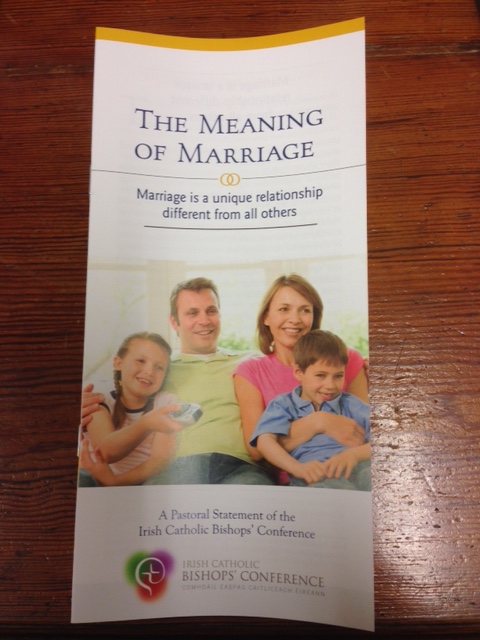
“It is a grave injustice if the State ignores the uniqueness of the role of husbands and wives, the importance of mothers and fathers in our society. Without protection and support for the unique place of marriage in society, the State could, in effect, deprive children of the right to a mother and a father.” Here’s a link to the full document http://www.catholicbishops.ie/wp-content/uploads/2014/12/Meaning-of-Marriage-Web-English.pdf
In conclusion therefore it seems that it’s our understanding of the meaning of marriage that determines our position on the question of the equality of same sex marriage. The question then that each one of us must answer, in conscience, and vote accordingly is: What’s your understanding of marriage? Is it about an adult’s right to a shot at happiness, the right of two men or two women to have a family, or is it about something much greater – not excluding a shot at happiness – but extending to children’s rights to a father and a mother and the security of their married love. Why should a child be deprived of the natural right to his or her mother because an adult man doesn’t want to act against his nature? Surely the rights of children trump the right of an individual or a couple to a shot at happiness or to a family? Surely the rights of children should be enshrined in our understanding of marriage and protected? Surely the rights of children are not just paramount but normative and therefore deserving of a uniquely protected relationship – one man and one woman marriage?
Mark 1:14-20, Third Sunday, Ordinary Time, Year B.
James and John leave everything. For a moment let’s picture their father Zebedee left in the boat with the men he employed. No doubt the father had built up the business with a view to his sons future. Now they’re gone. They’ll never really return.
It’s said that the departure of his sons caused Zebedee to go ‘ballistic’. He lost the head so to speak. That’s understandable. It’s said that in turn Jesus gave the name ‘sons of thunder’ to James and John, Mark 3:17.
At any rate, this following Jesus is portrayed as decisive, radical, life changing. The priesthood is modeled on these guys, downing tools, taking off after Jesus, staying with him, not returning. Whatever the historical roots of priestly celibacy even if several of the apostles were married, it’s not without considerable foundation in the teaching of Christ. It’s there, if we can hear it.
So when we start thinking about abolishing celibacy or making it optional – or countless other issues in the Church – we need to think about it from Christ’s perspective and those closest to him, rather than our own, because our understanding of these matters, indeed life itself, is very often a little out of sync – and that’s being generous – with the understanding that flows from the teaching of Christ.
“I had never believed. I had always known that the interest all around me in security, money, power and status was greater than any love of God or belief in his mercy” Colm Toibin, The Sign of the Cross
Colm Toibin captures this ‘out of sync-ness’ perfectly in his book “The Sign of the Cross”. Writing about his experience as a child growing to adulthood here in the Cathedral in Enniscorthy he says – and this is both harsh judgement and profound observation – “I had never believed. I had always known that the interest all around me in security, money, power and status was greater than any love of God or belief in his mercy.” I’m afraid too often that’s us.
This is the reason we need to really listen to God’s Word, to the Gospels in particular, because only when we really listen can we begin to ‘sync’ with the message and the teaching of Christ. Often our treatment of the Word is like meeting a person and asking ‘how are you?’ when we really haven’t time for the answer, or worse, we really don’t care! Instead, take the time to look into the other persons eyes asking ‘how are you?’ and wait for the answer. We need to listen to the Word like that. Only then can we begin to move from Toibin’s “security, money, power and status” and into the “love of God” and “belief in his mercy”. This is particularly true of the priesthood.
When we think of the priesthood we need to remember Zebedee left behind in his boat, the family business and his life’s effort for his sons welfare discarded, thrown aside, abandoned. We need to wonder – and wonder is all we can do because the sources are so scant and often contradictory – about the wives of these men, if any. What happened to them?
My sense in all this is that through the apostles, married and unmarried, Christ was calling those around him and future generations to a radical discipleship, to leave everything, even marriage, Mark 19:12, 19:29 and so many other passages throughout the Gospels. It’s my sense but it’s not without foundation in the teaching of Christ. In fact, I suspect the more we ‘sync’ with the teaching of Jesus found in the Gospels the more we’ll see this possibility.
Let me put it this way: Why can’t James and John keep the family business and follow Jesus, as well? That’s what we’d do. It’s a bit like asking: Why can’t a man be a priest and marry, as well? That’s what we’d do. My sense is that Christ is calling some to a much more radical discipleship, to leave absolutely everything, to rely on him alone, and if this radical discipleship is not found in the priesthood today, then where will it be found?
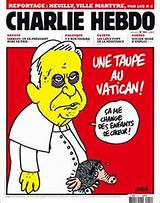
The Charlie Hebdo attack was truly outrageous. Terrorists responded to pencils with assault rifles.
Obviously Charlie Hebdo made good money by mocking just about everything. But do we need to mock anyone or anyone’s beliefs? I don’t think so. I understand the need to challenge people, not least militant Islam, but people can be challenged without resorting to insult and mockery. There are better ways – but they probably wouldn’t sell very many magazines! Don’t get me wrong, I believe in free speech but it belongs to us all, not just to members of the National Union of Journalists! As a recent blog post put it: Je suis Charlie, and I would like to proclaim that Jesus Christ is Lord, marriage can only occur between one man and one woman, and that abortion is murder. Or am I allowed to say that?” (Faith in our Families blog http://faithinourfamilies.com/2015/01/08/charlie-hedbro-you-are-not-allowed-to-say-that/)
It strikes me that there’s a level of foolhardiness in the media’s response to the Charlie Hebdo attack. While we’re resolute in upholding the right to free speech its application is at times a little thoughtlessly bold.
It’s something I learned while working in the prison system. Prison officers don’t insult prisoners, or at least some prisoners. They’re careful how they speak to some prisoners. But they should really claim their right to free speech, shouldn’t they? I mean they should be entitled to strut through the prison saying what they like when they like, shouldn’t they? But they don’t. Nothing would strike the average prison officer as more stupid! Prison officers appreciate that some of the prisoners are very dangerous so they don’t put their personal safety at risk by strutting about saying what they like when they like. More importantly, it’s not just about an individual officers safety, it’s about the safety of others. They refuse to put the safety of their colleagues at risk. It’s common sense, we’d call it simple cop-on!
Similarly, I’ve heard members of An Garda Siochana (Ireland’s Police Service) say that they’d prefer not to work with a particular garda because he or she would get you in trouble. The scene goes something like this: gardai arrive at an incident that’s under control. The situation is calm, but suddenly our garda friend opens his mouth, he’s got a right to free speech, right? He says all the ‘wrong’ things according to prudence, and suddenly a calm situation is turned into a flash-point. Our garda friend has managed to put his own safety at risk and that of his colleagues and possibly members of the public too.
Free speech might get you far but common sense – in this case a prudent evaluation of your opponent – will get you much further, not to mention saving innocent lives too!
Before we leave Christmas behind I want to look again at the context in which God became flesh because we can pull some interesting details from it.
Let us always remember that in the Church, in the spiritual life, we must always be deceived into focusing on the shadows, on the darkness rather than the light.
The first detail I’d like you to see is that when God became flesh he was really pushing the boundaries of our freedom. The incarnation sits on the very edge of human freedom. If God did anything more we’d have no choice but to believe… and instantly our freedom is gone.
So the whole belief thing and the Church – remember that Christ and the Church are inseparable – is a personal choice. Yes, absolutely, but in acknowledging that it’s a personal choice, we must also acknowledge that God has done everything possible to swing our choice in his direction while leaving us just enough freedom to be able to reject him. This is a very thin line – maxed out very deliberately by God.
I’d also like you to notice the role of the political leaders – Caesar Augustus, Herod and the various layers of Government and leadership – in the arrival of the Christ-child (Cf Luke). They had absolutely nothing to do with it! In fact, they provided nothing more than the historical backdrop, nothing more than a way to put a date on the events. They were by-passed – as Mary marvelled in her Magnificat; “he has pulled down princes from their thrones…” How? He just by-passed them making them largely irrelevant and went to the lowly stable where only the lowly, and those who make themselves lowly can recognize him. This hasn’t changed.
But later they did try to get in on the act, to thwart it, Herod particularly. So his eventual involvement is one of opposition. This is most interesting because this hasn’t changed either – politics is still largely opposing the influence of the incarnation, non-violently of course, and ironically it does so on the pretext of choice!
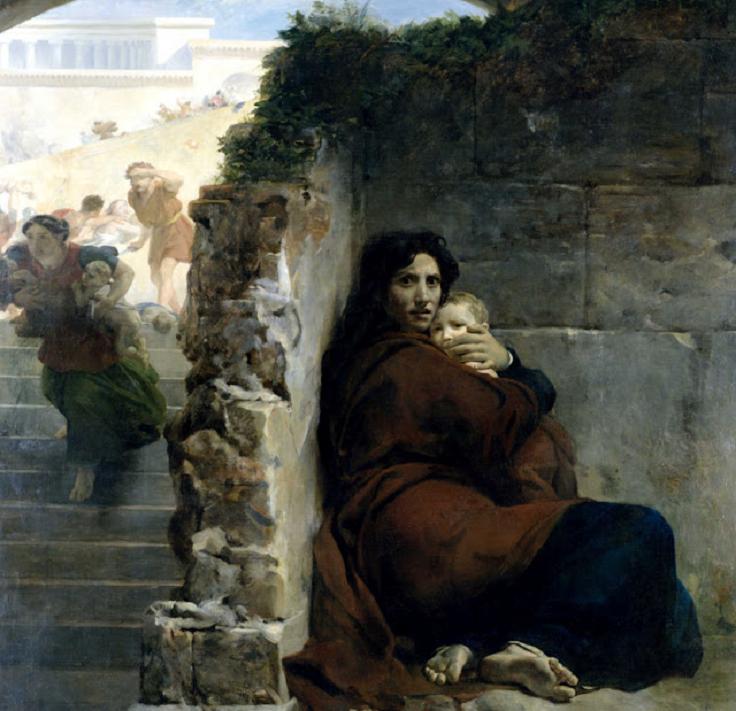
Slaughter of the Innocents, Leon Cogniet
The next detail I’d like you to see is the proximity of really dark evil to the unfolding of God’s plans. As the Christ-child arrived into the world Herod’s power was threatened. Initially he played politics with the wise men, trying to trick them into telling him where he could find the child Jesus so that he could eliminate him, but when politics fails he unleashes a terrible evil ordering the death of every new born male child. What I want you to see is the proximity of the darkest evil to the unfolding of God’s plan in the world – this is the price of human freedom – and it hasn’t changed either. Wherever God’s plan is unfolding you will have evil too, and the greater the plan, the greater the evil, but only for a time. Always remember that spiritually we must be deceived into focusing on the shadows, on the darkness rather than the light. It happens all the time – right now in the Church it is happening; has happened.
The final detail I’d like you to see is how the unfolding of God’s plan is always tottering on the brink. God’s plan is dependent on Mary’s ‘yes’, on a solitary woman’s ‘yes’, on a ‘yes’ that asks this woman to let go of all her plans and stare, and step, into an abyss (from a human point of view). It’s dependent on Joseph accepting Mary’s version of events. It’s dependent on Joseph’s dream, on the wise men’s dream. What I want you to see is the thin line, again this thin line. God’s will always looks like it’s about to flop, from beginning to end, from incarnation to resurrection and into the future.
Tonight God crosses the desert we heard about during Advent, he crosses the valleys, the hills, the mountains, the cliffs. Tonight God is with us – and he wants to stay with us, with you.
“In the mystery of the Incarnation there is also an aspect that is connected to human freedom. God has pitched his tent among us and we must hasten to receive the grace that he offers us” Pope Francis, January 05, 2014
He is with us in the real world, as Pope Francis says; “in this real world.” He doesn’t come to an idyllic world as if this (pointing to the crib) is just sentiment but nothing to do with the real world.
How real do you want it?
There’s the awkwardness of Mary’s pregnancy albeit by Gods direct intervention but who’ll believe that? I’m pregnant Joseph and you’re not the father! Thank you God, you really dropped me in it three!
There’s Joseph’s inevitable confusion, his uncertainty, his pride – think of a man’s pride in this situation, Joseph’s decision to leave Mary. Thank you God, you really dropped me in it there! See how close God’s will is to the edge, always tottering on the brink! God’s will always looks like it can’t possibly succeed.
There’s the long and difficult journey to Bethlehem for a heavily pregnant mother, a distance of 100 or more kilometres, on arrival there’s no suitable accommodation. Thank you God, you really dropped me in it there! Here we find the story of this child’s future life in summary; “foxes have holes but the Son of Man has nowhere to lay his head”… to this day. How have you changed that?
There’s the joy and the supernatural wonder of this night – the lowliness of the shepherds recognizing the Christ-child; haughtiness would never have been able to recognise the Christ-child – followed by the terror of the flight into Egypt to escape Herod’s slaughter of every new born male child. What’s it like for a father or a mother lying awake under a night sky knowing that at any moment a soldier full of murderous intent might find them? Thank you God, you really dropped me in it there! Tonight “there will be people from Nigeria to Iraq who take their life into their hands by going to midnight Mass.” (Fraser Nelson)
Not to an idyllic world but to this world, cruel, violent, craving power, divided but also good. God is with us in this world and because of this night (day) God has a face, a personable identity.
My second point tonight:
Many – far too many Catholics, possibly a majority – do not have a strong sense that God is with us even though he’s done this (pointing to the crib). Why?
A poor family are taking the boat to the US. They can afford to bring nothing more than bread and cheese for the journey and a little savings. About 3 days into the journey one of the children complains: Daddy, I can’t eat any more cheese, if I eat any more cheese I think I’m going to die. So the father gives the child a small coin from the family savings telling the child to go and buy an ice cream. About an hour later the child returns, excited, and tells the father: Daddy, I’ve had three ice creams and a dinner. Here’s your coin back, the food is included in the price of the tickets! (Peter Kreeft)
Many of us have tried to live on the spiritual equivalent of a diet of “cheese sandwiches” (Fr. Chris Hayden) not realizing that there’s so much more on offer.
This is the single biggest problem in the Church.
It’s the real reason – the reason behind all the other reasons – why people leave the Church. Think about it; how long will any of us last on a diet of cheese sandwiches? How long before you’re fed up? How long before you’ll walk away?
There’s a lunacy to all this that’s seldom named, but we’ll name it tonight; God has come bounding across the desert, the valleys, the mountains, the great divide between God and man – God is with us – and we’re bored, fed up, we think that this child will somehow place limits on us, somehow diminish our freedom, or we think that it’s not about us – you – that he’s not looking for you? Ah, come on!
To all of you making your annual visit I ask you to stare hard at this child and ask yourself why he came? And if you want it, if you’ve got the desire, I think Fr. Byrne and I can lead you to much more than cheese sandwiches. As Dell-boy would say; we guarantee you a full steak meal!
Tonight, and during the Christmas season I invite you to look again, visit the crib, take a good hard look and ask; why? Then ask yourself; what’s it got to do with me? I doubt he intended you to exclude yourself. Certainly not. As Pope Francis says, he intended us to use our freedom to “hasten to receive the grace that he offers us.”
The family is the foundation of society. It’s the basic unit of society – the most important. It’s the place where we learn how to love or more generally, how to be in the world.
The launching pad from which we’re all sprung.
The bow from which the arrow is fired.
It’s so important that it’s how God became flesh – in a family.
“As the family goes, so goes the nation and so goes the whole world in which we live.” John Paul II
Everything – economics, markets, Governments, States – must be made to serve the family.
The family begins in the love of a man and a woman, although that’s now being questioned.
To love another person is to seek that person’s good, it’s to desire that the other person becomes the best version of him/herself, to desire that the other person becomes the person that God intended him/her to be. This is the work of the family.
Nothing is as difficult as love. I’m serious. Primarily because we reduce it to one of it’s constituent parts, namely physical attraction. So let’s throw love around a little. What is it?
Actually to love is to become a moral person. Love is not just attraction. Try living in love without faithfulness. It’ll tear your heart out. Suddenly love also means faithfulness. What’s love without justice? I love you, but I’ll walk all over you! Suddenly, love includes justice, acting justly. What’s love without self-control? I’m angry so I’ll knock your head off! Suddenly, love now includes self-control. What about trust, patience, gentleness, kindness, goodness, truthfulness (honesty and personal integrity), forgiveness? Love is made of many different parts – virtues. Relationships don’t just fail, they fail because people don’t grow in virtue. To love is to become a moral person. A child, tomorrow‘s adult learns the art of love in the family.
In the family we learn to say ‘yes’ or ‘no’ and mean it, we learn to say ‘please’ or as Pope Francis says we learn to ask “may I”, it’s where we learn to say ‘thank you’, to say ‘I’m sorry’ or ‘forgive me’, where we learn respect for ourselves and for other people, for other people’s property. It’s where we learn to be a father or a mother. It’s where we learn to be moral people – before and above everything else we are moral people; our primary identity – moral people who can choose. Unless we’re moral people we’ll wreck everything! This is what distinguishes us from the animals, this is what makes us human.
Where these qualities are in short supply the family might survive outwardly, but inwardly it’s already a broken family and the people involved may be broken, they may not be whole within and they may reproduce the brokenness wherever they go, not always, but very often, not always because although at great personal cost we can still choose to be otherwise.
Nonetheless, as the family goes so will society go.
Nothing is more important than the family. We’ve got to get this right, and everything must be made to serve the family.


!["But if a child has no such right [to a mother and a father], then where in the world does the right of two men or two women to have a child come from?" David Quinn, Irish Independent, 19 January 2014](https://paddybanville.com/wp-content/uploads/2015/01/david-quinn.jpg)




 paddybanville's Blog