
Philomena, the film: What might God make of it?

If you haven’t seen the film, Philomena, I’m sure you’ve heard about it! It’s the true story of a young girl who became pregnant outside marriage in 1950s Ireland.
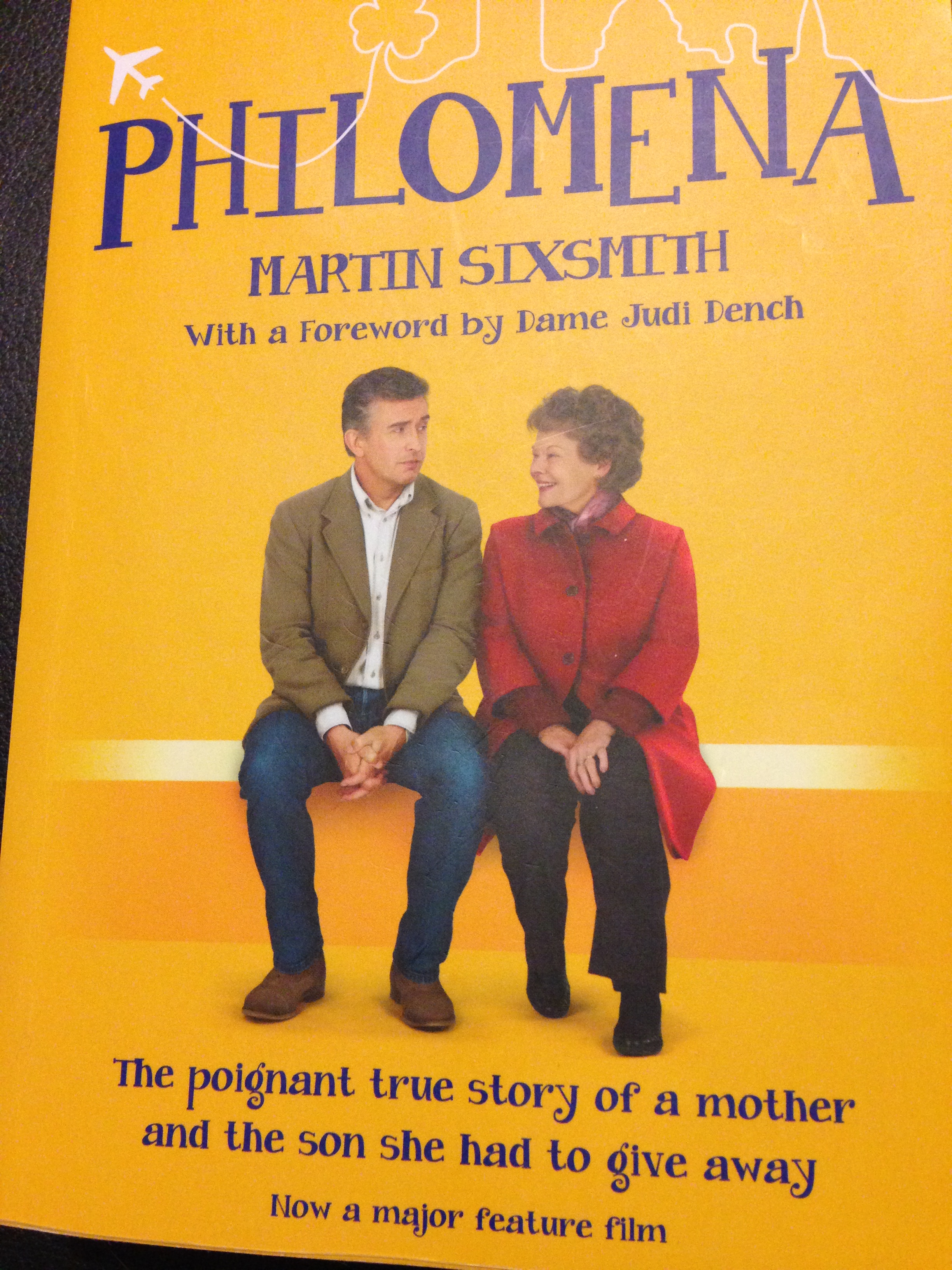
IMG_0860Before going any further I must admit that I haven’t seen the film but I have just finished reading the book. I was surprised by the book – not the pregnant outside marriage in 1950s Ireland story-line – but the level of promiscuity portrayed in the sections of the book dealing with Michael’s (Anthony’s) adult environment in the United States. I found it quite shocking and it’s dominating my initial thoughts about the book. Nonetheless the book has copper-fastened my belief that every child should have a right – an unassailable human right – to know his or her father and mother.

The book also got me thinking about what God might make of it all? So I’m going to do just that – look at the matter from God’s perspective. God’s perspective is effectively the will of God. The will of God is always in our best interests. It’s the true Paramount Principle because it’s the only guarantee of human well-being. Can we establish the will of God for the women portrayed by the character of Philomena? Yes, we can – but it’s not likely to be welcome – we may not like what we find!

So I’ll ask the obvious question: Is it the will of God that a young single girl should find she’s pregnant?

Essentially, it’s a question about the context of sex. Catholicism argues that sex belongs toIMG_1007 love – most will agree with that much – but Catholicism goes further, defining the love required as married love, but a very particular married love that can be dissolved only in death, i.e., sacramental married love. Catholicism believes the physical act of sex has its own innate meaning; sex is the seal of a reciprocal gift of self which is irrevocable and therefore sex belongs to sacramental marriage.
I appreciate I’m threading on dangerous cultural ground here but we can say with confidence therefore, no, it’s not quite God’s will that a single girl should find herself pregnant. But it’s equally not God’s will that she should be abandoned as in the case of Philomena. At the moment Philomena fell pregnant she became – borrowing the Gospel image – like a vulnerable sheep needing the Shepherds special care.

Still, whether we like it or not, from a faith perspective we must also factor in Christ’s condemnation of fornication as a sin (Mark 7:21-23). The Catholic Church cannot deny the existence of an objective moral order, to do so is to deny the existence of God. If there’s no objective moral order then there’s no need for redemption, and if there’s no need for redemption there’s no need for Christ. We save ourselves!

The tragedy is that many of the women portrayed by Philomena feel ashamed of their big secret. Yet from the Cross Christ says to every sinner – I did not die on the Cross for you to bear the burden of your sin. That’s redemption – it refuses to collapse the moral order, refuses to deny the reality of sin, yet, it sets sinners free.

Next question: Is it the will of God that the young girl should seek an abortion? It is never God’s will that human life – from conception to natural death – should be directly terminated. In fact during the Rite of Baptism I have started to thank mothers, single or otherwise, for choosing life.

Next question: Is it the will of God that the young girl should be incarcerated in the name of ‘care’ and be forced to give up her baby for adoption, for a donation to her carers? I think I have made the answer obvious by now, no, absolutely not.

Next question: Is it the will of God that the same young girl should be abandoned by theIMG_1017 father of her baby (let us not forget the father’s sin; fornication and possibly adultery), her parents and family, and society generally? The answer is; certainly not. Abandonment is not Gods will. Whom exactly was Christ abandoning when he died on the Cross?

So from the perspective of the will of God what do we find when we begin to examine the lives of the women portrayed by Philomena? We find that the people involved directly and indirectly in a young girls crisis pregnancy all sinned and the young girl’s sin is in fact the least of the sins involved. No doubt about it; Jesus wept every step of Philomena’s journey – for everyone involved!

Finally, let’s remember there is no reason why a single mother (or a single father for that matter) can’t become the greatest Saint that ever lived.
Love like Jesus – and get yourself in trouble!

Homily Notes

Seventh Sunday, Year A. Matt. 5:38-48

At first sight today’s Gospel seems very demanding.

Demanding might seem an understatement. Perhaps the immediate response of many will be; it’s impossible. It’s audacious in its demands; “offer the wicked man no resistance, if anyone hits you on the right cheek, offer him the other as well …”

Yet when Jesus begins to argue that if we do good only to those who do good to us and save our greetings for our friends (brothers) only, I think we can begin to see that he’s got a point.

IMG_0852There is nothing exceptional in doing good to those who do good to you or in loving those who love you.

When the words of Jesus drag us to look at ourselves in this way we can begin to see the obvious limitations of our goodness and by comparison the magnanimous goodness of God who “causes his sun to rise on bad men as well as good …”

Thus, here again we glimpse the missionary demand of Jesus, to move out of ourselves individually and collectively and to go out and always be charitable – even towards our enemies!

IMG_0850To live in this way is counter cultural. It sets us apart, makes us like a city built on a hilltop. You will never hear a Government minister or a TD* ask this of you. No media person will ask it of you. But Jesus asks it. Who do you follow?

While we might think that modern Ireland is challenging Catholicism, it’s actually not challenging Catholicism at all; rather, it’s challenging a poorly incarnated (lived) Catholicism. No democracy will ever present you with a challenge greater than loving your enemy or being as perfect as your Father in Heaven!

In the end we’re being called to love like Jesus Christ who gave his life, not just for good men, but for bad men too.

These words of Jesus open doors that’ll – if we pass through – get us in a lot of trouble!

IMG_0851

*TD – a member of the Irish Parliament (Dail Eireann)

Catholics are called to pure goodness.

Homily Notes

Sixth Sunday Year A. Shorter Gospel – Matt 5:20-22,27-28,33-34,37

If your virtue goes no deeper than that of the Scribes and Pharisees you’ll never enter the kingdom of Heaven.

Ouch!

Let’s hope the Scribes and Pharisees were very corrupt!

Jesus calls us to a higher – perhaps deeper – standard. It’s not just, thou shalt not kill; it’s thou shalt not be angry.

It’s not just, thou shalt not commit adultery; it’s thou shalt not lust.

Neither anger nor lust can be considered harmless; both can lead to serious spiritual bondage, to diminished freedom and to acts that are gravely sinful and sometimes criminal.

Thus Jesus calls us to purify our hearts – to remove all that leads to sinful and sometimes criminal behaviour.

A pure heart is nothing more than a heart – a person – who loves God.

Jesus’ final point about swearing and oaths calls us to the same goodness.

It’s not just, don’t break your oath; it’s be a person of such integrity that your ‘no’ means ‘no’ and your ‘yes’ means ‘yes’ and swearing or oath-taking is no longer necessary.

This is a breath-taking window-view opening out to show us the sheer goodness, the purity of heart to which we’re called and on which Catholicism is founded.

Indeed elsewhere in the Gospel Jesus tells us to be “as harmless as doves …”

Engaging with last weeks Gospel:

If last week Jesus called us to witness like “a city built on a hill-top” this week he reminds us that such witness flows from a heart that’s like a store full of goodness (a store full of goodness is how Jesus described a good heart)

If last week Jesus called us to be salt of the earth, this week we get a glimpse of how salt becomes tasteless – when we draw out from our hearts, not goodness but anger, lust, jealousy …

Weak discipleship means a weak Church.

Homily Notes

Matt. 5:13-16

To his disciples – to the fledgling Church – Jesus says; “you are the salt of the earth. But if salt becomes tasteless … it is good for nothing, and can only be thrown out to be trampled underfoot by men.” Strong words!

The disciples are to be salt of the earth.

So where would you find the disciples of Jesus Christ in our day?

Here, surely?

If the world looks at us and doesn’t see Christ’s disciples – well, something’s wrong.

If the people who don’t come to Mass don’t see something attractive in us – like happiness in IMG_0954our relationship with God – then something’s wrong.

When we received Baptism, Confirmation and Communion Jesus didn’t mean that it should be private like a lamp covered by a tub!

No. Our commitment to Christ is to be as obvious and attention-grabbing as a city built on a hill-top!

But if our commitment to Christ is not like a city built on a hill-top, if it’s not obvious, if it’s like a lamp covered by a tub, if we’re like salt that has become tasteless, if we’re ineffective disciples – the local Church too – becomes “good for nothing and can only be thrown out to be trampled underfoot by men.” Weak discipleship means a weak Church.

We are to be obvious attention-grabbers for Christ, my light, your light must shine in the sight of men – but notice the next line – so that seeing our good works people may give thanks to God.

Ah, now! Who would want that? Who wants to give God everything? Actually, very few! We’re terrified that there’ll be nothing left for us! What’s left for me? What do I get?

The raging cultural war in which Catholicism is being squeezed is actually about this question – is life about me, self, my ego, or is it about God?

IMG_0825

The answer is another day’s work – we’ll come back to it. For now I’ll leave you with an insight from Mother Teresa – “Many people mistake our work for our vocation. Our vocation is the love of Jesus.”

For love, a man or woman will give everything, even be prepared to die, and all our human loves – whatever the kind – are mere shadows, reflections and even distortions of the Love we really crave, the love for which we’re made. That love has a name; Jesus Christ.

So, open wide the doors.

The Presentation of the Lord

Luke 2:22-32

Homily Notes

Today I’d like to draw your attention to a detail that I find fascinating and indeed instructive for us on this February day in 2014.

When God became man He inserted himself in a particular religion; Judaism.

Thus we see Mary and Joseph bringing the child Jesus to the Temple to fulfil the requirements of Judaism. They were a religious family.

Indeed, Luke tells us that at the age of twelve years Jesus went missing and when Mary and Joseph found him, they found him in the Temple – where else? – “sitting among the doctors, listening to them, and asking them questions” Luke 2:41-46

IMG_0695Judaism and the Temple played a significant role in Jesus’ life. The Gospels reveal him moving between on the one hand, the Synagogues and the Temple and on the other hand, the sinners, the outsiders, calling all to himself as the fulfilment of Judaism – and nothing less than the light whom God has prepared for all the nations to see!

Although Jesus challenges the Jewish leaders, at times using very strong words, and although the Gospels reveal corruption within Judaism (take such corruption out and there’d be nothing of the Bible left!) Jesus never abandons Judaism but rather calls the Jewish people to fulfil their religion.

He affirms Judaism saying he has come not to abolish Judaism but to fulfil, to bring to completion, and with those who follow him he brings to birth out of Judaism the Christian religion which is historically Catholic.

Now I’d like you to see what I see – there’s an order to God inserting Himself in human affairs, it’s clearly bounded, and it’s far from perfect. In fact it’s imperfect, but God inserts Himself into it, and although there are clear boundaries, there’s a line through history, a particular people moving through history to this day – the People of God which is the Church, the baptized – there’s an open invitation to all people to enter in, to be a part of it, and to find Jesus Christ there, who doesn’t wait for perfection, doesn’t run away from corruption, but places himself in the middle of it and calls us to our proper fulfilment.

Remember, He is the light and a light is at its best in the darkness!

“Unlike other great religions, Christianity has never proposed a revealed law to the State and to society, that is to say a juridical order derived from revelation. Instead, it has pointed to nature and reason as the true sources of law – and to the harmony of objective and subjective reason, which naturally presupposes that both spheres are rooted in the creative reason of God” Pope Benedict XVI

Accusations of hoIMG_0662mophobia, religious fundamentalism and even suicide statistics fail to engage with Catholic reason concerning homosexuality
Ì too had the privilege of hearing Mary McAleese being interviewed by Pat Kenny recently. I was enthralled as she spoke of her modest lifestyle while studying in Rome. In the course of the interview about her book ‘Quo Vadis’ which is about Collegiality in the Code of Canon Law, she addressed the issue of homosexuality using suicide statistics and argued for a change in Catholic Church teaching. When she’d finished I was deeply troubled.

As I recovered I was struck by her use of suicide statistics – essentially the use of personal tragedy to argue for a change in Church teaching. I also noted her focus on the creature rather than the Creator. The discussion was about gay men and the Catholic Church – God was hardly mentioned! Surely, when it comes to judging the Catholic Church’s position on a particular issue the deciding factor must always be God’s will? After all, God’s will is the only guarantee of humankind’s well-being.

Of course, this view is diametrically opposed to the view that men and women know what’s best for the human race. That’s democracy. But Christians follow Christ. He alone is the Saviour of the world, not majority opinion! So the Catholic point of departure is always God’s will, in this case God’s will concerning homosexuality.

Now strange as it might seem when Catholicism seeks to propose laws to the State the appeal in the first instance is not to revelation but to nature and reason. Nature and reason then are Catholicism’s defence against the invalid charge of homophobia. Of course, like all reasonable people I accept that there are homophobic people in our midst but I do not accept the use of the homophobia blanket to smother every opposing argument. I find such blanket-smothering of opposing views to be really fearful!

The real fears within Catholicism have nothing to do with homophobia. Firstly, as a Catholic I fear sin, particularly the enculturation of sin. Catholicism doesn’t fear the human person – nothing could be more ridiculous – Catholicism fears sin. Besides, Jesus Christ came to save us from sin, not in sin! Secondly, I share with Catholicism the terrifying fear that we might “tie up heavy burdens and lay them on men’s shoulders” Matt. 23:4. Do you seriously think that men like John Paul II, Benedict XVI and Francis, and the majority of faithful Catholics have not struggled with such fear in our consideration of homosexuality? We certainly have and therefore Catholicism looks to the harmony of nature, reason and revelation. Where else can Catholics go?

Appealing to nature and reason the Catholic Church then argues as follows: male and female God made them, and so it is; we discover men and women, male and female as the essential dynamic of creation. We discover that the various parts of the male and female body are fit for sexual purpose, actually fit together and serve a very important purpose, the transmission of human life and the survival of the human race, while sexual intercourse itself implicitly speaks the language not of ‘trial’ love, but of Sacramental love; I give myself completely to you in love. What’s the alternative taken to its logical conclusion? In other words, the physical act of sexual intercourse innately means or is connatural with the mutual irrevocable gift of the whole person that is Sacramental marriage. As such Catholicism concludes that sex belongs to Sacramental marriage, love unto death, love that shares Gods creative work, love that bursts forth in the transmission of new life in all its forms. It may be idealistic (and difficult!) by humankind’s current standards but surely it’s the true meaning and purpose of sex as it exists in the mind of God. Surely as believers, notwithstanding our failures, we can agree on this much.

We also notice that there are exceptions occurring naturally, for example infertility, and among some men and women something very different, an attraction to their own sex. While the origin of homosexual attraction is unclear it is nonetheless real and cannot be denied, no more than we can deny heterosexual attraction.

However, the acting out of the attraction is considered to be contrary to Gods will because to put it bluntly, if not crudely, the parts just don’t fit together! The male body is not designed to facilitate sexual intercourse with another male, just as the female body is not designed to facilitate sexual intercourse with another female. The homosexual act lacks complementarity (meaning the fitting together of all aspects of the human person as male and female) and the potential to transmit human life. Thus Catholicism concludes that in so far as homosexual attraction leads to sexual activity that excludes complementarity and two becoming one in new human life it is objectively disordered. The key Catholic question here is; what is sex for?

We’re left then with a very important question; where does homosexuality come from if its expression is not part of Gods will? Some will respond instantly and perhaps with some outrage; how dare you attack my very person, of course homosexuality is part of God’s design; it’s the way I’m made!

Firstly, the Catholic Church seeks to attack nobody. We are all made in the image and likeness of God. Catholicism seeks only to uphold God’s rule in human affairs.

Secondly, in the context of a Christian worldview ‘the way we’re made’ is quite nuanced. In fact, it’s ‘the way we’re made’ that creates our need for salvation.

Thirdly, even if the origin of homosexuality is genetic and biological the same argument can be made for heterosexuality but with the additional evidence of the complementarity of the human body as male and female together with the potential to transmit human life. When compared to homosexuality, heterosexuality ticks extra boxes. These are substantial additional boxes and they cannot be ignored even in the face of suicide statistics. Consequently Catholicism gives the nod to the expression of heterosexuality as Gods design.

The perceived weakness in Catholic argument is its dependence on the physical which is countered by the principle that the evidence of male and female physicality and their complementarity whereby two literally become one in a new human life is not accidental but the primacy of Gods order. The bottom line here is; is there a God-designed order in terms of human sexuality? The Catholic Church says absolutely; it’s obvious! If there is an order then we can trust it. Life would be so much easier if the Catholic Church changed its teaching, but would a change be in keeping with God’s will? That’s the critical question.

There’s one further aspect I’d like to explore, namely Christ’s love for the marginalised which is increasingly used to argue against various positions held by the Catholic Church, including the Church’s position on homosexuality. The context in which Christ’s love for the marginalized unfolds is invariably the work of conversion. Too often commentators fail to mention the inner dynamics of Christ’s love; it is always targeted with a distinct purpose – go away and don’t sin anymore. So we simply cannot argue that Christ was compassionate therefore we should accept homosexual expression as part of God’s plan. No, Christ’s compassion had one purpose; not the blanket acceptance of humanity but the conversion of humanity.

Thus for the Catholic Church the issue is not about fear or prejudice, or homophobia, or any of the usual reasons advanced by liberal Catholics and non-Catholics alike, but about intellectual honesty endeavouring to ensure that humankind remains within the parameters of Gods will, since remaining within the realm of God’s will or recourse to Divine Mercy are the only guarantees of human well-being.

This is a massive call. Catholicism doesn’t make such a call lightly, rather, it’s a call made before God in fear and trembling with eyes fixed firmly on the harmony of nature, reason and revelation. The bulldozing accusation of homophobia simply refuses to address the Catholic argument. Instead, adapting Paddy Manning’s words on Twitter, proponents of the homophobia bulldozer “get to create a ‘crime’, charge people with it, and be judge and jury!”

Gospel (shorter version) Matthew 4:12-17 The people that lived in darkness and who dwell in the shadow of death has seen a great light.

If I’m not mistaken Zebulun and Naphtali were the extremities of Israel at the time of Jesus.

So the light reaches to the extremities. It reaches out, which is what it’s doing right here, right now.

The point of Catholicism is that Jesus Christ is already our light. He’s not meant to be outside us, he’s meant to be in here (inside). This is the critically important journey that every Catholic must make.

But often, even for Catholics, particularly cradle Catholics, the light inside us is someone or worse still something else, someone or something other than Jesus Christ.

We have our idols! Money is the obvious idol, education can become an idol (note the recent comments by the Minister for Education), even our children can become idols! There are endless possibilities.

IMG_0794

Where God is not loved, idols are loved instead. It’s a basic spiritual truth. These idols or ‘lights’ are the real driving force within Irish life today.

Every person has such a light or lights. The light of my life is what gives meaning to my life.

So ask yourself what it is, what’s the light that you’re living for, that keeps you going?

Then ask; will that light ever go out?

Jesus Christ once remarked; what if the light inside you is actually darkness? What darkness that will be!

There’s only one light that never goes out – Jesus Christ.

Thus Jesus begins his preaching with a call to ‘repent’ – why? – because the kingdom of Heaven is close at hand. Get the connection!

In other words, repent, which means turn away from sin, from idols, and turn towards God, so that you may enter the life of God and find what humankind is really looking for in our idols.

If there’s no objective moral order Jesus died in vain! Second Sunday of Ordinary Time

Homily Notes

Gospel: John 1:29-34 Look there is the lamb of God that takes away the sin of the world.

How does Jesus Christ take away the sin of the world?

By taking the sin of the world to himself.

He’s innocent but he made himself guilty in place of the guilty.

So, let’s draw out the implications of Jesus as lamb of God.

There’s an objective moral order to which we’re all subject – otherwise why would Jesus Christ need to die for sinners?

There is ultimate Justice.

Because there’s ultimate Justice Jesus was tolerant only in so far as tolerance served repentance.

The guilty who genuinely repent and turn to Christ are free – He takes the place of the guilty. That’s redemption. It’s the only reason a priest can absolve sins.

Jesus was merciful rather than tolerant. Learn the difference. Mercy is Justice transfigured by Love. It requires ultimate Love.

Sin is destructive – ponder Christ crucified. It’s the most destructive force known to humankind.

If Jesus doesn’t take away the sins of the world – if we refuse Mercy – where will the sins of the world go? Where will the destruction go?

Jesus Christ is our future.

Homily Notes

The Baptism of the Lord

When Jesus entered the waters of the Jordan to be baptized by John He was setting the tone for all that would follow.

John’s baptism was a baptism of repentance for sinners.

So by choosing to be baptised by John, by sharing in the baptism of sinners, Jesus deliberately put Himself among sinners as a brother – but He was (is) a brother who was (is) also the Divine Physician, the Saviour; a voice spoke from Heaven, this is my Son, the beloved.

Jesus put Himself among sinners, not to judge, not to condemn (this got him into difficulty), but to love, to attract to a better way of life, a new life, the life of God which every person can reach through repentance and conversion.

In many ways Pope Francis has chosen to walk on to the world stage in this way.

It’s amazing how many people accept the first part – the liberal left are all for Jesus as our brother – but choose to ignore the call to repentance and a new way of life!

True to form, the liberal left are misunderstanding Francis (because they misunderstand Jesus) and we’re witnessing the most amazing unfounded psychological projection of the liberal lefts desires on to Pope Francis.

Meanwhile, many traditionalists are a little confused.

It’s like being back in the days of Jesus!


This is just brilliant: Pope Francis’ homily during early morning Mass at the Casa Santa Marta on Saturday 11 January 2014 – taken from Vatican Radio. Click the link and scroll down to the bottom for Christopher Wells report and a video of Francis delivering it.

http://en.radiovaticana.va/news/2014/01/11/pope_francis:_the_true_priest_and_his_relation_to_christ/en1-763111

Pope Francis: the true priest and his relation to Christ 

At his daily Mass on Saturday morning at the Casa Santa Marta, Pope Francis spoke about the priesthood. A true priest, he said, anointed by God for His people, has a close relationship with Jesus. When that relationship is missing, the priest becomes “smarmy,” [unctuous, It:unctuoso] an idolater, a worshiper of the “god Narcissus.”

Pope Francis’ homily was entirely dedicated to the priesthood. Commenting on the passage from first letter of St. John, where the Apostle says that we have eternal life because we believe in the name of Jesus, the Pope asks about the relationship of priests with Jesus, because “the strength of a priest is in this relationship.” When Jesus was growing in popularity, the Pope said, “He went to the Father,” He retreated “to a deserted place to pray.” This is a kind of “touchstone for priests” he said: whether or not we seek to find Jesus. “What is the place of Jesus Christ in my priestly life? Is it a living relationship, from the disciple to the Master, from brother to brother, from the poor man to God, or is it a somewhat artificial relationship … that does not come from the heart?”

“We are anointed by the Spirit, and when a priest is far from Jesus Christ he can lose this unction. In his life, no: essentially he has it… but he loses it. And instead of being anointed he ends up being smarmy. And how damaging to the Church are smarmy priests! Those who put their strength in artificial things, in vanity, in an attitude… in a cutesy language… But how often do we hear it said with sorrow: ‘This is a butterfly-priest,’ because they are always vain… [This kind of priest] does not have a relationship with Jesus Christ! He has lost the unction: he is smarmy.”

Pope Francis continued:

“We priests have so many limits. We are sinners, all. But if we go to Jesus Christ, if we seek the Lord in prayer – prayer of intercession, prayer of adoration – we are good priests, even though we are sinners. But if we are far from Jesus Christ, we necessarily compensate for this with other, worldly attitudes. And so [we see] all these figures … priest-wheeler dealers, priest-tycoons … But the priest who adores Jesus Christ, the priest who talks with Jesus Christ, the priest who seeks Jesus Christ and who is allowed to seek Jesus Christ: this is the centre of our life. If that is not there, we lose everything. And what will we give to the people?”

“Our relationship with Jesus Christ, a relationship of anointing for the people,” Pope Francis said, “grows in us priests” more and more each day:

“But it is good to find priests who have given their lives as priests, truly, of whom the people say: “Yes, he’s difficult, he’s this or that… But he is a priest! And people know! On the other hand, when people see priest idolaters, so to speak, priests who instead of having Jesus have little idols… worshippers of the god Narcissus… When people see [priests like this] they say ‘poor guy!’ The relationship with Jesus Christ saves us from worldliness and idolatry that makes us smarmy, preserves us in the anointing [we have received]. And today, this is my hope for you who have been kind enough to come here to concelebrate with me: Even if you lose everything in life, don’t lose this relationship with Jesus Christ! This is your victory. Go forward with this!”