The Ascension; the authority of absolute victory.

Ascension imageCan Catholicism ever be a private matter?

Which is to ask can belief in Jesus Christ be a private matter – ever?

Think about it – this figure enters human history and overcomes death. The claims associated with Jesus of Nazareth demand serious investigation by every human being on the planet.

The feasts we celebrate during the Easter season – Resurrection, Ascension and Pentecost – are seismic.

Today we’ve reached Christ’s Ascension which gives purpose and direction to the Resurrection. Otherwise he’d still be roaming the earth in his resurrected body – eternally wandering with no home to go to! Home is important.

There are three parts to the Ascension; firstly the resurrection itself, secondly the power to judge (every man and woman) and thirdly, sitting at Gods right hand in glory.

From his place at God’s right hand he sends the Holy Spirit (Pentecost) thus fulfilling his promise not to leave us orphans but to come back. Unfortunately, many of us experience God as though we are orphans!

Jesus says that this Spirit will lead us to the truth. What is this truth? It’s not truth as facts, or the truth of particular happenings or events but truth as a person, God, who is absolute Truth. So “the truth will set you free” means that God will set you free. Two things happen when we experience the absolute Truth through the gift of the Holy Spirit. Firstly, we understand that we’ve ‘discovered’ the universal meaning and purpose of life – our universal home. Secondly, we see the glories of this world for what they are – trifles!

How do we get to this point?

The answer is in the Gospel; the eleven go to meet him, to the mountain where Jesus had agreed to meet them. The mountain is significant – the road to God is always likened to climbing a mountain.

On the mountain they meet him. Think of the effort involved in climbing a mountain – that’s what practicing the faith is about. When they climb the mountain they see Christ ascending – when we practice the faith properly we should begin to see things too; they fall down, though some hesitated. Some are still not sure, bewildered, and incredulous; it’s too much for them. It is; it’s seismic!

With absolute authority and power the risen Jesus walks up to them and the words that fall from his mouth are sovereign; “all authority in Heaven and on earth has been given to me. Go, therefore, make disciples of all the nations; baptise them in the name of the Father…” – it’s the authority of absolute victory.

What’s strikingly obvious about this claim – as with all Jesus’ claims – is that there’s no middle ground, it’s absolute. No surprise there because if the figure of Jesus of Nazareth really is the son of God then it cannot be otherwise. There can’t be a middle ground! There’s nowhere else to go and every detail of human life must be built on him, our response to him cannot be a private affair. It just can’t!

If he is who he says he is and we build human life on something else then it seems reasonable to assume that at some point there’ll be an adjustment!
God’s unconditional love; don’t confuse it with salvation.

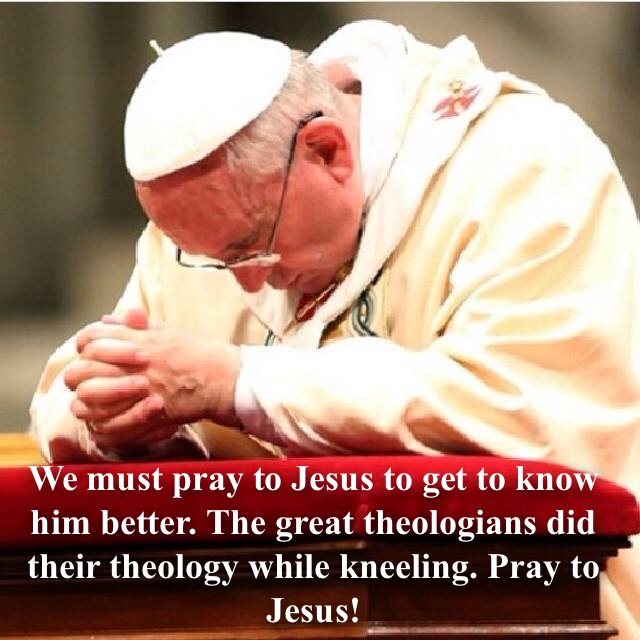
Prayer is the condition attached to getting to know Jesus better.

Prayer is the condition attached to getting to know Jesus better.

I don’t like using ‘unconditional’ to describe God’s love – if I use it I always qualify it. Of course that sounds like a condition, doesn’t it?

Here’s the problem:

If God’s love is unconditional then there was no need for Christ’s work of salvation. There was no need for the incarnation, no need for the passion, death, resurrection and ascension of Christ. No need for Pentecost or the Church. Everything is flat-lined and Jesus becomes not the Christ, but a nice guy!

Don’t confuse the message of Christ with psycho-babble!

“God loved the world so much that he gave his only Son, so that everyone who believes in him may not be lost but may have eternal life.” John 3:16

The condition is belief in him.

“If anyone loves me he will keep my word, and my Father will love him, and we shall come to him and make our home with him.” John 14:23

The condition is keeping his word because we love him.

“As a branch cannot bear fruit all by itself, but must remain part of the vine, neither can you unless you remain in me.” John 15:4

There’s a condition attached to bearing fruit.

If God’s love is unconditional it doesn’t matter how we live, not a jot! There’s no need for prayer, repentance, conversion – nothing! Ultimately it means there is no such ‘state’ as hell – there can’t be, certainly not if God’s love is unconditional. That’s not basic Bible theology, that’s psycho-babble!

People often think that God’s unconditional love and salvation are the same thing, indistinguishable. That’s what I’ve been doing here, confusing the two! So, let’s get it right. 

To say that God’s love is unconditional is to say that God always holds out the possibility of salvation – his mercy – to every man and woman even though they may be living in the depths of depravity.

In other words God’s unconditional love is the very possibility of salvation, it offers humankind the opportunity to be saved but God’s love doesn’t save us without our co-operation. God’s unconditional love requires our free response if it is to fulfill its purpose.

God can’t save me without me and I can’t save me without God!

This seems to be the only reasonable sense in which God’s love can be considered unconditional.

Sixth Sunday of Easter: How terribly discriminatory of Jesus!

Sixth Sunday of Easter Image“In a short time the world will no longer see me…”

The short time is his death (Good Friday), resurrection (Easter Sunday) and ascension (next Sunday).

After these events the “world” no longer sees him but Jesus makes a distinction – those who love him do “see” him.

How terribly discriminatory of Jesus!

So how is it that some “see” him and others don’t?

He promised to come back, to show himself, to enter into our lives and he achieves this through the gift of the Holy Spirit (Pentecost Sunday).

Have you ever noticed how it’s impossible to get inside another person’s life, how the other person is always totally other. This is not so with God, God is Spirit and thus able to enter our bodies and provided we co-operate the Spirit then draws us deeper and deeper into God. “On that day you will understand that I am in my Father and you in me and I in you.”

But we must co-operate. He says there are some, those whom he calls “the world” that can never receive him. Jesus, you’ll get yourself in trouble speaking about secular society like that!

In other words there are conditions attached to receiving Jesus Christ – shock, horror – that’ll send a few over the edge! It troubles me when I hear religious people speak of God’s unconditional love. It indicates they know little about the spiritual life. If by unconditional they mean God’s love is always offered, always available, that’s fine, no problem there. But God’s love is of little use to us if it’s always offered, always available but always out there and remote. We need him within. But if they mean by unconditional that there are no conditions to receiving Jesus Christ, that’s nonsense. Rubbish! Of course there are conditions, otherwise everybody would know Jesus Christ!

Jesus clearly states two such conditions in today’s Gospel. Indeed the whole teaching is prefaced by the conditions.

1. If you love me – for many that means a radical reorientation of life.
2. If you love me you will keep my commandments – the experience of receiving Jesus Christ through the indwelling of the Holy Spirit is simultaneously experienced as a call to a moral standard that simply cannot be detached from the person of Jesus Christ.

“If you love me you will keep my commandments, (and then) I shall ask the Father, and he will give you another Advocate…”

A word of caution: this is not instant, it requires spiritual growth over many years.

God hung among thieves!

Christ crucified among thieves“To be connected with the Church is to be associated with scoundrels, warmongers, fakes, child-molesters, murderers, adulterers, and hypocrites of every description. It also, at the same time, identifies you with saints and the finest persons of heroic soul within every time, country, race and gender. To be a member of the Church is to carry the mantle of both the worst and the finest heroism of soul … because the Church always looks exactly as it looked at the original crucifixion, God hung among thieves”

Fr. Ronald Rolheiser

Fifth Sunday of Easter: Jesus Christ, the joy of Catholicism


"When we pray properly sorrows disappear like snow before the sun"

St. John Vianney: When we pray properly sorrows disappear like snow before the sun.

It’s sometime before his suffering, death, resurrection and ascension.

Thus when he says he’s going away he’s talking about a future event.

It’s most interesting though to observe the meaning he gives to his going away. His going away is not his death, but his death, resurrection and ascension, and in going away he’s not abandoning us.

Thus in the teaching of Jesus Christ death is not the final end event, but part of something much greater. We need to begin to think in this way. For the believer life opens upwardly to the splendour of God. For the unbeliever life (ultimately) must narrow downwardly to the grave!

He is going away (death, resurrection and ascension) “to prepare a place for you…” This is personal.

Have you ever noticed that you can’t really walk in another person’s shoes, that no matter how close you might be to another person, that person is always separate, uniquely other? There’s a sense in which in the end there’s only God and you in the universe!

Jesus promises that after he’s gone (death, resurrection and ascension) he’ll come back to take you with him. It’s so personal.

We tend to think of this returning as death but that misses so much of the picture – most of all it misses the joy at the heart of our religion.

The returning to take us with him is the gift of the Holy Spirit (Pentecost) through whom God enters into our lives, not in the future, but now. We’re taken up into the Divine life. We’re given a “place” in the Divine life. This is what Jesus means when he speaks of “rooms in my Father’s house” – it’s a share in God’s life. Try to imagine what happens when the Divine life begins to enter our lives; a transformation begins. Thus we find the Saints saying things like; “When we pray properlysorrows disappear like snow before the sun.” St. John Vianney. The all powerful God mingles his life with ours – pure joy! 

This is what makes the Catholic. Without Him religion falls flat. In fact, I’ll go much further and say; this is the joy of life, never mind Catholicism!

We don’t inherit the kingdom because we’re good people. We inherit the kingdom because God has given us a place (or room) in his Divine life and God by his very nature can’t be held captive by death.

Fourth Sunday of Easter: Good shepherds or hired hands?

He says he’s the gate of the sheepfold. All others who have come are thieves and brigands.

What is this sheepfold and who are these thieves and brigands?

IMG_1352The very idea of a sheepfold suggests that we do not follow Jesus as individuals in isolation – there’s always Jesus Christ (the shepherd) and the Church (the sheepfold).

The sheepfold is the Church but it’s the Church merging into the kingdom of God. The Church is the gathering of those who’ve entered into the life of God through Jesus – it’s this passing through Jesus that produces the Church.

Jesus describes people who enter in this way as “safe” going “freely in and out” (of the life of God), “sure of finding pasture” – powerfully descriptive words.

There are other people who’ve entered the Church but without entering the life of God. They’re just going through the motions. These are the thieves and brigands – an accusation that’s directed in the first place at the religious leaders of his day.

Catholics, but particularly bishops and priests who maintain the mere external practice of religion without true conversion of heart are thieves and brigands. They usurp the things of God becoming obstacles rather than stepping stones to God. Pope Francis repeatedly warns about the threat such people pose within the Church.

But this problem is not confined to priests and bishops. Few are immune to the trappings of religion without the appropriate conversion of heart. 

Such ‘Catholics’ find life in the Church boring. They’re highly visible at the one-off events, First Communions, Confirmations, there’s an obvious disconnect which manifests itself in distraction. There’s little sense of the sacred, little sense of the presence of the Totally Other. In their distraction they “steal and kill and destroy” the sacred.

Finally, allow me to present you with the ultimate test of the Christian; are you a goodIMG_1356 shepherd prepared to lay down your life for the flock (the Church, God’s people) or are you a hired hand who runs away when the wolf attacks?

The difference, I think, is the gate we’ve used to enter the sheepfold. Have we really come in through Jesus?

“The liturgy is what makes God present among us”

IMG_1333

I’m a big fan of Joseph Ratzinger, Pope Emeritus Benedict XVI. Forget about the caricatures – just read his writings. I did, and he became a spiritual father to me! Here’s an example of why I rate him so highly:

“While there are many motives that might have led a great number of people to seek refuge in the traditional liturgy, the chief one is that they find the dignity of the sacred preserved there… We ought to get back the dimension of the sacred in the liturgy. The liturgy is not a festivity; it is not a meeting for the purpose of having a good time. It is of no importance that the parish priest has cudgeled his brains to come up with suggestive ideas or imaginative novelties. The liturgy is what makes the Thrice-Holy God present among us; it is the burning bush; it is the Alliance of God with man in Jesus Christ, who has died and risen again. The grandeur of the liturgy does not rest upon the fact that it offers an interesting entertainment, but in rendering tangible the Totally Other, whom we are not capable of summoning. He comes because He wills. In other words, the essential in the liturgy is the mystery, which is realized in the common ritual of the Church; all the rest diminishes it. Men experiment with it in lively fashion, and find themselves deceived, when the mystery is transformed into distraction, when the chief actor in the liturgy is not the Living God but the priest or the liturgical director.”

Joseph Cardinal Ratzinger, 13 July 1988

Third Sunday of Easter: Christ bestows life on those who love him.

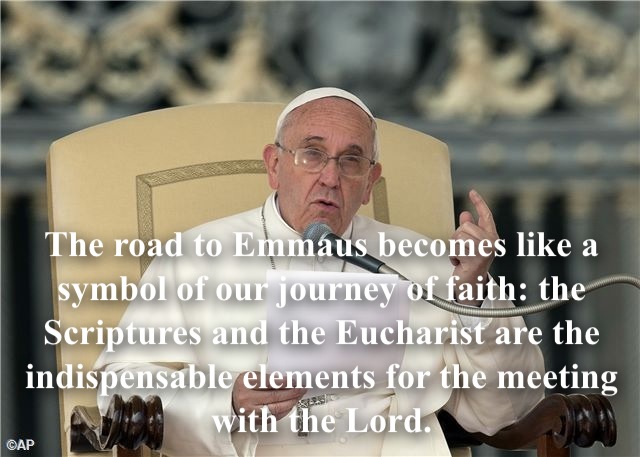
Everything needed to encounter Jesus Christ can be found in today’s Gospel.

Pope Francis, Sunday Homily, May 04 2014

Pope Francis, Sunday Homily, May 04 2014

Three things are needed; the desire for God, the Word of God and the bread of the Eucharist. Pursue the three things relentlessly and I guarantee you, if you’re not a Catholic already, you’ll become a Catholic – you’re inner world will start to resemble the Catechism!

Suddenly Jesus comes up and walks with two of his disciples. 

Significantly, they’re discussing him, his life and the events surrounding his death and reported resurrection. They’re downcast and haven’t yet come to faith describing Jesus as “a great prophet” rather than Lord. 

They’re interested in Jesus. He’s important to them. They’re looking to him and thus he comes to meet them. It’s a two way thing. This is the first requirement – interest, desire, or as Jesus put it, knocking, searching and looking because the privileges of the true Christian will never be disclosed to humankind at large.

Let’s imagine ourselves going for a walk down the promenade (a path on the banks of the River Slaney in Enniscorthy), or shopping, or our life from this moment to the next occasion we’ll gather here; how often is Jesus Christ likely to be the focus of our attention? This is the reason we don’t feel connected to God. Our hearts and minds are somewhere else. Do you know why this happens?

We accept much too uncritically the secular narrative that we need a particular lifestyle if we are to be happy – watch the soaps any evening and you’ll find that there’s a narrative running through them about what brings us happiness. It’s everywhere, it’s rarely challenged and it’s big business! We’re slow to understand that Jesus Christ bestows life on those who love him; a full measure, pressed down, shaken together and flowing over. Grace by its nature is excessive and overflows – it’s missionary!IMG_1202

Now look where he takes them when he begins to walk beside them. He leads them to reflect on the Word of God, the scriptures. This is the second requirement. Read the Gospels reflectively, repeatedly. There our minds will meet the mind of God, our hearts will meet the heart of God and our hearts too will begin to burn within us.

“… he made as if to go on; but they pressed him to stay with them.” They have the desire, they want him! If they’d let him go on, revelation wouldn’t have happened, they wouldn’t have been at the table with him when he took bread and they wouldn’t have recognized him. Imagine how close they’d have been but they still wouldn’t have made it. I’d say we’ve often been that close too!

This is the third and final requirement; the breaking of the bread. Their faith development reaches its climax in recognizing Jesus in the breaking of bread and suddenly he’s gone. Odd that, why disappear just then? Because he’s left them all that they need to find him. He’s left them directions – the Word and the breaking of bread, Holy Mass.

In every Mass two of the three requirements are always present; the Word and the breaking of the bread. But is the third always present; a real desire for Jesus Christ?

Second Sunday of Easter: Christ without the Church is a contradiction.

What’s brought them to this room? They’re gathered in the room for the same reason that Mary of Magdala was up early on Easter Sunday morning – while it was still dark – visiting the tomb of Jesus. They love him; if they didn’t love him they wouldn’t be there – simple as that. They’d be at home or occupied in some other way. They’d be somewhere else.

And what brings Christ to this particular room? Why not a room in some other house? Because the people who love him are gathered in this particular room. “Why should the privileges of the true Christian be disclosed to humankind at large?” (John Henry Newman). It’s not going to happen. He reveals himself to those who love him.

There’s something else about the people gathered in this room. Each person there is leaving another life behind – perhaps family and friends too – and they’re gaining new friends, bound together by a common interest and love; the person of Jesus Christ. This love steals their hearts and unites them with others (once strangers) in a bond that’s effectively the formation of a new family; the Church.

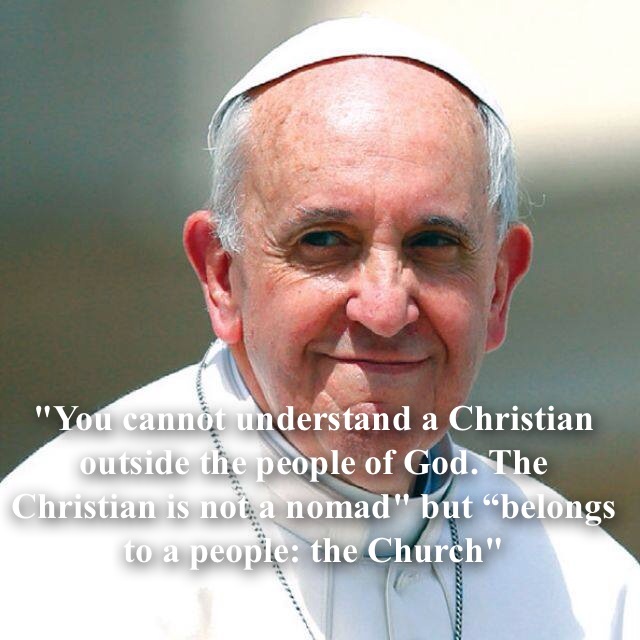
The idea that we can somehow follow Christ on our own is nonsense. Once Christ steals more than one heart he binds those hearts together in a union of love – which is why we find the disciples gathered together. They belong to one another as much as they belong to Christ. One flows into the other. Christ without the Church is a contradiction and the Church without Christ is an even bigger contradiction!

Torch-lit Good Friday 2014 Way of the Cross procession presided over by Pope Francis at the Colosseum.

We can only presume about the whereabouts of Thomas. It seems odd that he’s not with them. Why isn’t he with the others? What could be more important? I suspect he’s among the first people to leave the Church, disappointed and disillusioned, his faith shattered by the events of Good Friday. To borrow the words of Pope Francis; Thomas sees the monstrosity of man when we allow ourselves to be guided by evil, rather than seeing the mercy of God. Sound familiar? How many have left the Catholic Church for this very reason? And his insistence that unless he can see the holes that the nails made is the demand of a man near the edge of faith.

How is he saved from the edge? Eight days later the infant Church is gathered again and this time Thomas has returned to the fold because of the witness of the others. Now he encounters the risen Christ himself and the encounter restores his faith in Christ but it also seals his return to the Church – one flows into the other.

This is profoundly instructive – the future of the Church hangs on this and this alone; encountering Jesus Christ.

Easter Sunday: Without this day death has the last word.

“Why should the privileges of the true Christian be disclosed to mankind at large?” John Henry Newman.

It’s “the first day of the week (Sunday) and still dark” and Mary of Magdala is up early to visit Jesus tomb. Why? Because she loved him. If she didn’t love him she wouldn’t be there.

Finding the tomb empty she runs to find Peter and the other disciple. 

Just a few months earlier Mary of Magdala had a very different set of friends.

“They have taken the Lord” she says, using a title that she doesn’t fully understand. How can he be Lord if he ends in death? Death is Lord then! The only man worth calling ‘Lord’ is the man who overcame death – not some guy who can kick a football or host a TV show!

Jesus has brought them together – but for this man Jesus, Mary of Magdala wouldn’t be running to find Peter and the others. Their love of Jesus has bound them together, given her and given them a new set of friends, a new family – the Church.

Peter, if married, has allowed a new person into his life, a person now as important to him as his wife. Every marriage should have him! Every life!
IMG_1151
They run, they’re full of emotion, it’s a matter of love and BANG they’re allowed to see because they love him.

They see, not everyone sees, only those close to him. The majority are doing their own thing, elsewhere. So it is to this day. “Why should the privileges of the true Christian be disclosed to mankind at large?” John Henry Newman.

Nonetheless –

Without this day we have no future. Just the denial of an inevitable and approaching doom!
Without this day cancer will often have the last word!
Without this day injustice will often have the last word!
Without this day violence will often have the last word!
Without this day evil has the last word!                                                                                           Without this day death, always and without exception has the last word!