Nineteenth Sunday Year A: Believing like he’s not the son of God!

It’s evening and Jesus sends the disciples ahead of him. They are to cross the lake by boat, about a 5 mile journey, while he goes off by himself to pray.
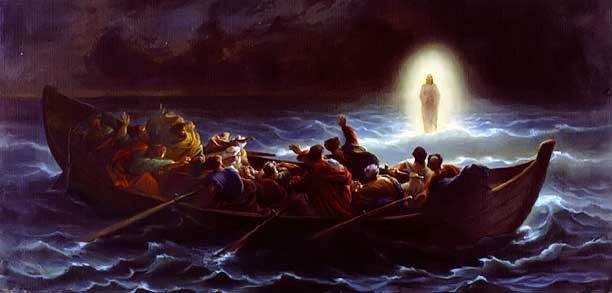
Jesus walking on water, Amedee Varin, 1860

The fledgling Church is in the boat “by now far out on the lake” and “battling with a heavy sea…” They’re in serious trouble. Some things never change!

Interestingly, the early Church adopted this scene, that of a boat battling with a heavy sea as an image of itself and its self understanding.

In the fourth watch of the night, between 3 am and 6 am, around dawn – and not until then – Jesus goes to them walking on the water. No hurry lads!

When they see him they’re already in a highly agitated state and his presence causes absolute consternation at first. It always does! This is classic Jesus.

Then typically Peter is the one who steps out and perhaps typically… he fumbles! There’s a moment when there’s no way back for Peter. It looks like it’s the end for Peter… then “Jesus put out his hand at once and held him.”

The disciples will go through a similar experience again when Jesus is crucified and they’ll prove that they haven’t learned a thing. They’ll think it’s the end and in fact the evidence will point conclusively in that direction. They’ll be highly stressed again, distressed, agitated, disillusioned… but then God stuck out his hand. So it was; the Resurrection, Ascension and Pentecost.

Only after Pentecost did the early Church stop fearing and falling down great big holes that carry the name ‘it looks like’ – meaning the real power of the Christian is in the supernatural.

The same dynamic is unfolding in the Catholic Church right now.

It looks like the Church is sinking, and the evidence in the western world is conclusive (not so elsewhere) but like Peter the Church will almost sink. When all looks lost Christ will put out his hand – and it’s a mighty big hand!

There’s a reason why the Church is sinking and it’s not the obvious suspects! The Church must be taken out so that the world will be “free” to develop in a particular way. The world wants to go down certain roads and to go down the roads God must be taken out, therefore the Church must be taken out. Indeed there’s a generation coming after us that has been almost completely sifted away from God. This is not an accident, this is a war and it will result in a time when much of the world will think it’s the end… a macrocosm of that moment when Peter realized he was sinking and there was no way back.

Then when the evidence suggests that all is lost God will act, as he did for Peter, as he did for the fledgling Church on Easter morning.

This is what sin does to the body of humanity. The story of Jesus is not just about God, it’s about us too!

Never forget what sin does to the body of humanity!

I’m afraid all too often we believe like he’s not the son of God – and that’s really unbelief.


Eighteenth Sunday Year A: Pursuing Jesus on foot without a packed lunch!

The first thing I should say about the multiplication of the loaves and fish is that it’s not about sharing – as though the real miracle was people shared. That’s a lazy interpretation. It’s a miracle of multiplication, plain and simple.Buy 2 get 5000

It’s one of the great signs given by Jesus and intended to cause all those present to ask; who is this man that he can feed thousands out of almost nothing and still have plenty left over?

Like all Jesus’ miracles the feeding has a much deeper meaning. If he can satisfy the physical hunger of thousands out of five loaves and two fish then he can satisfy humankind, full stop!

It points to a much deeper satisfaction and the Church with the benefit of hindsight (apart from its obvious connection with Moses) understands it as prefiguring how Christ satisfies his followers by sharing himself with them in the Eucharist.

Sadly many people – many Catholics among them, particularly cradle Catholics – do not understand the deeper meaning that Jesus can satisfy the human heart. Actually it’s an over-abundance of satisfaction symbolised by the baskets of scraps left over after “they all ate as much as they wanted…”

Thus they look at the Church, particularly the Mass, the summit of the Christian life and like the disciples looking at the loaves and fish they look at the bread and wine and think there’s not enough there, we must go elsewhere – corresponding to the disciples “send the people away and they can go to the villages…” Is this not the root of the vocation crisis?

But Jesus says “there is no need for them to go…”

There are just a few more points to note.

The people were fed because they pursued Jesus relentlessly, even out to a lonely place; “he withdrew by boat to a lonely place… but the people… leaving the towns went after him on foot.” But they didn’t just go after him, they stayed with him, time was lost, “the time has slipped by so send the people away” before they fall down with hunger! They were so taken in their pursuit of Jesus that they never thought of taking a packed lunch!

Does your participation in the Eucharist look anything like the participation of the thousands in this Gospel passage?

When you and I start following Jesus like that he’ll start feeding us too!

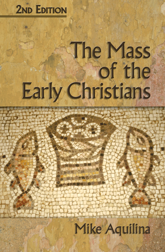
The cover of Mike Aquilina’s book ‘The Mass of the early Christians’ pictures a mosaic found in the remains of a Byzantine church in Tabgha, Israel. It’s a fifth century mosaic of the loaves and fishes which was a favourite symbol of the Eucharist in the Patristic era.


IMG_1554


The spiritual life is littered with big holes that carry the name ‘looks like’ and multitudes fall down them. It looks like the Church is dying but it only looks like it. Actually the near death experience of the Church will allow other events to happen in the world. We live in a very ordered universe. It’s a war for God’s sake!


Seventeenth Sunday Year A: Exposing the human heart

Parable of the hidden treasure Rembrandt

Rembrandt’s painting of the parable

“The kingdom of heaven is like treasure hidden in a field which someone has found…”

The treasure is Jesus.

He’s hidden. But God is hidden only to the degree of our spiritual progress.

The field is the Church.

So, Jesus is hidden in the Church.

The “someone” in the field is every single man and woman on the planet.

Finding the treasure is encountering Jesus.

Selling everything you own to buy the field has several meanings.

You must buy the field, you can’t steal the treasure. Cheating doesn’t work!

The treasure doesn’t come without the field. Jesus doesn’t come without the Church. You don’t just buy-in to the Church, you buy it! You give your life.

It’s a cost you’ll pay willingly, voluntarily, gladly, joyfully and expectantly, you’ll jump at it provided you can see the treasure… not unlike a business man selling so that he can buy to make a killing!

Using the parable what can we work out about those who’ve left the Church?

They were in the field but left it… perhaps they didn’t like something in the field, or someone, perhaps they couldn’t see anything but a bog…

However, according to the parable the real reason people leave the field is that they didn’t find the treasure. Perhaps they didn’t even know there was treasure in it – perhaps they still don’t know!

Simple. The whole God question is very simple, mysterious, but very simple.

Sixteenth Sunday Year A: What good is anything if you’ve nowhere to go?

IMG_1479God in his essence is simple. He’s clouded in mystery and we mistake the mystery for difficulty but God is not difficult… as the parables reveal.

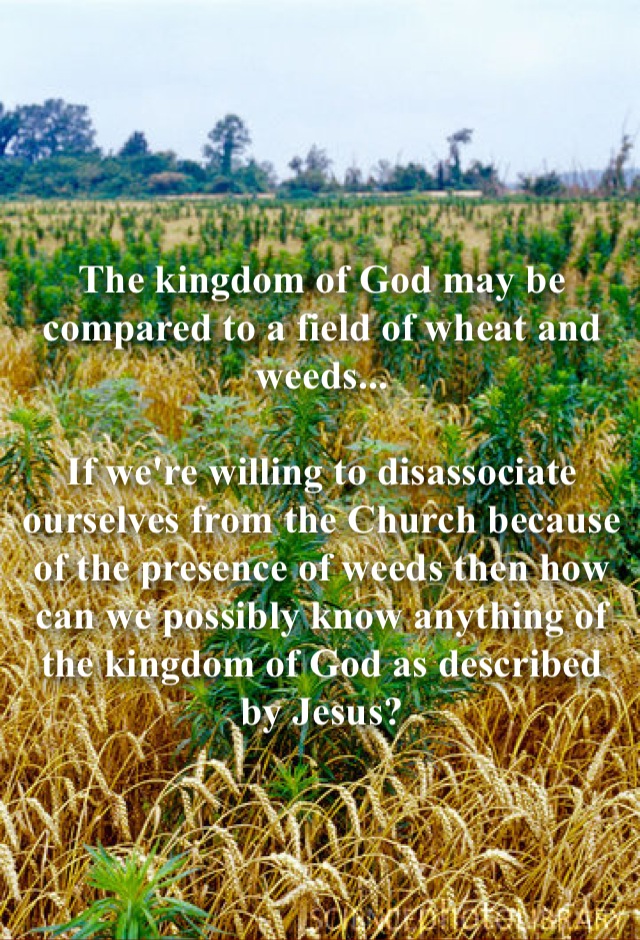
The kingdom of God on earth may be compared to a field of wheat and weeds…

This is a very startling way to describe the kingdom of God on earth.

We think there shouldn’t be any weeds in the Church, never mind the kingdom of God!

Yet here, two thousand years ago, Christ tells us what his kingdom on earth looks like… a field of wheat and weeds.

Would you have used such an image to describe the kingdom of God? I don’t think you would. We’re very good at imposing our kingdom on God’s kingdom! It doesn’t work.

Here’s another question: If we’re willing to disassociate ourselves from the Church because of the presence of weeds then how can we possibly know anything of the kingdom of God as understood by Jesus – anything of this kingdom?

Two thousand years have come and gone and we still haven’t understood this.

He makes an interesting observation about the danger of weeding out the weeds – some of the wheat will come with it. It happens – to this day.

Most interesting though is his assertion that at harvest time it’ll be sorted.

Here Jesus indicates – as he often did – that there is ultimate justice.

This means that there is no future in a life of sin.

It means there is no such thing as ‘getting away with it’ – ‘getting away with it’ is temporary, a short reprieve, like the weeds growing with the wheat until harvest time.

It means there is no future in dishonesty, fraud, theft, murder…

It means that if you’ve been successful by immoral means then you have no future… except to put right the wrong you’ve done. You are nothing more than a weed waiting for harvest time!

As Jesus asked elsewhere; what does it profit a man to gain the whole world and yet lose his very soul?

What good is anything if you have nowhere to go?

Mercy is about turning weeds into wheat. It’s never about leaving weeds unchanged!

God in his essence is really very simple… if we’d only listen to the parables and stop imposing our kingdom on God’s kingdom!

Fifteenth Sunday Year A: The basic problem; he has no root in him!

The parables make God and our response to God very simple… because God in his essence is very simple and understanding our response to God is equally as simple.

The seeds fall in various qualities of soil.

Parable of the Sower Matthew 13:1-23

Parable of the Sower Matthew 13:1-23

Now, the first thing we need to understand is that Jesus is describing people – like you and I.

The various qualities of soil represent people and their response to God – and Jesus lists just four broad categories. Does every human response fall into at least one of the four categories?

For the purposes of today‘s homily it’s the second category that grabs my attention. Jesus describes some people as being like seed that “fell on patches of rock where they found little soil and sprang up straight away, because there was no depth of earth; but as soon as the sun came up they were scorched and, not having any roots, they withered away.”

I’m sure you’ve often heard me say that I’ve always been a little perplexed by those who leave the Church, particularly by those who leave the Church citing the scandals as the reason. This makes no sense to me but it does point to a deeper truth – a truth which Jesus is suggesting here.

My immediate reaction has always been puzzlement expressed in a question; did they never encounter Christ in the Liturgy – even once, never mind every time or every other time they celebrate the Liturgy – knowing full well that if they had, leaving the Church would be like winning the lotto and failing to claim your winnings! It just doesn’t happen.

Well, here in today‘s Gospel Jesus is making a similar argument suggesting that the reason many people fall away is that they have no root.

This is what I mean when I say that people can come through the doors here for 40 years without ever encountering Christ… they have no root.

So when the sun comes up they’re scorched which means when they encounter trials such as the scandals they fall away – they’re scorched. Of course, Christ knew that this would happen – “obstacles are sure to come… better for him to be thrown into the sea… than that he should lead astray a single one…” Luke 17:1-3

Jesus lists three other categories of people but I’ll look only at one more – briefly.

Some seeds fell among thorns and the thorns grew up and choked them. When Jesus is asked to explain the thorns He says they represent the worries of this world and the lure of riches which choke the life of God out of us!

Now that’s most interesting because I’ve always believed that the basic difference between the believer and the unbeliever is how we spend our time. The most basic reason people do not believe and fall away… has to do with how we spend our time. If I spent my time like you spend yours, I wouldn’t believe either!

In conclusion, here in the parable of the sower Christ demolishes our arguments for falling away and for unbelief.

He makes it… simple!

Peter and Paul; a little of what made them tick goes a long way!

Today the Church celebrates Peter and Paul.

What I’m after today is what made these guys tick?

The red vestments indicate they died violently – but at any point they could have stood back and saved their lives. So, why didn’t they? What motivated them? This is what I’m after…

Jesus asks: Who am I?

First he asks the question rather generally, thus harmlessly; who do people say I am? There’s no threat in asking about what others think.

But then he turns up the heat: he makes it personal; who do you say I am?

Peter answers; you are the Christ… the Son of the living God.

Where did he get that from? Yes, sure, Jesus has worked a few miracles here and there but to get from a few miracles to Son of God? I guarantee you, not one of us here would get from a few miracles to Son of God. We’ve lost the enormity of this claim because we’ve grown up with it. Our familiarity with the Christian story hides us from the enormity of this claim. Thus few have made a real journey from the historical Jesus of Nazareth to Jesus as Lord. Familiarity breeds contempt!

I’d like you to catch it – if you can! The enormity of it; the Son of the living God!

Even the Taoiseach pictured (below) with Meaning of Life host Gay Byrne couldn’t get that far when interviewed on the Meaning of Life recently.meaning-of-life-enda-kenny Neither could Eamon Dunphy. But that shouldn’t surprise us – it’s an enormous claim.

Of course, that makes perfect sense because the moment I confess that Jesus of Nazareth is Lord (God), that’s the moment when I must logically give Him first place in my life.

I can’t truly believe that Jesus is Lord and then give Him second or third place… He must logically, reasonably take first place.

If you think about it there’s no way flesh and blood can convince anybody that Jesus is Lord (God). I might make a good argument in support of the claim but that’s about all it’ll be – an argument in support of the claim.

Thus even Jesus marvels at Peter’s confession of faith and significantly – and this is critical – He places the source of it beyond flesh and blood, even beyond Himself; “Simon son of Jonah, you are a happy man! Because it was not flesh and blood that revealed this to you but my Father in heaven. So I now say…”

This is what made Peter and Paul ‘tick’. It wasn’t just flesh and blood, although flesh and blood played its part, it was God Himself! God infused something of the Divine life into them and supernaturally confirmed the work of flesh and blood.

Now, here’s something that really troubles me about those who’ve left the Church – did they never receive such a Confirmation? Well, what were they doing instead?

Fourteenth Sunday Year A: Resting in God; the joy of Catholicism.

These things – the mysteries of God – are hidden from the learned and the clever and revealed to mere children.

This is how God operates… He chooses the lowly.

God never chooses the high and mighty – and with good reason.

The high and mighty are filled with… what, what are they filled with? Usually themselves and their own achievements! Thus there’s no time and no room for God. It is that simple.

So Jesus is not arguing against learning but against what it often does to the human heart. It can fill us with self… and the illusion of self-sufficiency.

The bottom line here is that only a heart with room for God can receive God. Another way to say that is to say that we must have a need for God…

Thus Jesus says come to me, all you who labour and are over-burdened – in other words all who have a need – and I will give you rest. There’s probably no better summary of the life and purpose of Jesus Christ: Come to me… and I will give you rest.

The first movement belongs to us; come to me. We must move towards God before God moves towards us – and Gods movement toward us is experienced as ‘rest’ for the human person. (In hindsight the soul will realize that the movement toward God was itself the work of grace but that doesn’t negate the human effort involved)

This “rest” which is actually a little bit of the Divine life entering into our lives here and now is our real security – “a man’s life is not made secure by what he owns…”

Now, this “rest” brings with it an awareness of a responsibility, a “yoke” and a “burden” that Jesus describes as “easy” and “light” (easy and light compared to the alternative which is to make a God (an idol) out of something or someone other than God)

In other words, we don’t get God without also getting a moral order!

Finally, a word about how we might actually “come” to Jesus.

The Eucharist is the God-designed point of contact where God waits for us to come to him… more particularly He has chosen to remain with us in the bread and wine consecrated in the Eucharist.

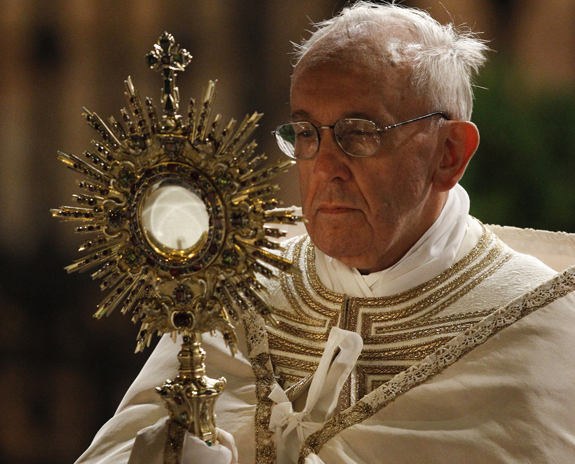
God has willed (in the same way that He willed Christmas) that the presence of Jesus Christ on earth be perpetuated (continued) in the bread and wine of the Eucharist so that effectively Christ never really left us!Pope Francis carries monstrance during observance of Corpus Christi feast

Thus we “come” to Him by being present to Him in the bread and wine of the Eucharist. That’s the reason the consecrated bread which we call the Blessed Sacrament is reserved in the Tabernacle – that we might “come” to Him.

The experience of “rest” which he promises is experienced only to the degree that we are truly present to Him.

This is the reason we must practice religion.

This is the reason the Church insists that Sunday Mass is the absolute minimum.

This is the reason the Church encourages adoration of the Eucharistic species – that you and I might “come” to Him and know His “rest”

Corpus Christi and Fatima; the centrality of Mass in God’s design.

Corpus Christi: the Body, Blood, Soul and Divinity of Jesus Christ. The whole mystery of God – from Christmas to Easter and beyond – packaged and given to us to be opened… plundered.

This is how God becomes ‘concrete’ in time, how he becomes personal, how he enters our lives…

This then is the big one!

But unfortunately for us (and it will be unfortunate!) in our day we’ve lost the importance of Mass. So, during the week I gave some thought to how I might register the cosmic significance of the Mass – even that’s understating it! Eventually I settled on using the events in Fatima to stress the centrality of the Mass in God’s design.

There’s a little known detail about Fatima that is so instructive in this regard. Shortly before the appearances of Our Lady in Fatima in 1917 an angel appeared to the three children. But the angel didn’t come empty handed.

The angel carried a host and a chalice in his hands… blood spilled from the host into theAngel of Fatima Image chalice. The children instantly recognized the host and the chalice as the central elements of the Mass.

Let’s stop at this point to reflect.

Why didn’t the angel bring a can of coke and a packet of crisps? Why not a glass of beer and a steak burger from the BBQ?

Then the angel did something even more instructive. Leaving the host and the chalice suspended in mid-air, the angel prostrated himself (bowed down before) the suspended host and chalice, taught the children to do the same, on their knees with their foreheads touching the ground and taught them a prayer.

Let’s stop again.

Why didn’t the angel say they should surf the waves on a Sunday morning and find God there? Or climb a mountain? Or go for a walk or a 10 kilometre run?

Why? Because God has chosen the way in which he gives himself – in bread and wine, the Mass!

Let’s look at the prayer, it’s equally instructive.

Most Holy Trinity, Father, Son and Holy Spirit, I adore you profoundly. I offer you the Body, Blood, Soul and Divinity of Jesus Christ present in all the tabernacles of the world, in reparation for all the outrages, sacrileges and indifference by which you are offended. Through the infinite merits of the Sacred Heart of Jesus and the Immaculate Heart of Mary I beg the conversion of poor sinners.

“Holy Trinity” (last Sunday); “Body and Blood… present in all the tabernacles” (today, Corpus Christi); “Sacred Heart” (next Friday) – there’s reason to these things, order!

Of all the prayers the angel could have taught, why this prayer?

The immediate purpose of Fatima was to prevent World War II – Our Lady told the children in 1917 that if people didn’t stop offending God a more terrible war would break out…

There’s a basic spiritual principle to be extracted here – the rejection of God (in other words the acceptance of sin) always ends in the figure of a crucified humanity. The rule of sin always leads to ruin.

I’ll finish with a question; according to the events that occurred in Fatima how important is the Mass?

The Holy Trinity: Everything we need to know about the future of the world can be found in the figure of Christ crucified.

Holy Trinity Icon

“The three persons of Father, Son and Holy Spirit are pictured at a table with a space vacant at the front for the believer; for you and me.” Fr. Billy Swan

Today’s Gospel (John 3:16-18) moves from the personal and the private to the public… from the salvation of the person to the salvation of the world, and back again to the personal and the private.

In our day there is a determined effort to confine religion and therefore the person of Jesus Christ to the private.

The wisdom of the day suggests that there should be no place for religion and therefore no place for the person of Jesus Christ in education, in health systems… anywhere in public life.

It’s absolutely impossible to reconcile this privatization of religion and the message of today’s Gospel which clearly states that the person of Jesus Christ is the key to personal salvation but also to the salvation of the world.

Now, I need to explain the meaning of salvation precisely because when we think about salvation we’ve already privatized it and we never think of salvation as having anything to do with the future of the world – here and now.

So what does salvation mean? It means nothing more than human well-being individually and collectively. Happiness. It means the well-being of the world – the old missioners would have said the temporal and eternal well-being of humankind.

This means that we can have all the economic policies we want, all the education policies, all the health policies… but if they’re not founded on God they’ll eventually turn and bite us!

The world is set on a path that says we don’t need God; we’ll do it our way, yet “God sent his son into the world… so that through him the world might be saved.” I trust you can see the contradiction?

So what’ll happen? This is what I think will happen; the world will persist on this path, the world is not for turning (there are very good reasons for that; historical reasons) and only from a point of collapse will the world return to God.

That’s what a generation will see and experience; a collapse. But let’s go deeper; spiritually it’ll look like the Evil One has taken everything from God and when it looks like Evil has triumphed God will act.

Go deeper again; in other words it’ll look like the period of time between Christ’s death and resurrection when even the disciples thought everything was lost.

Go deeper still; in other words what happened to Christ (what we celebrate every Easter) is what’ll happen to humanity.

The rejection of God always leads to the figure of a crucified humanity, to the point where everything seems lost. But God will not abandon his creation.

The future of the world is there before us in the figure of Christ crucified. Everything we need to know about the future can be found there.

Pentecost: Without the Holy Spirit religion easily becomes a kind of tyranny!

IMG_1380Pentecost is important – and with good reason. it’s ranked as a Solemnity.

Indeed, much can be understood in terms of the Holy Spirit’s presence or absence, or perhaps more accurately to the degree that the Holy Spirit is present in a person’s life.

In the First Reading (Acts 2:1-11) the Holy Spirit is portrayed as fire (a heart on fire for the mission of the Church) and wind (a blustery wind for the mission of the Church).

In today’s Gospel (John 20:19-23) the Holy Spirit is portrayed as the breath of the risen Jesus. Think about the meaning of breath – it’s our life. So the breath of the risen Jesus is the very life of God and when he breathes on them he is giving them his own life, the life he shares with God.

The purpose of religion is to reach this point – the point where it’s possible for us to share the Divine Life, the point where God can breathe his supernatural life into our natural life, the Divine into the human. I use supernatural deliberately because we’ve almost lost the experience of grace as a supernatural reality – thus everything’s mundane! The early Church Fathers described this process as Divinization.

Some weeks ago I spotted a number of people towards the back of the Church… they had completely disengaged and were deep in conversation. There’s no great mystery as to why we disengage at Mass or why we’re bored at Mass. It’s because a spirit other than the Holy Spirit dominates our lives – often it’s nothing more than our own spirit.

IMG_1424

Hearts on fire for the mission of the Church – Jesus Christ!

Where the Holy Spirit is absent (or just simply in short supply) religion is the most boring thing on earth!

Where the Holy Spirit is absent prayer is boring – worse, it’s sheer torture! A person in whom the Holy Spirit is absent finds prayer torturous, they resist, object; they want to run a mile! And with good reason; one spirit is fighting the other…

Finally, in our time religion is almost a bad word! Religion cut loose from the Holy Spirit causes huge problems (think of Ireland in the past). Religion without the Holy Spirit easily becomes tyranny. If you ask a person in whom the Holy Spirit is absent to practice religion they’ll experience it as a kind of tyranny!

Without the Holy Spirit religion easily becomes a kind of tyranny where there is little or no charity, little or no generosity, no joy, no gentleness, no peace, no faithfulness, no patience, no modesty, no kindness, no self-control, no goodness and no chastity!

The Holy Spirit changes everything. Come, Holy Spirit. Veni, Sancte Spiritus.