Category Archives: Catholic

In the end the Cross of Christ will save the global village.

The Exaltation of the Holy Cross

Numbers 21:4-9

John 3:13-17

To speak against God has repercussions both personally and communally. Remember that we speak loudest through our actions.

This is illustrated in the First Reading. The people “spoke against God” resulting in the arrival of serpents in their midst and the bite of the serpents “brought death to many in Israel”

This is a common theme throughout the scriptures but one which many, particularly the politburo, love to ridicule. I sinned and the sky didn’t fall down on top of me! Sorry, much too simple.

We should think of sin not so much in terms of breaking an abstract law but in terms of what kind of person it’s making me, the kind of person I’m becoming? More importantly, we should think of sin not just in terms of the individual but as contributing to the culture and to the kind of world we’re creating, a world moving nearer to God and its proper destiny or further from God. It’s sin that has become part of the culture that’s the most insidious and destructive, stealthily treacherous and deceitful.

The consequences of sin unfold only if we remain unrepentant over months and years, often over decades and sometimes over a century or more. It’s in this sense that we should interpret the biblical idea that the sins of the fathers (mothers) are ‘punished’ in the children.

The solution in the First Reading is to fashion a fiery serpent (the very thing that’s causing death), to raise it on a standard and all who look to it after being bitten will be cured. I know, it seems far-fetched, but stay with me.

Clearly this prefigures Christ on the Cross (in whom is crucified the very thing that causes our downfall) and he brings salvation to those who look to him.

Now what I find interesting about this is that Jesus doesn’t ridicule the basic premise of the First Reading – that sin leads to the certain death of the human community. Instead, while speaking to Nicodemus he uses the story and far from dismissing its central message he reinterprets it in light of his Cross without changing its basic message. But instead of a fiery serpent he presents himself as the one to save the global human community.

Thus he says: “For God sent his Son into the world not to condemn the world but so that through him the world might be saved” – a vital distinction. God doesn’t need to condemn the world because the world commits itself to self-destruction by choosing sin and therefore condemns itself. God’s purpose in Jesus Christ is to save the human community.

So there we have it. There’s nothing more important than Jesus Christ and his Cross. The future well-being of the global village depends on it.

That makes the local Church kind of important too, doesn’t it? Much more important than we think!

And some people think we can remove Jesus Christ from public life!

Here’s a link to Scott Hahn’s reflection for the same readings in which he quotes extensively from Pope Benedict XVI
http://www.salvationhistory.com/homily_helps/english/september_14th_2014_-_exaltation_of_the_holy_cross

Twenty-third Sunday Year A: We judge acts, not people!

Matthew 18:15-20

Here we’ve got one of the most troublesome passages you’ll encounter in the course of reading the Gospels Sunday after Sunday. The modern mind will find this passage particularly difficult.

From this piece we can establish that Jesus never intended anybody to follow him in isolation. In fact, as we’ll see Jesus intended the very opposite – so much so that it makes us very uncomfortable.

This piece outlines disciplinary procedures in the early Church. But much more problematic for us is that Matthew places these guidelines on the lips of Jesus and there is no good reason to doubt that Jesus actually said these things.

Obviously they clash with “do not judge” which is the popular image of Jesus (Mr. nice guy) but if we exclude these disciplinary procedures from the repertoire of Jesus why not exclude “do not judge” too?

We simply must judge acts. If we fail to judge acts nothing can stand.

So, let’s look at Christ’s advice. It’s a series of steps, each a little more serious than the previous step.

“If your brother does something wrong go and have it out with him, between your two selves.”

We are to “have it out with him” (her) privately. There’s to be no gossip! Gossip is much too easy… and lazy! It’s the mark of the non-disciple. We’re called to a much higher standard, to step up to a mark that terrifies most people. We are to assume responsibility for Jesus missionary outreach acting in his name to win back our brothers and sisters.

The purpose of this engagement is to win back… think about what’s not said there. It’s not quite the same as our modern understanding of tolerance. Jesus tolerates to win back.

If private personal engagement fails, we are to bring one or two others because “the evidence of two or three witnesses is required to sustain any charge”. That’s a long way from gossip.

If that fails, we are to report the matter to the “community” which has been given power to bind and loose on earth. Most people have no problem with that; it’s Heaven’s ratification of that power that makes us uncomfortable! Clearly Jesus means an organized “community” of believers with people in positions of authority – otherwise to whom would you report it? He means the Church.

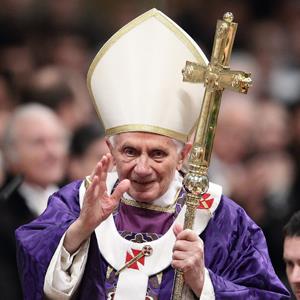
Between Christ and the Church there is no opposition: They are inseparable, despite the sins of the people who make up the Church. Pope Benedict XVI

Between Christ and the Church there is no opposition: They are inseparable, despite the sins of the people who make up the Church. Pope Benedict XVI

If the intervention of the Church fails we are to “treat him like a pagan or a tax collector” which effectively means exclusion.

This exclusion has a number of faces in the Church today, the exclusion of some people from receiving Holy Communion up to complete excommunication.

I told you this Gospel was going to be troublesome but we can’t get away from it… the Church we have today is not “made up” – even the hard bits. It’s got heavenly roots.

Here’s a link to Scott Hahn’s reflection:

http://www.salvationhistory.com/blog/to_win_them_back_scott_hahn_reflects_on_the_twenty-third_sunday_in_ordinary/

Here’s a link to Pope Francis reflection during his Angelus address, Twenty-third Sunday, September 07th 2014

http://www.zenit.org/en/articles/pope-s-angelus-address-sunday-7th-september

A link to Pope Benedict’s Lenten Message 2012 in which Benedict discusses “fraternal correction in view of eternal salvation” – well worth a read

http://www.vatican.va/holy_father/benedict_xvi/messages/lent/documents/hf_ben-xvi_mes_20111103_lent-2012_en.html

Twenty-second Sunday Year A: Anyone who loses his life for my sake…

Matthew 16:21-27

Peter’s reaction is the standard human reaction, “Heaven preserve you, Lord. This (suffering and death) must not happen to you”.

Jesus uses the prophecy of his own grievous suffering and death (described as put to death) to teach his followers something that’s completely counter cultural. We just don’t think in these terms.

“… anyone who wants to save his life will lose it; but anyone who loses his life for my sake will find it.”

The use of “saving” here is interesting – it means keeping life for yourself, hoarding, accumulating, because you’re afraid to give it away, to give it to Christ.

“Saving your life” then means placing yourself and your own ‘kingdom’ at the centre of your existence which inevitably leads to materialism and consumerism. Most of us do this to some degree – herein lies the fundamental difference between the average Catholic (you and I) and someone like Padre Pio.

We do this because we want to be happy.. we’ve bought the belief that happiness is attained through consuming the material. But who told us that?

Actually, we must believe this in a society where the economy is “God” – although a false god.

The ultimate victory of this belief is to win the whole world – a point Jesus makes – but he then subverts the idea asking what good is it to win the whole world but ruin your life? He means ruin your eternal life; to possess everything the world can offer but have nowhere to go! But we don’t think like that because we’ve been conditioned to think that winning the whole world is life at its very best. But that’s not your life. Your life is your pulse!

Anyway, the inner dynamic is much the same; we give to receive…

However, Jesus is arguing that the secret to happiness is in placing not yourself and your own kingdom but rather Jesus Christ and his kingdom at the centre of your existence.

The inner dynamic remains; we give to receive which is what Jesus argues, “… anyone who loses his life for my sake will find it”. The loss here is to one way of life, a worldly way of life, but in return we enter into (find) the kingdom of God, the life of God, which is so much greater.

Indeed, only when a man can see something greater (when seduced as in the First Reading) will he begin to let go of what he already has…

An after-thought:
We can use these terms to understand much about the Christian life including a vocation to the priesthood.

Twenty-first Sunday Year A: Experience of the mystery is the heart of Catholicism.

Matthew 16:13-20

The not very threatening “who do people say I am?” becomes the far more threatening “who do you say I am?”

Jesus is addressing the same question to us every time we read this piece whether we read it privately or as we do today, publicly here in St. Senans; “who do you say I am?”

The logical response to being able to say with Peter that the historical figure of Jesus is “the son of the living God” is to do exactly what Peter did… to make Jesus Christ your life and to become his missionary in the world.

Jesus says it’s not flesh and blood that effects this recognition (in you and I) but his Father in heaven. This is a very mysterious element in Catholicism but although mysterious it’s also central and without it Catholicism falls… flat!

In fact, every rejection of Catholicism is at heart the absence of this mysterious element.

It’s an absence that’s very evident in the Church’s missionary effort here in Ireland.

The Church expends huge effort celebrating baptism, first communion, confirmation, marriage, funerals and a whole lot more besides, but often in the practical everyday celebration of these events I sense there’s something missing, there’s plenty of “flesh and blood” effort but often (usually?) we’re not connecting with that which Jesus describes as “not flesh and blood”, the mysterious element that convicted Peter and changed his life. They’re events rather than encounters!

When people say they’re bored with everything the Church has to offer all they’re really saying is that they’ve yet to discover this mysterious element.

The presence or absence of this mysterious element described by Jesus as “not flesh and blood” explains so much about our attitudes towards the Catholic Church.

Twentieth Sunday Year A: It’s not fair to throw the children’s food to the house-dogs!

Matthew 16:13-20

Everything about Matthew’s description of this woman’s approach to Jesus suggests that she’s coming from somewhere that’s distant from God.

Notice Matthew’s words; “out” comes a woman (“out” as though from a foreign place or somewhere different). She’s shouting after Jesus. Shouting so loudly that she’s creating a scene that embarrasses the disciples, unnerves them, makes them uneasy.

She describes her daughter as being “tormented by a devil” – her daughter is held captive to some degree by the very enemy of God.

Jesus actions (“he answered her not a word”) and eventually his words (he compares her spiritual status to that of “house dogs” at the children’s table! Read spiritual maturity or state of soul before God) merely confirm Matthew’s description of the woman.

Here again we glimpse something that makes many Christians uncomfortable – there’s order in the spiritual realm. We’re not all equal – what’s equal is our opportunity to progress spiritually. We’re measured against an objective moral order that’s also a loving heart.

Secondly, we glimpse that anybody who wants to can progress in the spiritual life, all that’s needed is determination, the ability to take God’s knock-backs on the chin, to bear correction and even humiliation if necessary, to know your place before God, to know your misery (read sinfulness) and to keep approaching him.

The word approach here means daily prayer, active participation in Mass (activity that’s essentially interior before it’s exterior), constant unfailing knocking, talking, demanding, reading the Gospels.

Nineteenth Sunday Year A: Believing like he’s not the son of God!

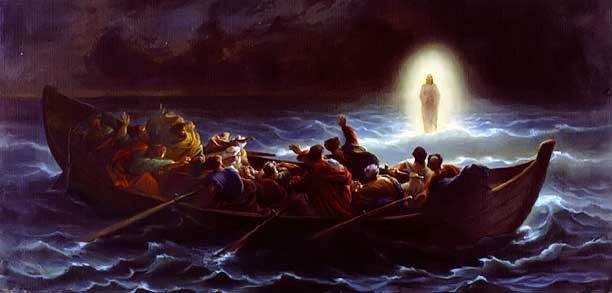
It’s evening and Jesus sends the disciples ahead of him. They are to cross the lake by boat, about a 5 mile journey, while he goes off by himself to pray.

Jesus walking on water, Amedee Varin, 1860

The fledgling Church is in the boat “by now far out on the lake” and “battling with a heavy sea…” They’re in serious trouble. Some things never change!

Interestingly, the early Church adopted this scene, that of a boat battling with a heavy sea as an image of itself and its self understanding.

In the fourth watch of the night, between 3 am and 6 am, around dawn – and not until then – Jesus goes to them walking on the water. No hurry lads!

When they see him they’re already in a highly agitated state and his presence causes absolute consternation at first. It always does! This is classic Jesus.

Then typically Peter is the one who steps out and perhaps typically… he fumbles! There’s a moment when there’s no way back for Peter. It looks like it’s the end for Peter… then “Jesus put out his hand at once and held him.”

The disciples will go through a similar experience again when Jesus is crucified and they’ll prove that they haven’t learned a thing. They’ll think it’s the end and in fact the evidence will point conclusively in that direction. They’ll be highly stressed again, distressed, agitated, disillusioned… but then God stuck out his hand. So it was; the Resurrection, Ascension and Pentecost.

Only after Pentecost did the early Church stop fearing and falling down great big holes that carry the name ‘it looks like’ – meaning the real power of the Christian is in the supernatural.

The same dynamic is unfolding in the Catholic Church right now.

It looks like the Church is sinking, and the evidence in the western world is conclusive (not so elsewhere) but like Peter the Church will almost sink. When all looks lost Christ will put out his hand – and it’s a mighty big hand!

There’s a reason why the Church is sinking and it’s not the obvious suspects! The Church must be taken out so that the world will be “free” to develop in a particular way. The world wants to go down certain roads and to go down the roads God must be taken out, therefore the Church must be taken out. Indeed there’s a generation coming after us that has been almost completely sifted away from God. This is not an accident, this is a war and it will result in a time when much of the world will think it’s the end… a macrocosm of that moment when Peter realized he was sinking and there was no way back.

Then when the evidence suggests that all is lost God will act, as he did for Peter, as he did for the fledgling Church on Easter morning.

This is what sin does to the body of humanity. The story of Jesus is not just about God, it’s about us too!

Never forget what sin does to the body of humanity!

I’m afraid all too often we believe like he’s not the son of God – and that’s really unbelief.


Eighteenth Sunday Year A: Pursuing Jesus on foot without a packed lunch!

The first thing I should say about the multiplication of the loaves and fish is that it’s not about sharing – as though the real miracle was people shared. That’s a lazy interpretation. It’s a miracle of multiplication, plain and simple.Buy 2 get 5000

It’s one of the great signs given by Jesus and intended to cause all those present to ask; who is this man that he can feed thousands out of almost nothing and still have plenty left over?

Like all Jesus’ miracles the feeding has a much deeper meaning. If he can satisfy the physical hunger of thousands out of five loaves and two fish then he can satisfy humankind, full stop!

It points to a much deeper satisfaction and the Church with the benefit of hindsight (apart from its obvious connection with Moses) understands it as prefiguring how Christ satisfies his followers by sharing himself with them in the Eucharist.

Sadly many people – many Catholics among them, particularly cradle Catholics – do not understand the deeper meaning that Jesus can satisfy the human heart. Actually it’s an over-abundance of satisfaction symbolised by the baskets of scraps left over after “they all ate as much as they wanted…”

Thus they look at the Church, particularly the Mass, the summit of the Christian life and like the disciples looking at the loaves and fish they look at the bread and wine and think there’s not enough there, we must go elsewhere – corresponding to the disciples “send the people away and they can go to the villages…” Is this not the root of the vocation crisis?

But Jesus says “there is no need for them to go…”

There are just a few more points to note.

The people were fed because they pursued Jesus relentlessly, even out to a lonely place; “he withdrew by boat to a lonely place… but the people… leaving the towns went after him on foot.” But they didn’t just go after him, they stayed with him, time was lost, “the time has slipped by so send the people away” before they fall down with hunger! They were so taken in their pursuit of Jesus that they never thought of taking a packed lunch!

Does your participation in the Eucharist look anything like the participation of the thousands in this Gospel passage?

When you and I start following Jesus like that he’ll start feeding us too!

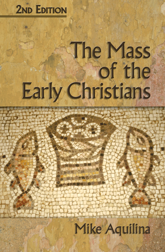
The cover of Mike Aquilina’s book ‘The Mass of the early Christians’ pictures a mosaic found in the remains of a Byzantine church in Tabgha, Israel. It’s a fifth century mosaic of the loaves and fishes which was a favourite symbol of the Eucharist in the Patristic era.


IMG_1554


The spiritual life is littered with big holes that carry the name ‘looks like’ and multitudes fall down them. It looks like the Church is dying but it only looks like it. Actually the near death experience of the Church will allow other events to happen in the world. We live in a very ordered universe. It’s a war for God’s sake!


Seventeenth Sunday Year A: Exposing the human heart

Parable of the hidden treasure Rembrandt

Rembrandt’s painting of the parable

“The kingdom of heaven is like treasure hidden in a field which someone has found…”

The treasure is Jesus.

He’s hidden. But God is hidden only to the degree of our spiritual progress.

The field is the Church.

So, Jesus is hidden in the Church.

The “someone” in the field is every single man and woman on the planet.

Finding the treasure is encountering Jesus.

Selling everything you own to buy the field has several meanings.

You must buy the field, you can’t steal the treasure. Cheating doesn’t work!

The treasure doesn’t come without the field. Jesus doesn’t come without the Church. You don’t just buy-in to the Church, you buy it! You give your life.

It’s a cost you’ll pay willingly, voluntarily, gladly, joyfully and expectantly, you’ll jump at it provided you can see the treasure… not unlike a business man selling so that he can buy to make a killing!

Using the parable what can we work out about those who’ve left the Church?

They were in the field but left it… perhaps they didn’t like something in the field, or someone, perhaps they couldn’t see anything but a bog…

However, according to the parable the real reason people leave the field is that they didn’t find the treasure. Perhaps they didn’t even know there was treasure in it – perhaps they still don’t know!

Simple. The whole God question is very simple, mysterious, but very simple.

Sixteenth Sunday Year A: What good is anything if you’ve nowhere to go?

IMG_1479God in his essence is simple. He’s clouded in mystery and we mistake the mystery for difficulty but God is not difficult… as the parables reveal.

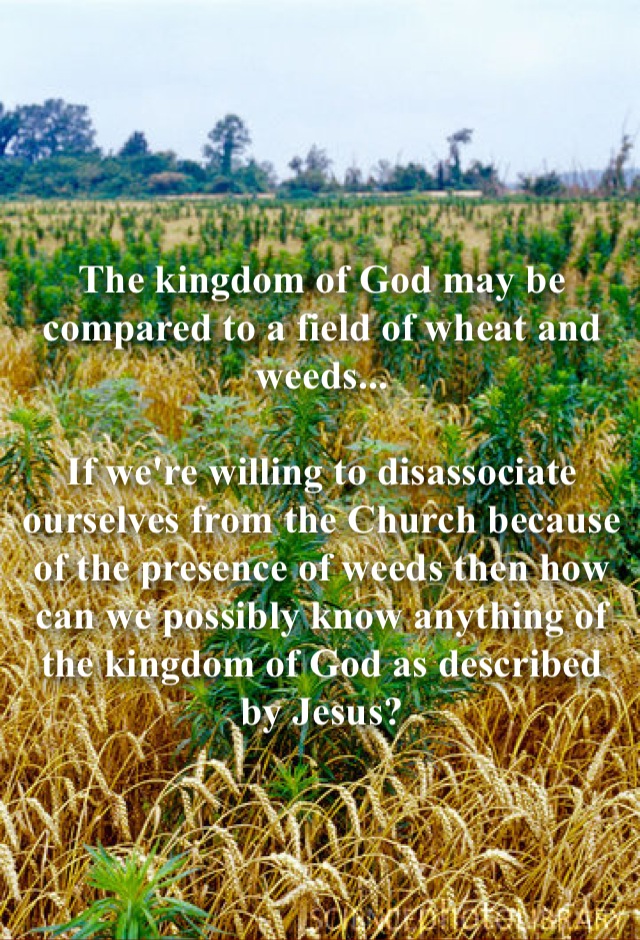
The kingdom of God on earth may be compared to a field of wheat and weeds…

This is a very startling way to describe the kingdom of God on earth.

We think there shouldn’t be any weeds in the Church, never mind the kingdom of God!

Yet here, two thousand years ago, Christ tells us what his kingdom on earth looks like… a field of wheat and weeds.

Would you have used such an image to describe the kingdom of God? I don’t think you would. We’re very good at imposing our kingdom on God’s kingdom! It doesn’t work.

Here’s another question: If we’re willing to disassociate ourselves from the Church because of the presence of weeds then how can we possibly know anything of the kingdom of God as understood by Jesus – anything of this kingdom?

Two thousand years have come and gone and we still haven’t understood this.

He makes an interesting observation about the danger of weeding out the weeds – some of the wheat will come with it. It happens – to this day.

Most interesting though is his assertion that at harvest time it’ll be sorted.

Here Jesus indicates – as he often did – that there is ultimate justice.

This means that there is no future in a life of sin.

It means there is no such thing as ‘getting away with it’ – ‘getting away with it’ is temporary, a short reprieve, like the weeds growing with the wheat until harvest time.

It means there is no future in dishonesty, fraud, theft, murder…

It means that if you’ve been successful by immoral means then you have no future… except to put right the wrong you’ve done. You are nothing more than a weed waiting for harvest time!

As Jesus asked elsewhere; what does it profit a man to gain the whole world and yet lose his very soul?

What good is anything if you have nowhere to go?

Mercy is about turning weeds into wheat. It’s never about leaving weeds unchanged!

God in his essence is really very simple… if we’d only listen to the parables and stop imposing our kingdom on God’s kingdom!

Fifteenth Sunday Year A: The basic problem; he has no root in him!

The parables make God and our response to God very simple… because God in his essence is very simple and understanding our response to God is equally as simple.

The seeds fall in various qualities of soil.

Parable of the Sower Matthew 13:1-23

Parable of the Sower Matthew 13:1-23

Now, the first thing we need to understand is that Jesus is describing people – like you and I.

The various qualities of soil represent people and their response to God – and Jesus lists just four broad categories. Does every human response fall into at least one of the four categories?

For the purposes of today‘s homily it’s the second category that grabs my attention. Jesus describes some people as being like seed that “fell on patches of rock where they found little soil and sprang up straight away, because there was no depth of earth; but as soon as the sun came up they were scorched and, not having any roots, they withered away.”

I’m sure you’ve often heard me say that I’ve always been a little perplexed by those who leave the Church, particularly by those who leave the Church citing the scandals as the reason. This makes no sense to me but it does point to a deeper truth – a truth which Jesus is suggesting here.

My immediate reaction has always been puzzlement expressed in a question; did they never encounter Christ in the Liturgy – even once, never mind every time or every other time they celebrate the Liturgy – knowing full well that if they had, leaving the Church would be like winning the lotto and failing to claim your winnings! It just doesn’t happen.

Well, here in today‘s Gospel Jesus is making a similar argument suggesting that the reason many people fall away is that they have no root.

This is what I mean when I say that people can come through the doors here for 40 years without ever encountering Christ… they have no root.

So when the sun comes up they’re scorched which means when they encounter trials such as the scandals they fall away – they’re scorched. Of course, Christ knew that this would happen – “obstacles are sure to come… better for him to be thrown into the sea… than that he should lead astray a single one…” Luke 17:1-3

Jesus lists three other categories of people but I’ll look only at one more – briefly.

Some seeds fell among thorns and the thorns grew up and choked them. When Jesus is asked to explain the thorns He says they represent the worries of this world and the lure of riches which choke the life of God out of us!

Now that’s most interesting because I’ve always believed that the basic difference between the believer and the unbeliever is how we spend our time. The most basic reason people do not believe and fall away… has to do with how we spend our time. If I spent my time like you spend yours, I wouldn’t believe either!

In conclusion, here in the parable of the sower Christ demolishes our arguments for falling away and for unbelief.

He makes it… simple!